



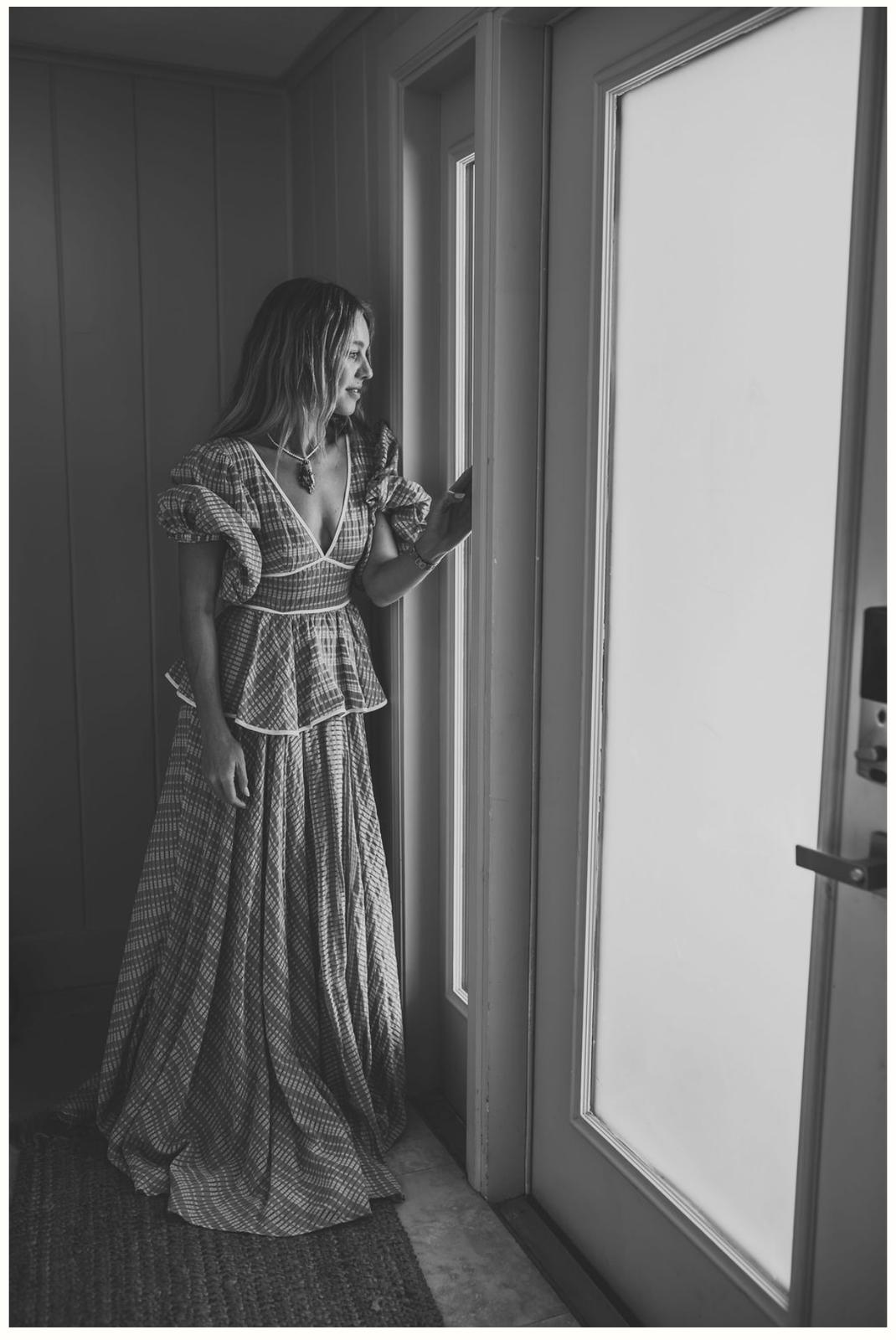
I could have chatted to Simi Polonsky all day. Polonsky’s maiden name is Gestetner. She’s the daughter of Rabbi Elozer and Miri Gestetner from Coogee Shule.
We’re the same age, with mutual friends, and I’m fairly certain our paths would have crossed as teenagers. However, I don’t recall ever meeting her properly.
Although I’ve followed her journey from Sydney to the USA, from starting The Frock with her sister Chaya and losing her beloved husband Shua, and now to launching her new podcast, It’s Not About Me, I’ve never truly spoken to her properly.
Until now.
While she was on a recent trip to Sydney to visit family, I took advantage of the fact that we were in the same time zone and locked her in for a chat.
And what a chat it was – filled with raw emotion, honesty, vulnerability and beautiful insight. You’d be forgiven for forgetting that she’s only 39 years old.
We went deep, and Simi was all too happy to share.
The first question, how did she end up in the USA? She answered simply, “I left to chase a husband.”
That husband was Shua Polonsky. Many in Australia, especially in the Sydney community who followed Simi and Shua’s journey, would know their story. Simi shared deeply on The Frock’s social media accounts as she grappled with Shua’s diagnosis – a rare virus that attacked his heart. Three weeks after his diagnosis, Shua passed away. Simi was four months pregnant with their third child.

“I don’t think it’s possible to say a little bit about Shua,” Simi told me as we chatted. Simi explained that he was the only person in the room not vying for her and Chaya’s attention on a night out in New York. That’s what drew her to him.
“At the end of the night as me and Chaya were walking home, I said ‘I’m going to marry that guy.’ That was Shua. Shua stood out, he was different. He was so wise beyond his years, the love just oozed out of him. He also was just a beautiful man and a beautiful presence. And he had this quiet, confident humility about him, which I loved because he was confident and outgoing, but he was so humble. Everyone wanted to be around him. I’m so lucky that I got to have him as my husband and that my kids got to have him as their dad.”
Just a few months after Shua’s passing, Simi gave birth to their son – Joshy – named for his father. As we’re chatting, Joshy bounds into the room to show Simi his “lost tooth”. Turns out it’s just a tic tac. But it’s that cheeky smile that I can imagine Joshy shares with his dad.
“If I could tell Simi back then, just hold on a little bit longer, just a little bit more. You don’t have to think that life is amazing. Just one more breath. That’s it.”
At the time, Simi was incredibly open about her experiences, largely on The Frock’s social media. She leaned into her family, her faith and her ancestors, explaining how her grandparents helped her find a way through.
“I know I have to rebuild,” she wrote in an Instagram post shortly after Shua’s death. “When my paternal grandfather was 15, he watched the Germans take his parents, brothers and sisters to their death. As he watched his entire family walk into cattle cars, he could have given up. But here I am today. When my maternal grandfather was 6 he buried his mother in the snow, somewhere in Siberia. Until this day he has not found where she was buried. He could have given up. But here I am today … I carry with me a legacy of strength, courage and the ability to rebuild from even the darkest valleys of death, whether I am able to accept it right now or not. So I will.”
And despite the heartache and pain, Simi has indeed found a way to rebuild, always with Shua by her side. When we spoke about Shua, Simi began to cry as she shared her ongoing grief but also her ongoing love.
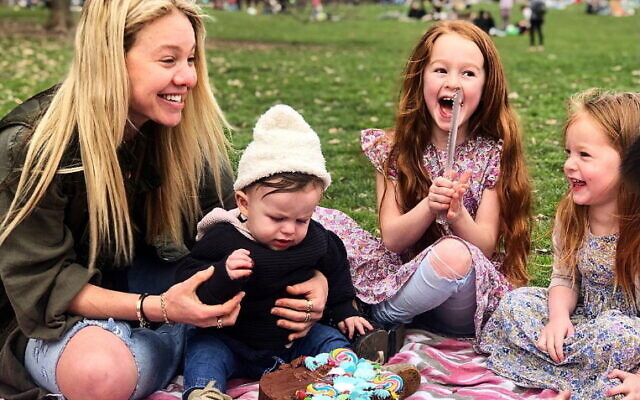
“It’s really my honour to cry,” Simi said. “For the rest of my life, it’s going to be my honour to cry and say that I was married to the best guy. The tears now are really, it’s going to sound so weird, but it’s my privilege.”
Recalling that she was convinced that Shua would walk through the door when she gave birth to Joshy, Simi described projecting a lot of her emotions and heartache onto her children in the beginning. But throughout the years, she has learned to let them find their own way to deal with their loss, with their father still so present in their everyday lives.
Simi recalled sitting in Coogee shule in Sydney and hearing her son’s full name for the first time – Yehoshua Rafael ben Yehoshua Rafael. While she said Joshy didn’t really notice, she knows that the name will take on a much deeper meaning as he gets older.
“He’s going to have to step into it in ways I will never understand, because I, thank G-d, have both my parents alive. So it’s going to constantly evolve, and I see that in different ways,” Simi said. “I really try not to project. I did a lot in the beginning, and as I’ve done so much healing, I’ve tried to just pull back and be like, this is my kids’ journey too. I didn’t choose this for them … it’s part of all of our journeys – them to have Shua and lose Shua in this way. And so his name for him will be something that he has to especially grapple with.”
Since the beginning, Simi has been open about the impact of Shua’s death. She shared a story with Mamamia about her daughter admitting that she loves Hashem but simultaneously hates him for taking her daddy. She made the comment shortly after Shua died. She was just seven years old. And since then, Simi has continued to have the hard conversations with her children, especially as they get older.
She is honest with her own feelings – dark and light – now sharing them widely with the world through her podcast, It’s Not About Me, which Simi acknowledges is very much part of her ongoing healing.

“Launching this podcast, I would say has catapulted my healing exponentially and has allowed me to step into a new version of myself that I didn’t anticipate right now,” Simi explained. “It made me realise very humbly that the sky’s the limit, that there is infinite growth that we were put here to do and that we can do if we decide we want it.”
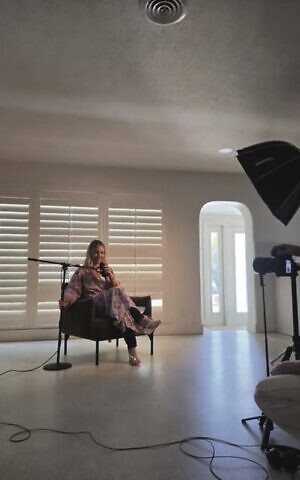
Simi recorded her first episode live in front of some of the women most important to her.
It’s Not About Me is a scripted monologue and at first, Simi didn’t plan to record it with an audience. Two weeks earlier though, she had a lightbulb moment.
“When we allow ourselves to celebrate grief communally, there’s a healing power that doesn’t mirror the grief journey that we can do on our own.”
“I’m doing this because it’s about connection for me,” she explained, saying she couldn’t simply sit there and record alone, it didn’t make sense. “The whole point is that I’m sharing something and that energetically it’s transferred to someone else and that I get something back. So part of it was selfish. I needed the energy of other people in the room.”
Simi explained that part of her healing is to be and feel seen. Saying it took her a few years to realise that this is simply a human need, she felt that the moment had to be witnessed.
“When it started, we were all on a journey together and every single person in that room, even the cameraman, we all changed. Something shifted in us energetically and it hit me. That’s how I knew I was meant to be doing this. It was like my soul calling. And then it just felt so natural.”
While Simi acknowledged that it was a very vulnerable moment, and that the vulnerability is still challenging for her, she knew it was important to share. If nothing else, she hoped it would help people feel comfortable in their grief, their loss and their own vulnerability.
The feedback has been overwhelmingly appreciative.
Admitting that while she was confident that she needed to share It’s Not About Me with the world, there were still doubts. She said that every single message she has received has been affirmation that she was on the right path.
“When we allow ourselves to celebrate grief communally, there’s a healing power that doesn’t mirror the grief journey that we can do on our own. And I say celebrate because grief, it should be a celebration. It should be revered, celebrated, ritualised, because it’s so much a part of us. We celebrate everything else in life. We celebrate birthdays and Mother’s Days and coffee mornings … Celebration, really, is about giving something the respect, time and space it deserves. And so grief doesn’t really get that.
“There’s a texture of shame that exists with grief,” she continued. “And so when I say celebrate it, it’s like, I, for the rest of my life, get to talk about and celebrate my grief in any capacity that I need to. And I think that will give it so much more airtime – we just get to be able to live in our fullness.”
In the first episode, Simi walks listeners through moments she has had while driving, aptly titled Driving Solo. She details extremely vivid dreams where she would be driving towards a rocky cliff without stopping, telling her daughter that they’re going to see daddy.
“I think those were some of my lowest moments, the darkest, when I knew I was alive technically, but I didn’t really want to be,” she narrates in the episode. “So I prayed hard. I begged. I begged Hashem to take me and my kids together, just to let me out.”
It’s heartbreaking to hear. But relatable, especially to those who have experienced some sort of grief. It’s this relatability that Simi hopes will help others through. Especially because she found her way out and forward.
“One of my hopes, because there’s so many, is that it gives someone just a little bit more breath, the ability to take a step back or forward with a little bit more perspective that yes, life can be so painful, so hard, so challenging, big or small, mundane, tragic,” she said. “My hope is that they can imagine that maybe there’s a little bit more. Because once you touch that, the possibilities are exponential of where your life can go.”
Simi lost her husband. Her children lost their father. And Simi said it could be very easy to stay in that mindset. But Simi chooses to see the little bit more.
“Can you even try to hope or maybe imagine that there is something else? Because in the very early years or time and space after Shua died, there was nothing else. And I didn’t want to live in this world. And now that I’m here and I’ve gotten to this place, I’m like, if I could tell Simi back then, just hold on a little bit longer, just a little bit more. You don’t have to think that life is amazing. Just one more breath. That’s it.”
We finish the interview with a question. What would Shua say about It’s Not About Me? Simi knows he’d be proud.
“He’d be saying like, that’s my girl. Let’s go. He’d be so proud,” she said, explaining that it was actually Shua who was the public speaker out of the two of them. “I always said to him, ‘Shua, you’re going to go around the world speaking’. That’s what I said to him. And now he’s looking at me and he’s like, Sim, you’re going to go around the world speaking.”
To Simi, thank you for speaking.
It’s Not About Me is available for streaming on Apple Podcasts. Follow Simi on Instagram: @thelifeofsimi
comments