



Recounting a Shanghai legacy
SAM Moshinsky describes a youth spent amid the turmoil of wartime Shanghai in his new book, Goodbye Shanghai.
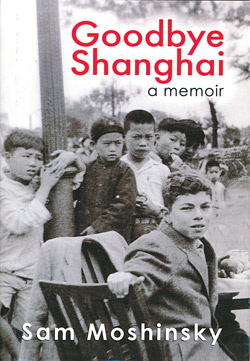 BOOK REVIEW: PETER KOHN
Goodbye Shanghai by Sam Moshinsky
Mind Film & Publishing, $39.95
IN the introduction to his memoir, Sam Moshinsky writes to his grandchildren: “You probably think grandparents are born old.”
In the following 219 pages, this 75-year-old describes a youth spent amid the turmoil of wartime Shanghai.
He opens with a daunting scenario — a 17-year-old who had led a sheltered life in Shanghai leaves for Australia. Fate has cast him as an unlikely trailblazer for his family, who he prays will be able to follow him.
It is 1951 and Mao Zedong’s communists have made life unpalatable in China.
We rewind to the beginning. Moshinsky was born in Shanghai in 1934 after his parents and paternal grandparents settled there, ending an odyssey from their Ukrainian homeland to Vladivostok after the 1903 Kishinev pogrom.
When civil war gripped the new Soviet Union, grandfather Shlema Moshinsky took his family to Shanghai.
As a treaty port of the Opium Wars, Shanghai had developed a free-wheeling international character, and welcomed foreigners, including many Russians.
Moshinsky describes his grandfather’s success in Vladivostok with developing packaging for those Russian staples, cottage cheese and sour cream.
In Shanghai, he established a factory manufacturing packs for ice-cream and chocolates, later managed by his father Abe.
The Moshinskys led a comfortable life in the French Concession, which like the Anglo-American zone, was an extraterritorial precinct ceded to the European powers.
Moshinsky was attended to by an amah (Chinese servant), dined well and wore tailored clothes. Early in his life, his parents divorced, and he became close to his grandparents.
He contrasts his own wellbeing with the miserable lives of most Chinese, and describes beggars, and infants frozen dead after spending one too many nights sleeping rough on winter pavements.
He also compares his lifestyle to that of the Central-European refugees arriving from Nazi Germany, and later from Austria, many with little more than the shirts on their backs -— and the social welfare system Shanghai’s Jews established for them.
December 7, 1941, the date the Japanese attacked Pearl Harbour and entered the war, was significant in Shanghai, because they extended their encirclement of Shanghai to a full occupation.
In 1943, perhaps under pressure from their Nazi ally, the occupiers declared a restricted area for stateless European refugees.
Moshinsky’s Russian family was not affected, but he describes conditions inside the ghetto, and the terrifying American air raids of 1945.
Moshinsky details his education at a succession of schools, including a French school that came under the influence of the pro-Nazi Vichy regime and a British school closed by the Japanese, who sent pupils and their families to internment camps for enemy aliens.
After 1945, there was an exodus of refugees to the United States, Canada and Australia, but the Moshinskys, ensconced in their well-established lives, felt at home in Shanghai.
Yet by the end of the 1940s, the city felt alien, and in 1949 the communists replaced the ramshackle Nationalist regime. Shanghai pulled in its welcome mat to foreigners, and prohibitions against the Moshinsky business led to a decision to emigrate. A relative in Australia sponsored the family.
We are back on the train with 17-year-old Sam, who is wondering what his Australian journey will lead to. It led to a strange continent, where homeowners washed their own dishes, took out their own garbage, and, still reeling from wartime frugalities, ate rabbit stew for dinner.
But it didn’t take Moshinsky long to fall under the spell of Australia’s quiet egalitarianism, and he has remained a fan ever since.
Moshinsky writes of swelling ranks at his seders, including the grandchildren to whom he has dedicated this book, and contrasts these gatherings with an early seder in Australia, at which he wondered if he would ever be able to restore his life.
His memoirs are a life-affirming message, not just to his grandchildren, but to anyone interested in an uplifting autobiography.
comments