



Restoring a shul to its glorious past
AN Australian man has been an integral figure in the restoration of Poland's historic Reichenbach Synagogue, which survived Kristallnacht.
DALIA SABLE
IN a town called Dzierzoniow in Poland, there once was a thriving Jewish population. In what was once the centre of town, the Reichenbach Synagogue still stands -— one of only a handful of shuls that survived both Kristallnacht and the ensuing years.
Once an imposing structure with a glorious past, the Reichenbach Synagogue until recently stood windowless, its support beams visible and its facade showing the very signs of its age and struggle to survive.
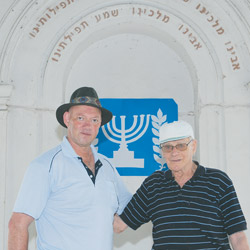
Fred Moses, an Australian who has taken an interest in the restoration of the shul after visiting it, told The AJN that “one look at the still imposing stature of the Reichenbach Synagogue suffices to imagine its glorious past”.
“But at a closer look, one feels as if there were a ghostly and sad atmosphere hanging over the whole structure,” he added.
Inspired by its history, Mr Moses is assisting a foundation committed to restoring the Reichenbach Synagogue to its glorious past, which before 1937, and again after 1945, was a religious hub.
The Beitenu Chaj -— 2004 Foundation, or in English “Our House Lives on 2004”, is led by Rafael Blau, who lived in Dzierzoniow (then Reichenbach) with his father for five years as a child, before making aliyah in 1965.
Blau, who now lives in Be’er Sheva in Israel, spends his summer months in Dzierzoniow, dedicating his full time to the foundation’s activities in the restoration of the synagogue.
The foundation has begun works to restore the synagogue, which upon completion will once again serve as a bustling shul and educational centre for the now growing Jewish population in Poland. In addition to functioning as a religious centre, the Reichenbach Synagogue will also include a museum.
The foundation states as its objective to “make it possible for people from all over the world, Jews and non-Jews, especially young people, to get to know the story of the Jews in Poland, not just in relation to the horrors of the Holocaust, but also to the ancient, rich heritage of Judaism, related to its contribution to the history, culture and the development of the Polish nation”.
The foundation has, to date, repaired holes in the synagogue roof, replaced windows, missing gutters and downspouts to stop rain and snow from coming in, and erected a fence around the synagogue.
“Much has been done, much is being done, but so much more has got to be done,” Mr Moses said. “It is most definitely an enterprise of great merits, which should be rewarded accordingly.”
Together with a group of others, including foundation vice-president Beata Sauermann, who lives in the United Kingdom, and John and Maria Koch from Canada, Blau is seeking further assistance for the continued restoration project to “bring new life to the synagogue”.
Now in its fifth year, the foundation is obviously making progress, with the Reichenbach Synagogue hosting its first service in more than 20 years on Rosh Hashanah.
Enquiries: Rafael Blau beitenuchaj-2004@tlen.pl; Fred Moses fredmo@aapt.net.au.
comments