



I am a Bukharian Jew. But for most of my life, I took for granted what those words truly meant.
My parents fled Uzbekistan, then part of the former Soviet Union, in their late twenties, leaving behind family, friends and a life that, for all its limits, had been familiar, carrying me, just 18 months old, into a new life in Australia.
Like many refugees, they rebuilt their lives in a new country, determined to give their children opportunities they never had. And, like many children of migrants, I learned early that fitting in was easier than explaining. My birth name, Tatyana, was hard to pronounce, easy to tease. “Bukharian” meant nothing to most people. “Uzbekistan” was usually met with puzzled looks. Saying “I’m Russian” was simpler, even if it wasn’t quite accurate.
Last year, I returned to Uzbekistan, the country of my birth. The journey was not only about travel, but about curiosity: I wanted to understand the world that had shaped my parents and the generations before them, and get a better understanding of the identity I had quietly set aside.
Bukharian Jews are neither Ashkenazi nor Sephardi, but something in between: a community shaped in relative isolation, carrying Jewish life across the deserts of Central Asia for more than a thousand years.
It helped me feel the breadth of our global Jewish identity; each of us carrying a piece of our culture and history shaped by geography, migration and memory.
Our roots trace back to Persian Jewry along the Silk Road, some say possibly even to the Babylonian exile. We developed our own language, Judeo-Tajik, and traditions that were distinctly Jewish yet uniquely Bukharian – from embroidered robes and silk kippot to rich cuisine and communal rituals.
Growing up, I heard stories of women gathering to prepare food together before festivals, of families making matzah by hand, of celebrations that belonged not to individuals but to entire communities.
Yet these stories felt distant from my Australian reality.
History was rarely kind to Bukharian Jews. Under Muslim rule, Jews lived as dhimmi – protected, yet restricted. Under the Russian Empire, opportunity came with upheaval. Under the Soviets, synagogues were shuttered, Hebrew banned, religion pushed underground. From the 1970s onwards, most Bukharian families emigrated. Today, where there were once tens of thousands of Jews in Uzbekistan, only a few hundred remain.
Today, Bukharian Jewish life has largely shifted beyond Central Asia. Thriving communities exist in Israel and in cities such as New York and Phoenix, where Bukharian synagogues, schools, music and cuisine continue to preserve a distinctive culture shaped over centuries.
In Australia, the community is much smaller, but no less committed. We still gather for simchas and festivals, traditions are passed down in kitchens and communal life continues through regular gatherings.
Part of my return-to-Uzbekistan journey was spent travelling with SAMi: Sephardic American Mizrahi Initiative kosher tour group, made up of mid-life Jewish professionals from Australia, the United States and the UK, brought together by a shared interest in Uzbekistan’s Jewish history.
But beneath the itinerary and sightseeing, my own motivation felt more personal: I wanted to see where my story began – and what, if anything, remained.
Landing in Tashkent felt surreal and completely surprised me. Instead of the grey, Soviet city I had imagined, I found wide boulevards, open squares, musical fountains, bustling markets and metro stations that felt like underground palaces. My husband and I wandered the city for days, navigating with my rusty Russian, trying to locate the homes of my family. Many streets had been renamed in an effort to erase the Soviet past; buildings had been demolished and rebuilt.
The physical traces of my family’s life there were gone.
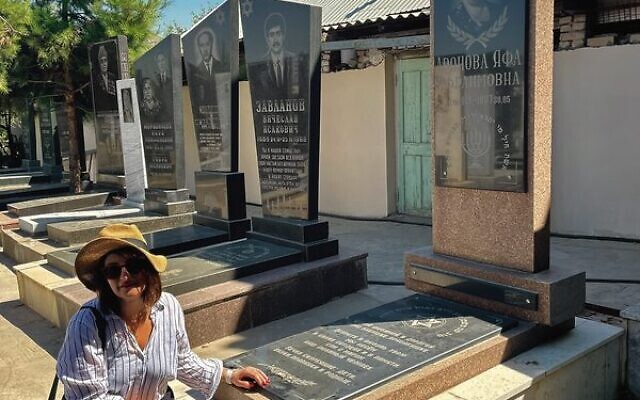
At the Chigatay Jewish cemetery, however, I found something solid. I stood at my grandmother’s grave – the grandmother I last saw at 18 months old.
From Tashkent, we travelled by fast train to Bukhara, once the beating heart of Bukharian Jewry. We walked through the old Jewish quarter and visited one of the two remaining synagogues, now barely managing to gather a minyan on a regular Shabbat. Former Jewish halls stand repurposed as hotels and restaurants, while grand mosques, madrassas and minarets dominate the skyline. I felt a quiet ache. Other faiths are remembered through monumental architecture; our history here is preserved in modest synagogues and cemeteries.
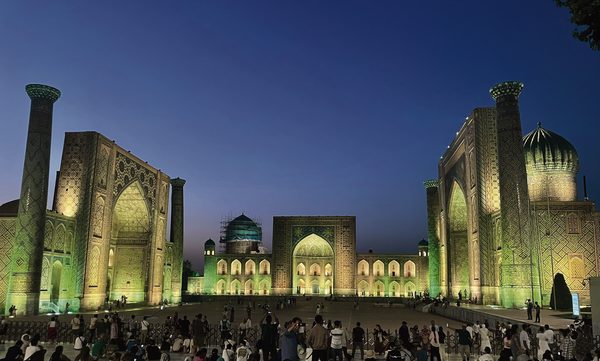
Samarkand told another chapter. My great-grandfather was a Silk Road merchant there, father to 16 children. Standing in Registan Square (a bucket list item finally checked off) once a hub of global trade, culture and learning, I felt, perhaps for the first time, I could picture it: that my family once truly belonged somewhere.
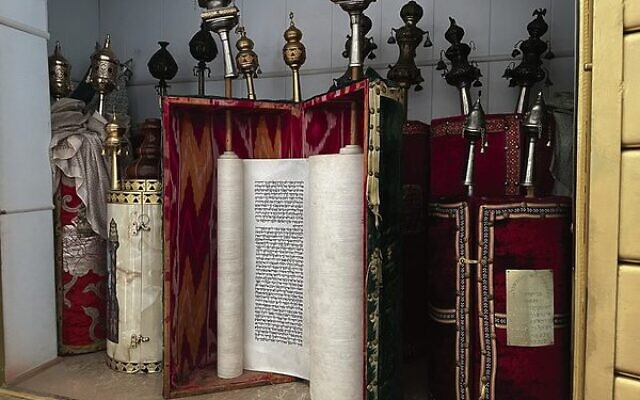
At the Gumbaz Synagogue, built in 1891, its modest exterior concealed a beautifully preserved interior with its iconic blue dome. Torah scrolls wrapped in Uzbek silk, well-worn siddurim, and framed photographs of rabbis lined the outside wall. During World War II, the Bukharian Jewish community welcomed Ashkenazi refugees fleeing Eastern Europe, offering food, shelter and safety, often at great personal sacrifice.
At the Samarkand Jewish cemetery, we cleaned neglected graves of children who had died decades earlier. One grave, specifically sought out by my husband on request of his friend, belonged to a toddler whose parents fled Europe during the Holocaust. Thanks to FaceTime, his descendants back in Melbourne watched as we gathered there and recited Tehillim – the first visitors in 83 years.
Uzbekistan today feels remarkably safe, warm and largely untouched by Western consumerism. Perhaps this is why it has captured renewed global attention as a travel destination. One evening in Tashkent, I watched families gathered around musical fountains, present and unhurried.
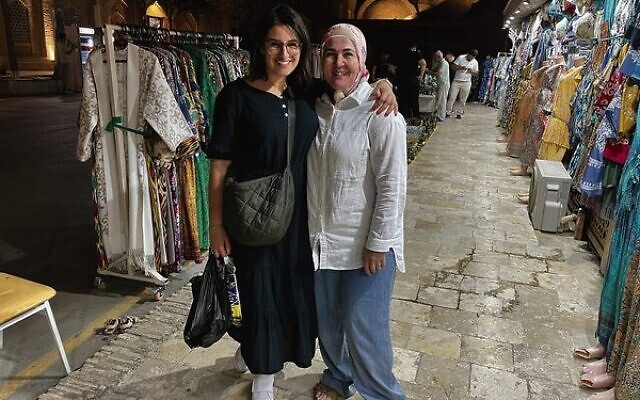
In Bukhara, a market vendor my age, already expecting her third grandchild, smiled when I wished her b’sha’ah tovah and replied inshallah. We embraced and took a photo. The irony wasn’t lost on me: I felt safer as a Jew in this Muslim country than I do here at times today.
The trip wasn’t without discomfort. Some restoration efforts felt curated rather than authentic, raising difficult questions about how Jewish history is preserved, who tells the story, and what gets lost along the way. But more than anything, this journey gave me clarity. It helped me feel the breadth of our global Jewish identity; each of us carrying a piece of our culture and history shaped by geography, migration and memory.
I came back home with a renewed determination to try harder, to carry that culture with more pride.
It means learning to cook the Bukharian dishes we tasted on our journey, wearing the embroidered gowns (jomah) and traditional kippot (tyubeteika) at our simchas and Yom Tov tables, and weaving small rituals into everyday life so that my children can see, taste and feel their ancestry. They may not appreciate it now – just as I didn’t at their age – but one day, I hope they will understand that they, too, are part of a beautiful and resilient history: a people who carried Jewish life across empires and deserts.
This journey brought me closer to a heritage I once struggled to appreciate – and to a community whose story deserves to be remembered, not only in museums and cemeteries, but in living homes and voices.
My name is Tanya Munz – and I am a Bukharian Jew.
comments