




About 10 years ago, playwright Jessica Bellamy was inspired to explore her Jewish heritage through an artistic lens. The Moriah College alumna had always immersed herself in different versions of her Judaism – from her Orthodox schooling to her progressive bat mitzvah (because she wanted to “read from the Torah, improve my Hebrew, and prove to myself that I had it in me to learn a maftir and haftorah”).
Bellamy, who leaned into the performing arts world after school, studying theatre at UNSW and NIDA, started her career writing what she refers to as “quite universal plays that any Australian audience could relate to”. But then, she decided to focus on how art and Judaism could intersect.
Having spent years as the youth engagement worker and religion schoolteacher at Leo Baeck Centre for Progressive Judaism in Melbourne, Bellamy was in a perfect space to explore the role models who are available to young Jewish women.
Her new play, A is for Apple, follows 12-year-old Shoshana who is about to celebrate her bat mitzvah. But, as the play explores, both Shoshana and her teacher, Miriam, keep asking the question “what is a Jewish woman?” and they’re stumped with the answer.
“I would love to provoke questions and conversations within – and beyond – our community about the breadth of Jewish identity”
“I wrote this play after spending quite a bit of time mulling over the lessons we learn from the Old Testament and how so many fascinating women are mainly remembered for who they married to and whose children they bore,” Bellamy told The AJN.
“I wondered if other Jewish women have to find inspiration from outside the tradition, like I did – at least until discovering strong Jewish women through pop culture. I also wondered how we are meant to develop confidence when our role models are not always allowed to stand squarely in the spotlight.”
A is for Apple stars Jewish actors Amy Hack and Zoe Resnick, and the fact that they’re Jewish, Bellamy said, really adds to the show.
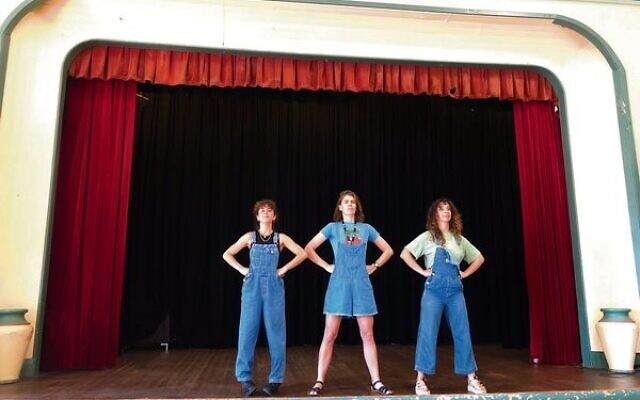
“Our wonderful director, Scarlet McGlynn, (who is not Jewish and therefore provides an important wider framework) has frequently commented during rehearsals about the number of specific Jewish references that the actors pick up on immediately, and how this enriches the script analysis,” she said. “It also makes the work a lot more personal for the actors, because any Jewish woman has probably experienced some of the challenges and questions that come up in this world.”
The play searches through the Old Testament’s patriarchs and matriarchs on a quest for role models, as Shoshana herself becomes a woman. It looks for ways to create a new version of “woman”, who embraces contradiction and complexity, and explores genre-blending and cultural accessibility.
In Bellamy’s words: “Through the help of a pop-culture-obsessed self-help coach, motivational poses, and a little bit of time travel back to Torah times, these women come closer to working out who they want to be, and learn how they can create their own role models.”

Importantly, for Bellamy, it’s about ensuring every Australian Jew feels represented in contemporary theatre.
“I would love to provoke questions and conversations within – and beyond – our community about the breadth of Jewish identity,” she explained. “I have felt for a while that there is not really a broad enough version of what Jewish life can look like in Australia, because we’re such a small community. I want my Jewish community to have room for difference and diversity, and it seems like the arts is the perfect place to push such a conversation.”
While the show is written primarily for an adult audience, Bellamy is keen for teenagers to come along.
“This is a story about a young woman forming her identity and working out a version of herself that she is happy with. Often, in our teens, we believe we have to fit a certain mould or framework,” she said.
“The arts can be powerful for showing possibility and potential for a different, more meaningful self-conception.”
It’s a funny play with big ideas at its heart, and one that is sure to generate important conversations.
A is for Apple is showing at the Griffin Theatre, March 29 to April 9. Buy tickets
comments