



Adam Slonim: What is your overall assessment of how the Royal Commission is proceeding?
I don’t think it could have gone any better than it has so far. The number of submissions received have exceeded all expectations, the willingness of individuals to come forward to give oral evidence has been incredibly impressive. Some of them are taking a bit of a risk in terms of their job security, their safety, their wellbeing, and yet have come forward.
Australia is the only country in the world that has had the courage to put itself under a microscope and examine the seriousness of antisemitism as a problem within Australian society. The evidence that has come out has been, I think, in some ways cathartic for the Jewish community, and also an eye opener for the non-Jewish community in Australia and overseas.
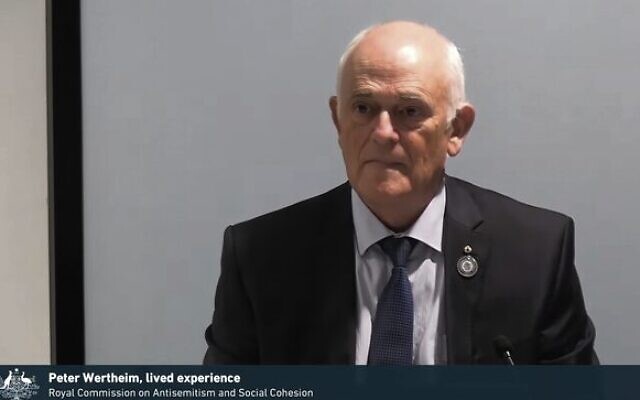
AS: How have these accounts landed inside the commission room itself?
My overall impression is that the entire team of counsel assisting the Royal Commission have been incredibly insightful and empathetic towards the witnesses. I’m particularly impressed with the Commissioner herself. I have experienced firsthand just how empathetic she is, how understanding she is. It’s not just a matter of high intelligence, but high emotional intelligence that she has displayed throughout the proceeding.
On the very first day the commissioner referred to one of the witnesses who was a Holocaust survivor by saying we have the honour to have with us a Holocaust survivor. It’s a small thing, but really telling about the level of sensitivity of the commissioner to the challenges that people who have undergone trauma face when they have to talk about that trauma.
Gareth Narunsky: I got a sense the commissioner was probing witnesses more in the second week.
Your perception is correct, but it wasn’t the timing, it was the type of witnesses. In the first week, we had witnesses who were just talking about their lived experiences, and there was very little about that that was really capable of being challenged. In the second week, there were expert witnesses giving evidence about the nature of contemporary antisemitism. This isn’t lived experience, this is expert evidence. We had Andrew Marcus, we had Andre Oboler, we had Dave Rich, and Dave Rich did a wonderful job.
The commissioner was quite right to give [the Jewish Council of Australia] the opportunity to cross-examine those witnesses. There’s not many of them, but it is a part of our community. My own impression was that the cross-examiner didn’t lay a glove on any of them. The commission will come to its own view.
AS: The ABC reported that cross-examination very selectively. Has the commission dealt with the ABC’s role yet?
That part of the conversation has not seriously been had as yet. It may happen, not in the next block of hearings, which I think will be dedicated to security, but perhaps in the block after that. The ABC has been a constant source of complaint from the community about a range of things. Biased reporting is the most common complaint.
AS: There was a telling moment when you gave evidence about Jewish connection to Israel.
The commissioner asked me, what is the basis of the sense of attachment of Australian Jews to Israel? She said, is it because Israel is seen as a safe sanctuary if things go wrong? I was able to say to the commissioner that is part of the picture, but it’s only a small part. The sense of connection really runs much deeper, and that depth of connection is because of the historical connections that Jews generally have with not just our religion, but with our peoplehood. This is where the land of Israel is, where the Jewish people became a people, it’s where the Hebrew language originated. It was also a source of Jewish civilisation in a broader sense.

This was an ideal opportunity that the commissioner provided to explain all that, not only to her, but to the broader Australian public. I think it was a very important moment, because it showed that the commissioner, for all her insight and wisdom, had missed that point, and it was an opportunity to put it before her.
AS: What don’t non-Jewish Australians understand about Jewish identity?
The first thing that’s missing is how can Jews be both a nation, an ethnic community on the one hand, and a religion on the other hand. In the modern mind, religion is one thing. If you’re a Catholic, you’re a Catholic. But your ethnicity is something else. For us, religion, ethnicity, language and culture are all wrapped up in the one holistic identity, because that was the way human identity was conceived in ancient times, and we’re a 3000-year-old people.
So that’s the first thing we have to explain to people, and then they begin to understand why, what they have always thought of as a purely religious community, can have the right to have its own nation. It might seem obvious to us, but it’s not obvious to other people.
AS: Has the commission resolved where criticism of Israel crosses into antisemitism?
They’re still struggling with that. They do understand the difference between a critique of the policies of the Israeli government or the actions of the IDF on the one hand and denying Israel’s right of existence on the other. But in between there’s a lot of grey area and I think they’re still grappling with that.
This is where the peoplehood point is so critical. Once that’s established and understood, and Zionism is explained as the right of self-determination of the Jewish people in the land of Israel, the historic homeland, the corollary should be easier to delineate: one species of antisemitism is the denial of what is considered a universal right of peoples, namely the right of self-determination in their respective homelands, just to the Jewish people.
GN: The commissioner has endorsed the IHRA definition. Doesn’t that resolve where the line is?
Part of the problem is that IHRA itself is not, and does not pitch itself as, a legally binding definition. The IHRA working definition is a good guide, but it is a starting point. It is not an exhaustive definition, and is not intended to be. It has illustrative examples as a guide to educating people about what antisemitism can look like, and the different forms it can take, but it’s not definitive.
And, of course, the commissioner didn’t just take it on herself to adopt the IHRA working definition as the guide for the commission – this was baked into the terms of reference from the outset and it was very important, I think, that it should have been.
AS: Has enough attention been paid to Islamic extremism?
In the submissions, yes. In the hearings so far, no. The commission is limited by one very powerful restriction: it cannot prejudge any of the factual issues that are likely to emerge in the upcoming trial of Naveed Akram.
Whilst the violent attacks that have taken place on Jewish institutions have been associated with either the Islamist extremists of the Islamic Republic of Iran or ISIS or other groups, the broader social problem of the marginalisation, cancellation and exclusion of Jews from full participation in various parts of Australia’s public life is actually coming not from Islamism, but coming from the anti-
Israel left, the extreme anti-Israel left.
AS: What about far-left antisemitism in universities and cultural institutions?
There’s certainly been a lot of attention paid to the problem, because of all the personal testimony that’s been given. A lot of the lived experience related precisely to that. It’s not just Deborah Conway and other people in the arts and culture sector, but young students at school, university students. All of that testimony has come out and been dealt with in the first block of hearings, but the institutional responses to that has yet to come under scrutiny.
GN: Antisemitism carries on despite the Royal Commission, including antisemitic commentary about the commission itself online. Your thoughts?
I’m sure the commission is well aware of it, because they have people monitoring the media. What the commission makes of that, we’ll find out in the final report.
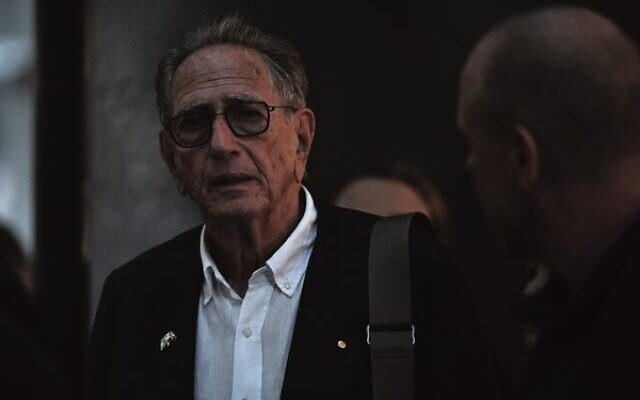
I suspect the whole online sector will come under scrutiny at some stage. The Royal Commission really is an opportunity to call those sectors to account, because it has extensive powers. It can serve notices to produce on organisations, it can require them to answer questions. Those powers also apply to witnesses who perhaps will have a different interest and will be less inclined to be cooperative with the commission, but if they refuse to cooperate, they could be held in contempt of the Royal Commission, and that carries very serious penalties. It’ll be interesting to see how the commission exercises those powers.
AS: Can the commission compel social media companies to cooperate?
[Facebook] have an office here, quite an extensive office, and they have an Australian arm. They are within the jurisdiction. They can be compelled to produce documents, they can be compelled to answer questions, but of course it’s entirely within the discretion of the commission itself as to how those powers are used.
AS: What outcomes would constitute genuine success?
I’ll be looking for cultural change in different sectors of Australian society. A better understanding of what antisemitism is, how it manifests, and the necessity of avoiding it. I don’t think antisemitism is going to go away, but if we can roll back the tide and push antisemitism back into the margins, and make it once more unacceptable in the mainstream, that will be the test. If antisemitism continues in the mainstream in any systematic way, as it has over the last two and a half years, then I think it will be a very sad day, not just for the Jewish community, but for the whole country.
AS: Are you more optimistic or more worried about the future of Jewish life in Australia?
Both. I’m optimistic because Australia has actually had the guts to put the microscope on itself, and it has done so because of a grassroots public clamour to look at the underlying causes of what happened at Bondi last year. The other thing that gives me hope is the outpouring of support that the ECAJ gets from Australians of all different backgrounds. Every time there’s been some atrocious thing happened to the Jewish community, whether it was the Opera House steps incident in 2023, the Adass synagogue fire, the Bondi shootings, there’s been an outpouring of support.
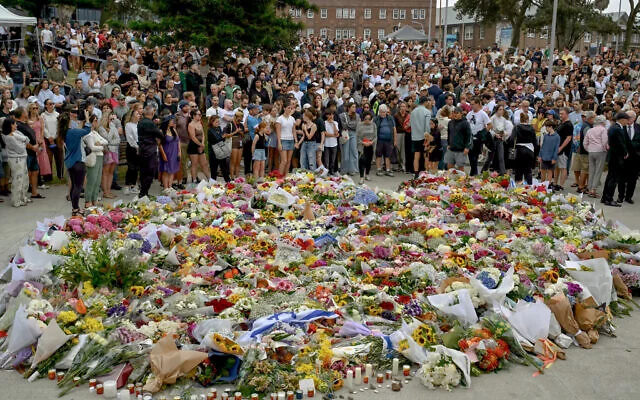
On the other hand, there’s also been a smattering of people who contact us saying, well, what do you expect? You deserve it. My optimism is not unbridled. I haven’t personally made any arrangements to emigrate or make aliyah. I know that many other Australian Jews have done so, and I make no criticism of them. Everyone has to make their own personal assessment. My view is to be realistic, but not to panic.
GN: Will there be enough time to complete the work by December?
We were always of the view that was going to be a challenge to do it in one year, because most royal commissions go for much longer. I wonder whether there’s enough time to compel the production of evidence and the answers to questions from different segments of society. This is not generally a quick process, particularly if there is resistance, as I expect there would be. I think it’s an immense challenge personally, but ultimately this is going to be the commissioner’s call.
The commissioner can only request the government to extend the term of the Royal Commission. She cannot unilaterally extend it herself.
comments