



Second gentleman goes back to his Jewish roots
Douglas Emhoff has made combating Jew hatred his main focus since entering the White House, touring college campuses to talk on the subject and leading events with Jewish organisations.
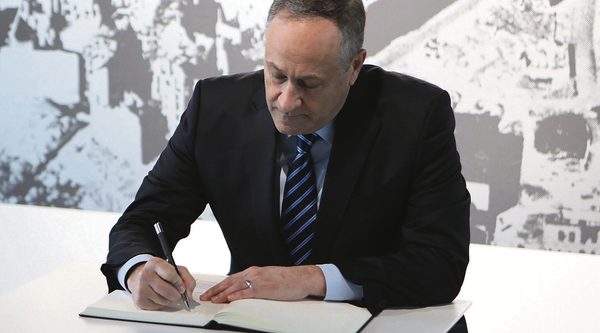
For US second gentleman Douglas Emhoff, the final hours of a five-day working trip to Poland and Germany brought everything into focus.
In the underground information centre in Germany’s central Holocaust memorial, Emhoff sat down with several survivors, including two who had recently fled war-torn Ukraine.
One of them “was saved in the Holocaust as a young baby, settled in Ukraine and then just had to flee again. And she was taken in by Germany,” Emhoff said after the meeting. “It was a real emotional and intense way to finish the trip.”
The journey – which he undertook with Deborah Lipstadt, the US special envoy to monitor and combat antisemitism – included visits to Krakow, Poland; to the nearby memorial and museum at Auschwitz-Birkenau; and to the Polish village of Emhoff’s ancestors, Gorlice.
It was all intended to feed into the design of a “national action plan against antisemitism” that Emhoff is working on with Lipstadt and others. The second gentleman has made combating Jew hatred his main focus since entering the White House, touring college campuses to talk on the subject and leading events with Jewish organisations.
But this trip, which began on International Holocaust Remembrance Day, took Emhoff’s efforts onto the international stage – and brought him back to his ancestral Jewish roots.
In Berlin, he met with US ambassador to Germany Amy Gutmann, Germany’s commissioner of Jewish life Felix Klein and other leaders. He and Lipstadt took part in an interfaith roundtable hosted by the Central Council of Jews in Germany, before visiting a historic synagogue in former East Berlin and meeting with members of the community. He also visited three Holocaust memorials.
My friend Ruth survived Auschwitz. She’s spent her life raising awareness about the dangers of hate and antisemitism. It was my honor to invite her as my guest to the State of the Union. pic.twitter.com/e1xS9KWWEj
— Douglas Emhoff (@SecondGentleman) February 8, 2023
Speaking to a small interfaith gathering at the Central Council headquarters, Emhoff said he could not help thinking of his grandparents, who had escaped persecution in Poland and settled in the United States.
“They found opportunity and freedom,” he said, “and now, 120 years later, their great-grandchild is the first Jewish spouse of a United States president or vice-president, who is working to combat hate and antisemitism. That’s something isn’t it?” he said. “It’s a remarkable full circle.”
Emhoff told reporters the purpose of the trip was to share best practices and feed ideas into the “national action plan”.
“We are going to put our heads together and talk about what we learned, and then put it into the pipeline so we can come out with the most effective national plan,” he said. He added that he would be addressing the United Nations in early February.
Emhoff’s last official act was his meeting with the survivors. Sonja Tartakovska, who had survived a Nazi mass shooting operation in her village during World War II, told Emhoff how she had to flee Ukraine last year without a change of clothing. She is one of the Ukrainian Jews whom the Claims Conference brought to Germany last year, said the organisation’s representative Rudiger Mahlo, who took part in the meeting.
The fact that former Holocaust victims were now seeking refuge in Germany was not missed.
“We have been talking about the Holocaust, talking about antisemitism, about violence and oppression; and here in Europe all these years later, these things are still happening through this unjust, unprovoked war,” Emhoff told reporters after the final meeting of the day.
“I was also struck: One woman [German Holocaust survivor Margot Friedlaender] was 101 years old. Imagine living with those memories for 80 years. Those are the kinds of things I take back with me,” Emhoff said.
JTA
comments