




Elie Wiesel: Soul on Fire, directed by Oren Rudavsky, is a portrait of one of the most consequential Jewish figures of the 20th century, told largely in his own voice. For Elisha Wiesel, the Nobel laureate’s son, the film is both a legacy project and something far more personal.
Elisha spoke exclusively to The AJN from New York about the making of the documentary, what it means to carry his father’s name in a world his father would barely recognise, and why he believes Elie Wiesel’s identity as a Zionist still has the power to stop people in their tracks.
Finding the right filmmaker
The idea of a documentary had been circling the Wiesel family for years. After Elie Wiesel’s death in 2016, approaches from filmmakers and producers became more frequent. But Elisha and his mother Marion, Elie’s widow, were cautious.
“We were approached by quite a few people after my father passed. It’s been almost 10 years,” Elisha told The AJN.
“Many of them wanted to make a film about Night, but we had very specific instructions from my dad that he never wanted another creative getting between him and his readers.
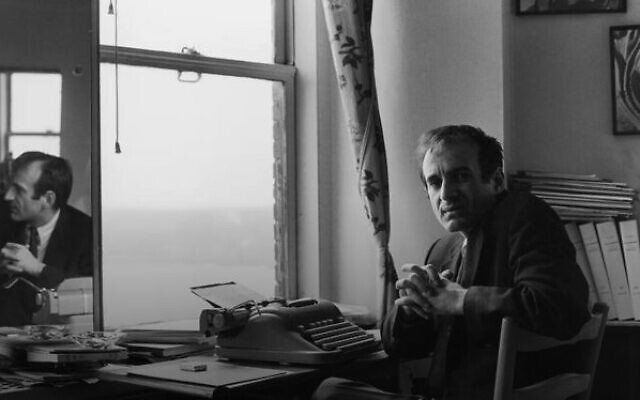
‘We still felt that we wanted to create something that was a legacy about his life, that was really a testament to his life. So we, my mother and I, went in search of a producer director.”
The search eventually led them to Oren Rudavsky because of their admiration for his previous film ‘Hiding and Seeking’.
“We found a film that we fell in love with and we said, my God, who produced this? And that led us to Oren Rudavsky,” Elisha said.
Rudavsky, for his part, came to the project with a clear vision. In an interview with Kveller, he described the terms he set from the outset.
“We need complete independence. This needs to be our film, but your cooperation is vital to making this the kind of film that will reveal Elie Wiesel in a new way,” he said.
The family agreed, granting access to personal archives and participating in original interviews. The result, Rudavsky said, was a four-year process.
A man heard in his own voice
The documentary opens with Elie Wiesel’s early life in Sighet, Romania, where he was born in 1928 and raised in a Jewish family with three sisters. In 1944, following the German occupation, he and his family were deported to Auschwitz. His mother and younger sister Tzipora were murdered almost immediately upon arrival. Wiesel and his father were later forced to march to Buchenwald, where his father perished. Wiesel was liberated on April 11, 1945, and transported to France among a group of orphaned survivors who became known as the Buchenwald Boys. His sister Hilda discovered him through a photograph in a French newspaper, and he eventually reunited with both Hilda and his other surviving sister, Beatrice.
From France, Wiesel made his way to New York, where he became a writer, teacher, lecturer and, ultimately, a Nobel Peace Prize laureate. The film traces this full arc — not just the horror of the camps, but the decades that followed.
Central to Rudavsky’s approach was the decision to let Wiesel narrate as much of his own story as possible.
“What’s very powerful about the documentary is that it’s in his own words,” Elisha said.
“Oren was very concerned about how to do justice to my father. It was his idea to lean as much as possible into the archive footage of my father so that it was my father’s voice dominating. And I think that that was really the right move. It was the respectful move, and it was the right move.”
The film draws on family photographs, recordings of Wiesel’s voice, personal family footage, original interviews and striking hand-painted animation to construct what is described as a holistic portrait of a notoriously private man. Classroom scenes filmed at Boston University, where Wiesel taught for many years, sit alongside footage from a contemporary middle school classroom in Newark, taught by Paris Murray of the Northstar Academy — a reminder that Wiesel’s lessons are still being passed on.
Elisha hopes the documentary will find audiences at every level of familiarity with his father’s work.
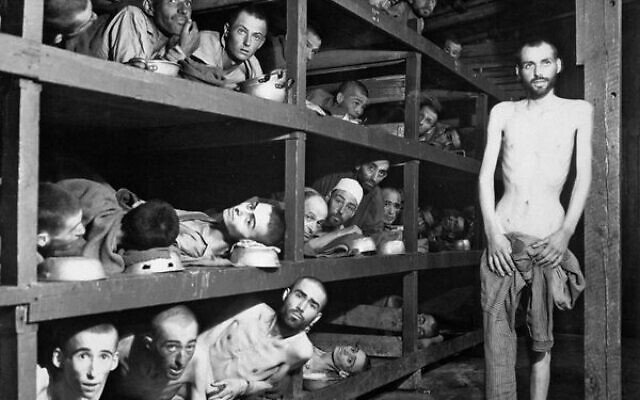
“For those people who knew my father, it reopens all these memories. It reestablishes my father in their mind,” he said.
“Then there are also people who had heard of my father, but maybe didn’t know as much about him. And for them, this is a tremendous kind of next step after reading Night to go a little bit deeper, to discover a bit more about his journey and who he was.”
A proud Zionist
The documentary arrives at a moment of acute significance for world Jewry. Asked what his father would have made of the current climate of antisemitism and hostility toward Israel, Elisha was careful to answer.
“I feel that there are very few privileges to being dead, and I don’t mean this flippantly, but one of them is we shouldn’t put words in the mouth of people who are no longer here,” he said.
“What I can tell you is, as his son, who spent obviously a lot of time with him and was raised by him, I can tell you what I took away from him and how I respond to this moment.
“He would look at the way Jews are being hated today. He would look at the way I see it through those eyes. Here is a man who spent so much of his career educating about hatred, and here we are, the Jews being subject to hatred again in the form of anti-Zionism, antisemitism. It’s profoundly tragic. The concept that this is what we ended up with, it’s almost too much to bear.”
For Elisha, one of the most powerful things he can do in his father’s name is to confront a particular piece of cognitive dissonance head-on.
“This person, this great leader, was a Zionist and I watch people’s brains explode,” he said.
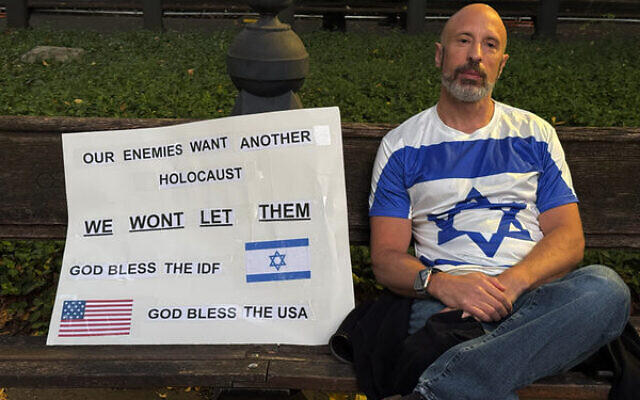
“It’s almost like they can’t handle the cognitive dissonance. Wait, Zionist is evil and now you’re telling me Elie Wiesel is a Zionist? You can observe the cognitive dissonance unfold. And I feel that that’s one of my roles because there aren’t a lot of institutions that can or will send that message, but I can.”
It is a message Elisha says he feels compelled to carry personally, having watched antisemitism move from the margins to the mainstream in the span of his own adult life.
“I grew up at a relatively blessed time,” he said.
“Did I experience direct antisemitism throughout much of my adult life? No, I really didn’t. There were moments, and now it’s everywhere. My teenagers are growing up in a world where antisemitism is part of their college campus experience. It’s part of their New York City experience. It’s part of everything they see.”
Elisha’s two children Elijah and Nova feature in the documentary and Elisha revealed his daughter changed their name to Nova two years before October 7.
“It wasn’t a response to October 7th,” he said, “but it’s something obviously that has tremendous meaning now and brings us even closer to our brothers and sisters in Israel.”
October 7 and after
The attacks of October 7, 2023 marked a turning point for Elisha. Having recently retired from a 25-year career on Wall Street and opened a new business with two non-Jewish partners, he found himself compelled to step back and step up.
“I was horrified on October 8th to see how here in the United States, so many people were quick to accuse Israel before Israel had yet lifted a finger to defend herself or do anything about rescuing the hostages or applying military pressure to retrieve the hostages or secure her borders,” he said.
“And immediately, all of a sudden, Jews were on the defensive. Israel was on the defensive.”
His response was to become publicly active – appearing on CNN and MSNBC, writing opinion pieces and channelling his energy into the Elie Wiesel Foundation for Humanity, where he serves as chairman. He noted one unexpected bright spot amid the darkness: his non-Jewish business partners called on October 8 to tell him they understood he would need to focus elsewhere, and that they had him covered.
Among the Foundation’s current priorities is its work with the Ethiopian Israeli community.
“My parents were obsessed with making sure that the Ethiopian community in Israel would have every possible chance for success,” Elisha said.
“And these Ethiopian Israelis are shedding their blood. They are sending soldiers. They are on the front lines. They are bleeding the same as any non-Ethiopian Israeli soldier. So we are doubling down.”
He called the common portrayal of Israel as a “white colonial” project not just wrong but one the Foundation is specifically committed to challenging.
Winning — by still being here
Despite everything, Elisha’s outlook is not one of despair. Asked about the battle of being Jewish in today’s world, he said. “We’re winning”.
“And how do we know we’re winning? Because we’re still here, even if a lot of people don’t want us to be here.”
He draws on Talmudic wisdom to describe what he sees as the dual obligation of Jewish engagement in this moment. On one hand, to push back firmly against ignorance and hatred. On the other, to draw people in — to Shabbat tables, to Jewish song and food and community.
“We have to exercise both of these muscles,” he said.
“To know how to push away and also know how to bring closer, and there’s no science to it. This is the art of human engagement.”
For his own children, he said the most important thing is that they know what they are fighting for — not just what they are fighting against.
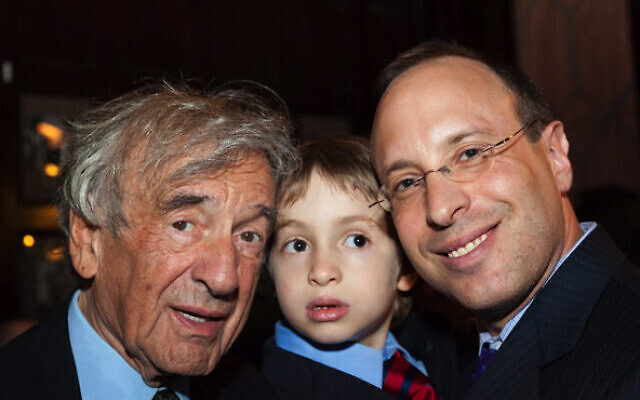
“My kids have a real sense of the treasure that is the Jewish experience and how valuable it is to keep fighting for. And that’s something that I worry often gets lost in modern times.”
Elie Wiesel: Soul on Fire was screened in Australia as part of the Jewish International Film Festival (JIFF) by The Joint Australia with Elisha delivering a video message to the audience beforehand. In fact, Wiesel was not only a Holocaust survivor and Nobel laureate but also The Joint’s very own Australian patron.
The film explores his life journey from his family’s deportation to his legacy as a writer, a husband and father and human rights advocate, told in his own voice.
Eighty years on from the Holocaust, that voice, it turns out, still has much left to say.
comments