



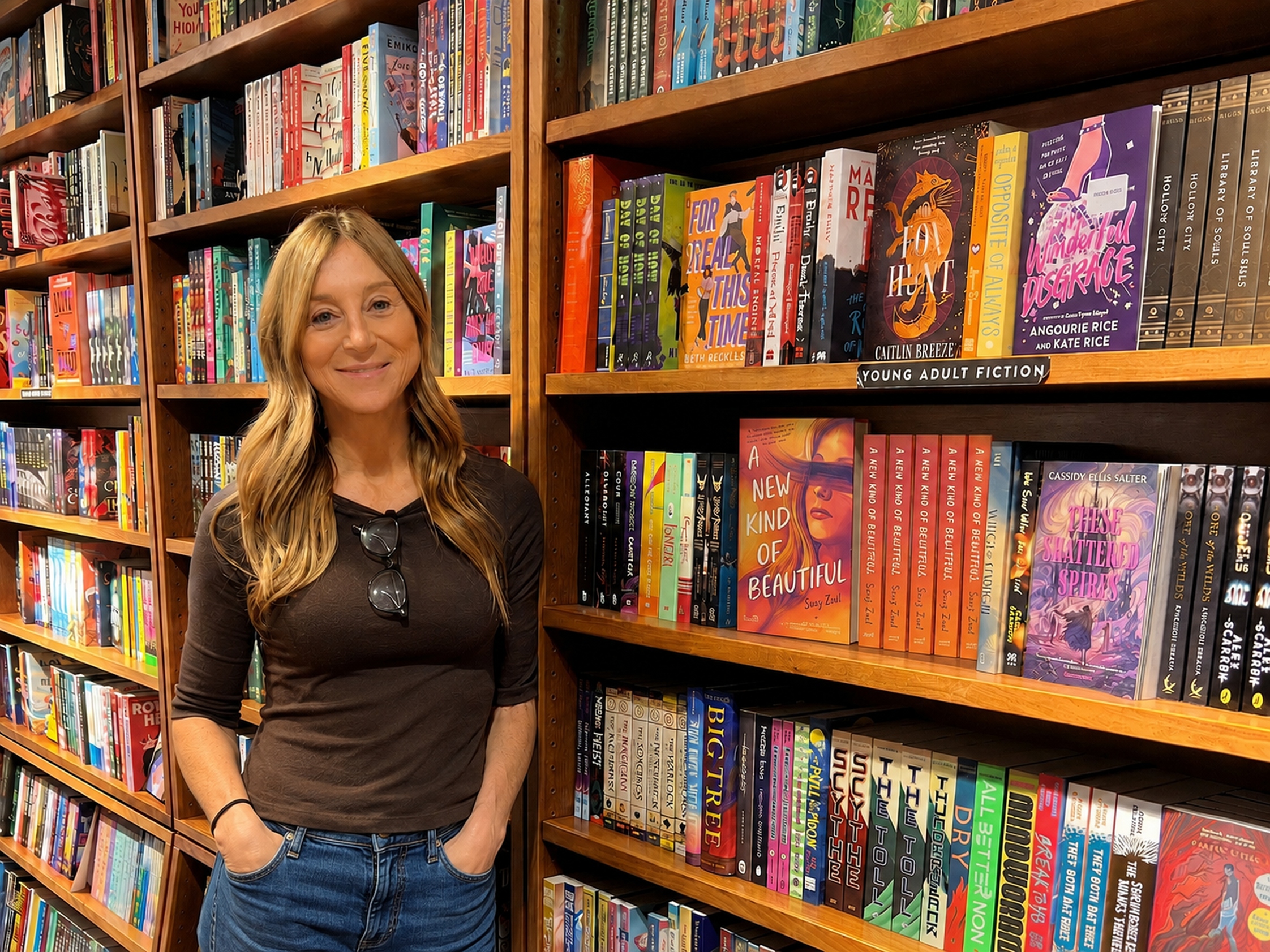
It started with a question Suzy Zail never got to ask.
Her husband’s aunt Lil was diagnosed with Retinitis Pigmentosa in South Africa in the 1930s and lost most of her sight by 16. Her parents’ shame was so deep they hid her away when guests came. It was only after they died, and Lil joined her sister in Australia, that she learned to use a cane and cook a meal. She was 60 before she lived in a home she could call her own. Before she fell in love.
Lil died four years ago. And though Zail had asked her once what it had all been like, she received a one-word answer. Fine.
“Lil didn’t have the words to describe what grief felt like any more than she could explain how freedom felt,” Zail told The AJN. “Growing up, she hadn’t been encouraged to access the parts of herself that felt anger, fear, sadness or confusion.”
In the days after Lil’s death, Zail couldn’t stop wondering. What would it have been like for 16-year-old Lil? And what was life like now for a teen with low vision? Was the world still inhospitable?
“I want readers to know that life can still be beautiful, even when it doesn’t go to plan…”
Those questions became A New Kind of Beautiful. The novel follows Paige Wilding, a 16-year-old artist whose future is mapped out until a diagnosis of Stargardt’s disease, an incurable eye condition, begins to blur the life she had planned. As her sight fades, Paige must learn what it means to create, to connect and to be seen for who she really is.
“Becoming Paige Wilding helped me answer those questions, and write something for teens to encourage them to think about the way they see the world and how they might build a better, more inclusive one,” Zail said.
The daughter of a Holocaust survivor, Zail has spent her career writing stories that grow from personal experience. Her previous novel, Inkflower, drew on her father’s experience in Auschwitz and won the 2024 CBCA Shadow Judging Book of the Year for Older Readers. Each of her books centres a young person fighting to live a life of their own choosing.
This one is no different.
Zail spent more than a year immersing herself in the realities of vision loss. She consulted professionals, teachers and counsellors, undertook cane training with Guide Dogs Victoria, and walked streets wearing simulation goggles that mimicked Paige’s condition. She tried dining and yoga in the dark.
“Wearing simulation goggles, I noticed the changing textures under my feet, shifts in air temperature, the hum of the streetlights,” she said.
A turning point came when she found artist Madeleine Popper through Vision Australia’s website. Popper lives with significant vision loss and paints bold landscapes with her fingers because she cannot see the end of a brush. Zail visited her studio and watched her work.
“Madeleine talked me through her art process, and how her fading sight had made her work more instinctive and honest, more alive and full of feeling,” Zail said. “When you write experiences outside of your own, you owe it to the people you’re writing about to represent their lives with sensitivity and nuance. To do that you have to ask questions and listen.”
Popper’s idea of “happy mistakes” found its way into the novel. Paige, too, must learn that imperfection is not something to hide.
But the book is not only about disability. Zail wanted Paige’s journey to hold a mirror up to the pressures every teenager faces in an age of filters, followers and performance.
“We live in a culture that encourages young people to airbrush their lives so they appear flawless,” she said. “The less Paige can take part in the superficiality of image culture, the more she learns to value authenticity over performance, and recognise that her own individuality aren’t things she needs to hide, but rather things that make her real.”
When you write experiences outside of your own, you owe it to the people you’re writing about to represent their lives with sensitivity and nuance. To do that you have to ask questions and listen…
For all its difficult themes, the novel is threaded with warmth and humour, and a love story between Paige and Zac, her rival for the school art prize who becomes her safe place.
“Many of the blind and low vision people I interviewed had found greater clarity about themselves and the world through the process of losing their sight, and their reflections shaped the tone of the novel,” she said.
And true to form, Zail does not offer readers a tidy resolution. Paige’s sight is not restored. But something shifts in perspective.
“I want readers to know that life can still be beautiful, even when it doesn’t go to plan,” Zail said. “And I hope they take her lead and begin to look for beauty in unexpected places and ordinary moments, and in people they might otherwise overlook.”
A New Kind of Beautiful is published by Walker Books Australia.
comments