



The most effective and powerful analogies are always the simplest and easiest to picture.
And during an empowering 90-minute presentation at Sydney’s Dover Heights Synagogue late last month on how to identify, and fight back against, the dangerous tsunami of antizionism that’s enabling the spread of hatred against Jews, Josh Dabelstein – the Australian chapter coordinator of the Movement Against Antizionism (MAAZ) – delivered an absolute beauty.
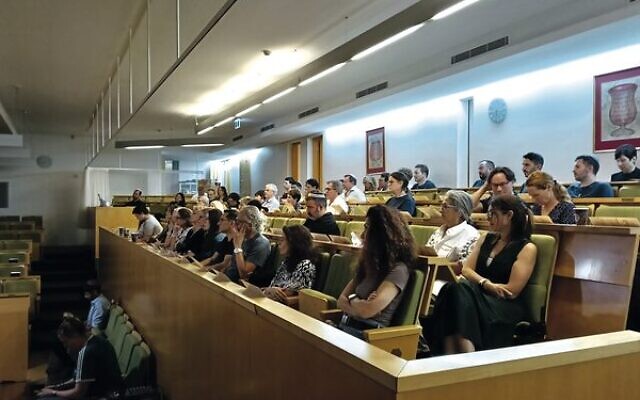
At the event organised by the Zionist Council of NSW, Dabelstein, who has a unique and deep knowledge of antizionism because he was once an antizionist himself, relayed to the audience of more than 100 this most potent of paragraphs:
“If we think about the highway to Jew hate, one lane is antijudaism, the middle lane is antisemitism and the other lane is antizionism. We [society and the law] blocked those first two lanes. That doesn’t mean that there are still people swerving all over the road. Some people do just hate Jews, right? But the one lane that allows them through today and emboldens them, provides them a permission structure and allows society to really spread all of this stuff, is antizionism.”
WHY ANTIZIONISM IS SO DANGEROUS NOW
To understand why Dabelstein considers antizionism the single greatest threat facing Jews in the Diaspora today, it helps to understand how MAAZ frames the history of Jew hatred as a whole. At his Dover Heights shule address, he explained how those “three lanes on a highway” are related, but also quite distinct, with each associated with different “permission structures”, meaning they utilise a system of language, beliefs and authorities that makes the harm that the protagonists cause feel justified and allows people to adopt positions they once would have vehemently rejected.
Antijudaism, the oldest form, targeted Jews through religion – which is now illegal. Antisemitism targets Jews through race and ethnicity – which is also now illegal.
But antizionism – the dominant form today – targets Jews through demonising the Jewish state – disguising the hate as political criticism, or for social justice.
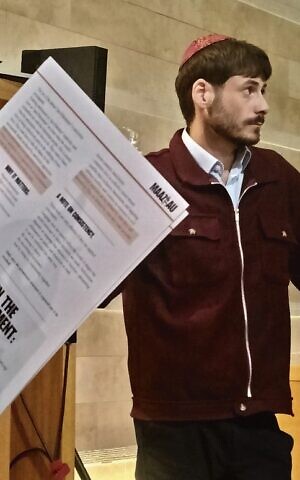
In each case, he argued, the hatred operates not by engaging honestly with its stated target – Judaism, Semitism or Zionism – but by inventing a phantom proxy and loading it with libels.
“They take all the things that they hate and they shove them in that word.”
In the antizionist era, today’s libels – genocide, apartheid, colonialism – are directed at the Jewish state, are repeated ad nauseam and, Dabelstein said, “are elevated to fact status through pseudo-academia and institutional adoption.”
The conspiracy theories have shifted accordingly: Israel’s President Isaac Herzog is likened to Hitler during his recent Australian visit; and stigmatising Jews is now “simply achieved through misusing the word Zionist”.
What makes all forms of Jew hatred dangerous, Dabelstein said, is precisely that each presents as fashionable in the context they arise, before eventually being revealed as violent systems that produce violent ends.
While antizionism presents itself as anti-colonial, anti-racist and humanitarian, the violence it invites is moralised the same way it was in medieval and Nazi Europe.
“The Jewish state is positioned as the inverse of our most treasured values,” Dabelstein explained. “In an entire world flattened into this oppressor/oppressed binary, the Zionist is considered the ultimate oppressor and hunting Zionists becomes an ethical duty.
“This is how people who consider protecting minorities to be the best thing anyone can do, justify hunting a minority.”
WHAT DOESN’T WORK
One of the most confronting parts of Dabelstein’s presentation was his frank assessment of the strategies the Jewish community has been deploying for decades – and why they are failing when applied today.
The dominant instinct, he said, has been to try to educate, explain and correct antizionists.
An example is when someone tells you Israel is a colonial project; you explain that Zionism is a national liberation movement tied to ancient Jewish connections with the land. Or when someone claims Israel controls the world; you point out how small Israel is and how often it is outvoted at the United Nations.
“We turn out our pockets for these bigots, thinking that they’re interested in understanding us,” Dabelstein said.
“But antizionists love that, because those responses accept the premise that we’re on trial. We end up emptying our pockets for bigots, while we’re being abused.”
The core problem, he argued, is that antizionism is not a product of logic and education and therefore cannot be defeated by logic and education.
“These libels – colonialism, genocide, apartheid – they’re not falsifiable. Their definitions are adjusted in accordance with the antizionist’s need to stigmatise us.
“The bottom line is, it is a hate movement that’s rooted in abuse.”
Equally futile, he said, is the common reflex of calling antizionism antisemitism, because doing so actually “hands antizionists an escape route”.
“They just say: no, we’re not racist – this is political. So we reinforce the antizionist permission to keep hounding Jews, because we allow it to exist as something that has to cross a line into overt race-based hate in order to be taken seriously.
“The result is that most anti-Jewish hate is allowed to operate freely today, requiring the use of old, familiar slurs before it is even recognised, let alone acted upon.”
Calling antizionists antisemites, in other words, plays by their rules.
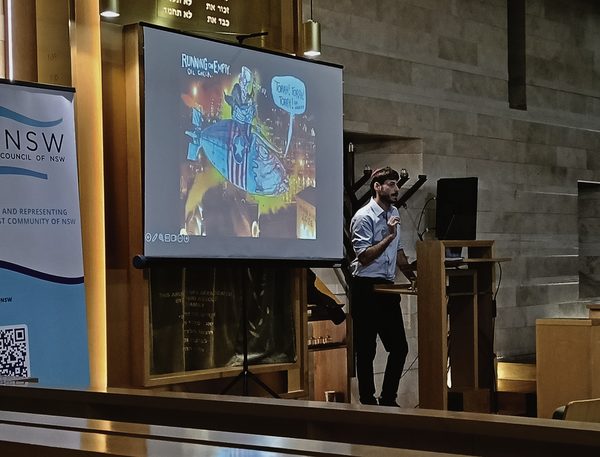
The proof, he said, was visible in mainstream Australian media earlier in the week. He displayed David Rowe’s cartoon published in the Australian Financial Review’s March 20 edition, arguing it would be impermissible were antizionism not being allowed to masquerade as political criticism. The cartoon depicted Israel’s Prime Minister Benjamin Netanyahu riding a missile, like riding a horse, that had US President Donald Trump’s face painted on it and using a dipstick to check the level of fuel in it, with the oil’s colour being blood red instead of yellow.
THE APPROACH SHIFT THAT’S NEEDED
What actually works against antizionism, Dabelstein said, requires a fundamental shift in both mindset and language.
The model that MAAZ Australia offers, utilises proven approaches from other social justice movements that successfully changed what is and isn’t socially permissible.
The lesson from each of them is that you cannot legislate behaviour that people don’t yet have a name for, you have to name it and call it out first.
“Take feminism,” Dabelstein said. “When women entered the workplace from the 1950s to the 1970s, they couldn’t go to Human Resources and say, ‘Bill keeps asking me out and it makes me feel like I don’t want to come to work.’ Because that didn’t violate any rule.
“So what did women do? They spoke to each other. They realised they were having the same experiences. And they created a new language – sexual harassment, patriarchy, glass ceiling – and that language changed everything.”
Similarly, the racial justice movement created the term microaggression, to capture and make visible forms of denigration that didn’t fit existing definitions of racism.
And the trans rights movement coined the terms misgendering and transphobia.
“Each movement drew clear boundaries, refused to apologise for them and – critically – shifted attention onto the abuser,” Dabelstein said.
Applied to antizionism, the prescription is disarmingly simple.
“If you take nothing else away from this evening – just name it: antizionism.
“We have to talk about it, or it stays invisible. We give those accusations legitimacy by treating them as anything other than abuse.”
The lowest-level response is to internalise it, start to believe it, or feel compelled to disprove it – a big mistake.
The next level – where Dabelstein said most of the community currently operates – is to dispute, which “feels like fighting back, but it isn’t, because it accepts the abuser’s framing entirely”.
The higher-level response – and the one MAAZ Australia trains people to use – is to expose the cycle.
Rather than engaging with the content of an antizionist’s accusation, Dabelstein urges community members to say things like: “You’re using the coloniser libel, which leads to violence against Jews.” Or: “Your antizionist conspiracy theory is bigoted.” Or, most simply: “Stop abusing me – this is abuse and your abuse is the problem.”
Crucially, he stressed, the goal is not to persuade the person doing the abusing.
“APAN [the Australian Palestine Advocacy Network] and the Jewish Council of Australia, for example, are not going to listen to you, but it doesn’t matter. It’s about who’s watching – the people in the middle.”
There could be many who have absorbed antizionist libels, not because they are committed to the hate movement, but because those libels have gone largely unchallenged.
So on social media especially, Dabelstein points out, when you call out abuse, in the comments section, “that audience will see you standing up for yourself. So describe the libels and denounce it as a hateful, abusive and unacceptable movement.
“You can debate a well-intentioned friend who says, ‘I hear a lot of stuff about Israel and it sounds pretty awful, but I want to understand’ – that’s one thing. But don’t debate antizionists. Just call out their abuse.”
He also recommends to stop referring to antizionists as being “pro-Palestinian”, because that’s what they want you to believe.
“If we call them that, we are recycling their propaganda.”
DABELSTEIN’S PERSONAL JOURNEY
Part of what gives Dabelstein’s work its particular force is the unusual vantage point from which he delivers it.
As a young man, he was an antizionist activist and a Jewish one at that – the grandson of Veronica Goldrick, who had escaped Budapest in 1939 with her parents.
It took a gradual process, not a sudden realisation, for him to see the light.
During a stay at his grandmother’s place in Bowral, during a bad bushfire season in 2018, he pulled a book from the shelf – it happened to be the Routledge Atlas of the Arab-Israeli Conflict by Martin Gilbert.
“It was just maps of who had owned which land and when. I gradually realised that the entire pocket of information I’d been fed as a uni student had been stuffed only with libels.”
He kept reading and realising and two years later, he began dating a Jewish woman from Caulfield who had been doing work in Israel funded by the Israeli government to help non-Jewish Israeli women escape domestic abuse and honour killings.
“I thought: why would a genocidal state do that? And then, in 2021, a fellow student at university said to me, ‘The Jews just need to go back to Europe’ – that was the last straw.
“Even as I grew out of it [antizionism], I’ve watched people from that chapter of my life continue to become part of the machine.
“I have a lot of empathy for these monsters and I try not to speak ill of them – as individuals – because I get that it is a very seductive mind virus.”
TRAINING OPPORTUNITIES
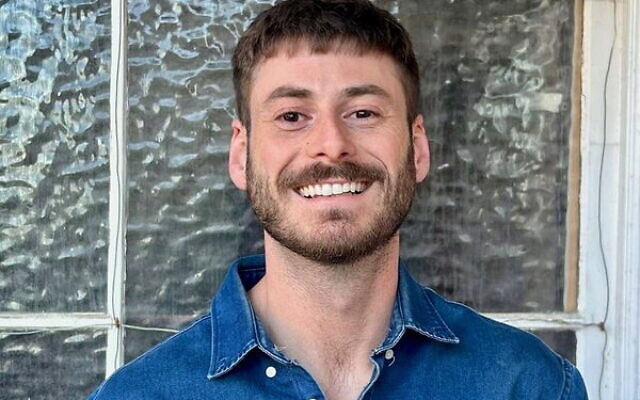
MAAZ Australia, through Dabelstein, runs free training seminars every Wednesday night and Friday morning.
“It’s unpaid and it’s on rain, hail or shine. We do it because people are asking for it.”
Dabelstein noted that MAAZ Australia is a grassroots organisation that “has a lot of friends in most of the Jewish organisations”, but he reserved extra thanks on the night to the Zionist Council of NSW, for seeing the utility in MAAZ Australia collaborating.
“The faith and trust that’s been put in us by the Zionist Council of NSW is just so big and the gratitude is monumental,” Dabelstein said.
He also urged people to refer to examples of antizionism in submissions to the Royal Commission on Antisemitism.
Zionist Council of NSW president Orna Triguboff said in her speech, “Here in the Diaspora, we’re taking matters into our own hands by becoming part of the solution to combat antizionism. Because when we equip ourselves, we learn how to advocate and we build our own confidence – both personally and also communally.
“I really hope that what we’ve learned tonight with our wonderful presenter, Josh Dabelstein, can help us all be more resilient and strong and inspired to join MAAZ and do more training with them. They’ve got some amazing resources and we have partnered with them, thanks to the vision of our vice-president Rebecca Lacey-Ehrlich.
“Through this collaboration, we’ve developed short videos, articles, public statements and delivered guest talks to a range of organisations. And we’re hoping to do that more, as part of a sub-committee of cooperation with MAAZ.”
For more information about MAAZ Australia, email maaz.aus@maazaction.org or follow them on Instagram @maaz.aus or visit movementagainstantizionism.org
comments