



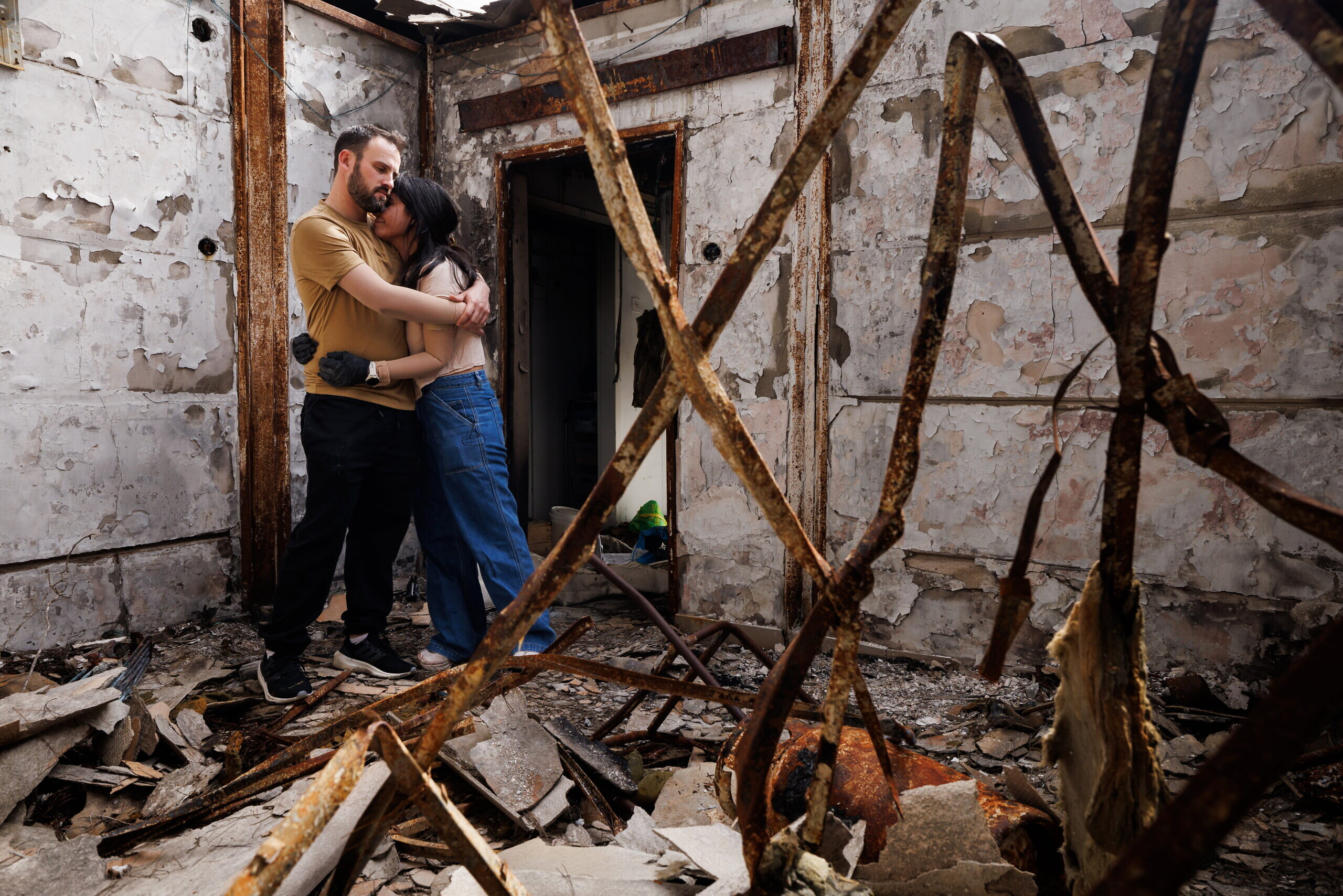
“Who would have believed that walking into the fire would be what saved our life?”
These are the words of Dr Ellay Hogeg Golan. A mother. A wife. A doctor. An October 7 survivor.
Golan describes life on Kibbutz Kfar Aza as idyllic.
“Life on the kibbutz was amazing. We loved it. The community was so strong, the togetherness and taking care of one another. It’s absurd to say, but we felt safe,” Golan told The AJN while in Australia to share her story for the Australian Jewish Fertility Network major events. “I felt safe that my children could run around in the kibbutz. We felt like it felt safer than the city. We were probably naive about what was going on on the other side of the fence. But we loved it.”
It wasn’t until Golan woke up from her induced coma after suffering burns over 60 per cent of her body that she realised just how many terrorists infiltrated Kfar Aza on October 7. Kfar Aza, which is around five kilometres from the Gaza border, was one of the major targets of the Hamas terrorist infiltration. Over 10 per cent of the 765 residents were either murdered or taken hostage.
Golan, her husband Ariel and their 18-month-old daughter Yael, fought hard to ensure they were not part of that 10 per cent.
At 6.28am, the rockets started. Golan shared that by 12.55pm, her life changed forever when their home was breached. When terrorists realised that the family was not going to come out of their safe room, they decided to burn the house. The hope was that the family would try to escape, allowing the terrorists to either kill or capture them, or they’d perish in the fire.
Golan admitted that they felt like giving up. It was Yael who helped them through.
When they couldn’t take the smoke in the safe room anymore, the Golans were faced with a choice. They knew the terrorists were waiting outside the house for them, so they had two options: stay and die from smoke inhalation, or try to run through the flames to survive.
“In a split second, we chose the flames, and the chance to fight over giving up to them,” Golan shared at the AJFN event.
“I felt safe that my children could run around in the kibbutz. We felt like it felt safer than the city. We were probably naive about what was going on on the other side of the fence. But we loved it.”
The family left the safe room to find refuge in another room of the house.
“We fled from the reinforced room through the fire into the bedroom and hid at the edge of the bed,” Golan shared in The October 7 War, a book by Israeli photojournalist Ziv Koren. “Ariel lifted the mattress, and the three of us knelt under it. Through the bedroom window, the terrorists began throwing in glass bottles, stones and sticks. At some point, they tore off a butane cylinder, opened it, and threw it on the floor next to us. The cylinder exploded, and the huge fire engulfed us.”
After regaining consciousness, the family moved to the shower, trying to soothe the burns already covering much of their bodies. The terrorists heard the water and another gas canister was thrown inside. This one did not explode. A terrorist did, however, struggle with Golan through the window, stabbing her in the forehead with a wooden stick.
It was while they were in the kitchen, waiting with knives to confront the terrorists, that they realised the terrorists had given up, and left them to die inside.
They decided to find a place to hide outside. They believed that the army was on its way to take control. As has come to light since though, they had to wait a while.
“We jumped out of the window barefoot, in boxer shorts and tank tops, with burns all over our bodies,” Golan wrote, explaining that they found two tractors which seemed like a good place to hide. Only then did they realise the extent of their burns. Yael was going in and out of consciousness and although she didn’t realise it at the time, Golan was suffering chemical pneumonia.
When they eventually made it to the entrance of the kibbutz, they were finally greeted by soldiers.
Golan gave them instructions on how to help Yael, and then lost consciousness herself.
The family was airlifted to hospital where they remained until they recovered. Yael was sedated for eight days, Ariel for 10 and Ellay for 52. She told The AJN she woke up to a different reality.
“I don’t think we realised the amount, not until I woke up did I understand the amount of terrorists who were there,” Golan recalled. “I think, you can’t really describe the feeling of fear for your daughter’s life or your family’s life, until you’re at the point where every other feeling stops. You can’t breathe, the fear is controlling … it numbs every part of your muscles; waiting for it to stop, waiting for the army to enter. I don’t know how to describe it, how to find the courage and strength to escape.”
Golan explained that both she and Ariel knew they weren’t going to give up, that they needed to keep fighting, and every time they laid eyes on Yael, they knew they needed to keep going.
“They came to take life. We are here to bring more love and light into the world.”
“Every time I saw that Yael was alive, we just kept on going no matter what. The main thing that gave us the strength to keep on going is to bring Yael outside, to save Yael. That was the strength that I needed, that we needed,” she said.
When the family was airlifted to hospital, they were taken to Sheba Tel-Hashomer. When she woke up from the induced coma, Golan stayed in the ICU for two and a half weeks before being transferred to the burn unit.
At the time of the October 7 attack, Golan was studying to be a doctor, undertaking a three-month internship at Soroka Medical Centre. She wanted to be an ICU doctor, helping those who are fighting for their lives.
“Before October 7, I studied medicine at Ben Gurion University in Beersheba,” Golan shared in a video on social media. During her recovery, she finished her internship year at the very same hospital that saved her life. “I want to be an ICU doctor. I wanted that before, and now I want it more, because I realised the meaningful part they took in my recovery,” she said.
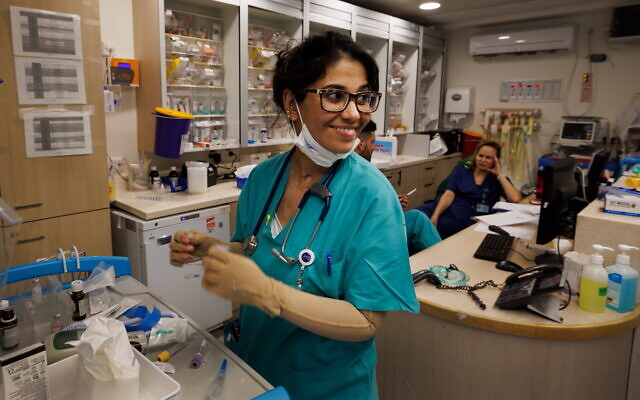
While Golan was meant to begin her residency at Soroka Hospital, the Sheba director general, Professor Itzik Kreiss, had other ideas, presenting Golan with a new stethoscope to replace hers which had been melted in the fire, as well as a Sheba employee card. It is possible that Golan is the first person to be a patient and a resident in the same hospital.
According to Sheba Medical Centre, the family were treated with an innovative product, NexoBrid, invented in Israel. Professor Josef Haik, director of the National Burns Centre at Sheba, said the family’s positive outcome is largely due to the immediate treatment at Sheba using NexoBrid.
“If we hadn’t used it, the Golans would have had lots of skin grafts, surgeries, a longer hospitalisation, and experienced more pain. By using NexoBrid we had to perform less debridements and saved tissue that otherwise we would have cut off,” Haik is quoted as saying on the American Friends of Sheba Medical Centre website.
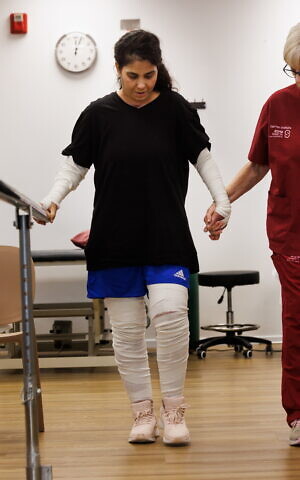
Golan described waking up, saying she had lost muscle and fat, couldn’t move her legs, couldn’t eat or drink. Slowly, she regained her strength, learned how to walk, eat and drink again. And thankfully, she regained enough strength to hold Yael. She regained enough strength to graduate from university with her medical degree.
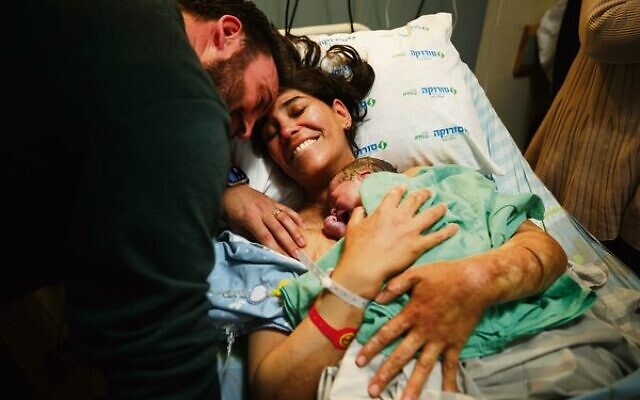
She also gained enough strength to bring new life into the world. She shared with the AJFN major event audience that one of her greatest wishes in life was to become a surrogate, helping to bring new life into the world. But due to her injuries she is no longer able to. She is considered high-risk, which is why her son Iftach, born seven months ago, is a miracle.
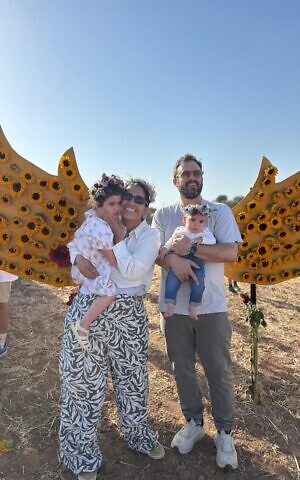
“Iftach is a ray of light in the darkness. Yael helped us to survive October 7, and Iftach reminds us how to keep on living,” Golan shared. “We survived because of Yael. We survived for Yael. She was our strength to survive against all odds. We’re alive today because of Yael, because we knew that we had to do whatever we could to ensure she had a future.”
During her impassioned speech to the AJFN audience, Golan also touched on why the Jewish nation has continued to survive, despite thousands of years of persecution.
And it’s her reasoning as to why they’ll never win against us.
“As Jews, we have learned that we must support one another in every way possible. Since we have been in Australia, we have seen that it’s not only been tough for Israel, but it has been difficult for you too. We now know being Jewish in Australia feels especially heavy. There’s so much darkness on social media, in the news, on the Harbour Bridge, outside art galleries and other venues. It all reminds us how fragile it is, how fragile our place in the world can be. But in this challenging time, we do what Jews have always done. We focus on bringing light.”
She also expressed a tinge of survivor’s guilt. Golan shared with The AJN that the family was just moments away from being captured, and she carries the guilt of not only being alive, but also being free.
She shares her story for those who were murdered and those who are still being held by Hamas, and she doesn’t take it for granted that she is alive.
But her ultimate message to the AJFN audience was that without a doubt, despite everything, we are one people, one community.
“The power of the Jewish community is that we still choose life,” she said. “They came to take life. We are here to bring more love and light into the world.”
Dr Ellay Hogeg Golan was in Australia for the AJFN major events, as the organisation looks to support 150 Jewish families who are facing fertility challenges. For more information about AJFN or to support, visit ajfn.org.au
comments