



Taking the Torah’s teachings to the bedroom
THE book, The Passionate Torah: Sex And Judaism, features 18 essays that tackle challenging topics within a religious framework.
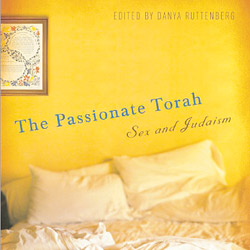 BOOK REVIEW: SHARON GIVONI
The Passionate Torah: Sex and Judaism. Edited by Danya Ruttenberg
THIS book strings together 18 essays by “intelligent thinkers” in the hope, states the editor Danya Ruttenberg, of finding “a new model of [Jewish religious] practice for the future”.
Why the need? According to the strong sentiment that comes through in the writings, the Torah needs to be re-interpreted to adapt to sexual needs of Jewish people in contemporary times.
Chapters explore “no-go” topics, such as Judaism’s approach to queer sexuality, female sexual empowerment, inter-religious coupling, prostitution and modesty.
Having said that, I don’t expect this book to stir up anywhere near the type of publicity that Rabbi Shmuley Boteach’s Kosher Sex (A Recipe for Passion and Intimacy) generated — having apparently been banned in some bookstores overseas or sold wrapped discreetly in brown paper.
That book, it seems, was more of a “how-to” book. While this book also attempts to tackle some challenging topics within a religious framework, it does so with an academic slant and post-modern emphasis.
While that in itself may put some people off, it is worth persisting with. For one, the daring foray into topics that are rarely discussed in the open may help disenfranchise Jewish single people, and gay and lesbian couples feeling that their partnerships are unrecognised.
Through an exploration of Judaism’s treatment of gender, dilemmas, and sociological issues arising out of the sources of Judaism, you can read about concepts such as halachic infertility.
Premarital abstinence -— the idea that nearly any non-marital sex can make a women a harlot -— is also considered.
Contradictions are also a looming theme and Ruttenberg considers hypocrisies that can arise out of the concept of modesty (“Tzniut”), which can be a malleable concept.
Women’s dress in Orthodox synagogues in Manhattan on a Friday night, she says, may very well reach past the knees and elbows but are “I-can’t-breathe-and-I-bet-you-can-see-every-single-curve-on-my-body skin-tight”.
Ultimately, Ruttenberg concludes that the ethic of modesty does have a place, but more in the same way as to refrain from showing off one’s money has a place. The focus, she says, should be on the person and not what they wear.
The counter argument might be revealing clothes should be forbidden as it is a temptation that men cannot be “expected to resist”.
She responds with S Bear Bergman’s comment: “We don’t camouflage a doughnut shop to protect dieters from the tempting sight of doughnuts.” The body and food are two different things, but the sentiment is clear.
Leaving aside the issues covered, I also enjoyed the historical perspective offered by the book. People often think that openness of sexuality is a modern-day issue. Therefore there is an obvious fascination with how these so-called modern-day issues were dealt with in a historical context.
The book is peppered with stories and tales from the biblical times. It is almost humorous to read how rabbis traditionally defined how often a man was required to have “conjugal relations” with his wife to fulfil his “sexual duties”.
We are introduced to technically couched terms such as “minimal frequencies”, prescribed by the Mishnah. Once in 30 days for Torah students, twice weekly for workmen and once a day for men of independent means.
Women whose husbands were sailors might have needed a little more patience for once in every six months.
While well researched, the strong opinions and, at times, strong feminist slant may not appeal to all. Rather than be portrayed as an earthy religion of the body, it tends towards Judaism as a patriarchal institution with some troubling perspectives.
comments