




A shock to the system
I’ll start with a personal confession and that is, I had in my life two panic attacks. The first one was when the United States assassinated Iranian General Qasem Soleimani, who commanded the IRGC’s Quds Force. At the time, I was in Germany in a mosque, surrounded by Hezbollah and IRGC members and the next 15 minutes of my life is blank.
The second one was on October 10, 2023, just three days after the massacres in southern Israel. I’d had a conversation with a Hamas leader, who I think was my best source in that terror organisation. I’d first met him 15 years ago. We’d had a good [working] relationship and we’d always speak in terms of symbols – it was never personal, ever. That is, until that phone call, when he was so happy – he was in euphoria. His first sentence was: “We figured out that you [Israelis] are a paper tiger and that we can smash you and destroy you.”
That was awful, shocking, because they [Hamas], for those days or months, had lost their barrier of fear of Israel – that deterrence.
I’m very pleased to tell you that two years after that particular conversation, Israel has rebuilt its name in the Middle East and I think its deterrence factor is even bigger.
Hamas, unfortunately, is still in the Gaza Strip, but I can’t see any situation in which, in the near future, it could rule Gaza again.
They think completely differently
I want to tell you about a book by a guy called Bassam Jarrar, who was a philosopher of Hamas, famous in the West Bank and Gaza Strip. I met him once.
In 1997, he was in an Israeli jail, when he finished writing it. The Arabic title can be translated to The Destruction of Israel in 2022. He believed that. Why? Because Allah said so – that’s what Jarrar wrote.
This book would have been thrown into the garbage bin of history, unless three very important people in Hamas in the Gaza Strip were sitting with him in the very same cell.
One of them was Yahya Sinwar, another Rawhi Mushtaha and the other Tawfiq abu Naim. Those three believed that he is a real prophet and that his book was a prophecy.
Okay, Jarrar was talking about the date June 2022 and the October 7 attack was a bit more than a year later than that. But this was the conception.
And I can tell you that, for years, I’d get dozens of phone calls from people in Gaza and they’d say the same story – that Hamas members are always asking us to prepare a suitcase, because at any moment, you could hear the gong, which would indicate that the “path towards Jerusalem” had opened.
You know, when you really try to understand how these people consider what is reality, you cannot! They think totally differently to us.
There are more examples. I met Ismail Haniyeh – who used to be the head of Hamas – once in the Gaza Strip and just after the interview, he started to interview me. I was flattered.
Earlier, I’d asked him, how is the end of the Israeli-Palestinian conflict going to be? And he told me that, at the end of the day, we’re going to conquer you.
He said it will take dozens of years, hundreds, maybe one thousand – the time it takes doesn’t matter. And then he asked me, where do you and your parents come from? I told him, proudly, that I was born in Israel, my parents too and my grandparents came from Iraq and Morocco.
Then he started laughing and said: “You’re going to go back there, as the Golden Age of the Jews was under the Islamic regime.”
Tunnels and timeframes
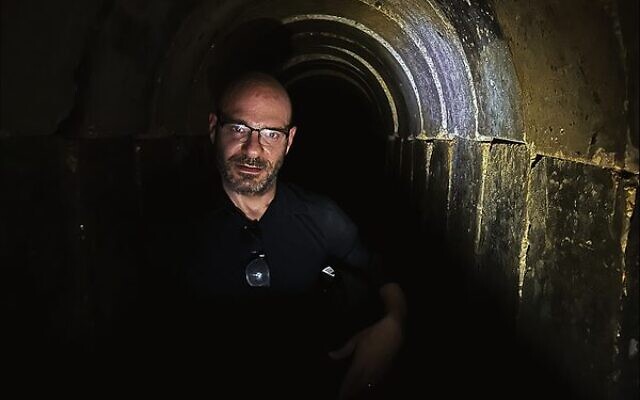
I took this footage in Gaza during the beginning of the war [He plays a short video, then continues]. In it, I’m entering the most famous of Hamas’s tunnels, more than 1km in length, under the Shifa Hospital. And believe me, each one of the people there knew about these tunnels.
And you could see command and control rooms, restrooms, kitchens – a whole different world. These tunnels are under all of Gaza – we’re talking about over 800km of them.
This is a project that only an organisation that considers time as eternity – and the conflict with Israel as from now until the end of days – could start doing. It shows us the way that Hamas considers the world.
What we’d believed in Israel before the war was that tunnels in Gaza are like trees and there was an idea that if you cut the trunk, the branches will die. But what they figured out now is you could find branches everywhere that have nothing to do with the trunk. Today, more than 50 per cent of the tunnels in Gaza remain and the IDF still don’t know where some of them are.
Hamas despised in Gaza
I think that today, the vast majority of people in Gaza are against Hamas. Hamas used to be popular – they were voted for in the election there in 2006. But I talk to a lot of Gazans every day and most say of Hamas: “You destroyed our lives and you brought the ‘new’ Nakhba – why the hell did you have to do it?”
Whoever is against Hamas in Gaza, though, does not mean that they are pro-
Israel. And this is very important to understand. You could hate Hamas and you could hate Israel.
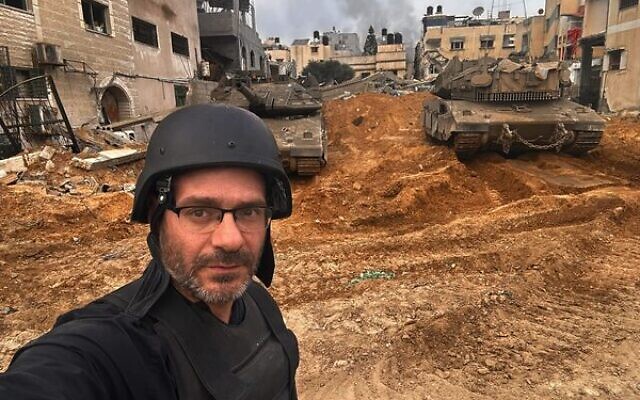
I want to show you a unique video, because this was the only time in the war that the IDF allowed a correspondent who is not Palestinian, to talk freely to Palestinians. It was in Jabalia refugee camp and I did dozens of interviews.
[He plays the video and another that he filmed more recently with Gazans]. As you could see, they were speaking against Hamas and these are genuine voices – they knew the risk of retribution if Hamas would find out. I think many spoke because they felt desperate.
You could hear criticisms from them, like: “We are sitting here with explosions going over our heads and meanwhile, Hamas guys are sitting in five-star hotels in Qatar, or here in Gaza in their tunnels, having a great life and stealing humanitarian aid, while we are suffering.”
A lost opportunity
Now, I must tell you that, one of the problems for the Israeli government during the war is that there has been no hasbara.
Yet for the last two years, there has been the best hasbara tool around ever – the two million people in the Gaza Strip.
Did anybody in Israel use these materials? No. And they could get it from anyone on the ground.
Meanwhile, it’s interesting that outside of Gaza – including here in Australia – there are people marching on the streets for Hamas. Not for the Palestinians, but for Hamas. They have no idea.
What could be next in Gaza?
What we are seeing in the Gaza Strip these days is competition – about who is going to enter into Gaza. Will it be the Turks and the Muslim Brotherhood and the Qataris? Or will it be the moderate Sunni world – Egypt, Saudi Arabia, the UAE and so on? And the latter want to do it only if Israel will allow the Palestinian Authority (PA) to enter there, but the Israeli government does not want to allow the PA.
So, this is the big question that hangs above everything.
Because, in a war, you can’t ever reach the last terrorist of Hamas. You need a diplomatic solution and that, as far as I and a lot of Israelis understand, should go through the PA.
Are the PA good? No. But are they better than Hamas? Much more. Is there anybody else who can deal with the situation in Gaza besides Israel or the PA? The truth is no. You will never see Egyptian, Saudi, or American soldiers entering into the Gaza Strip and fighting Hamas. Nobody is going to clean Gaza [from Hamas] for us.
Appreciation for UIA
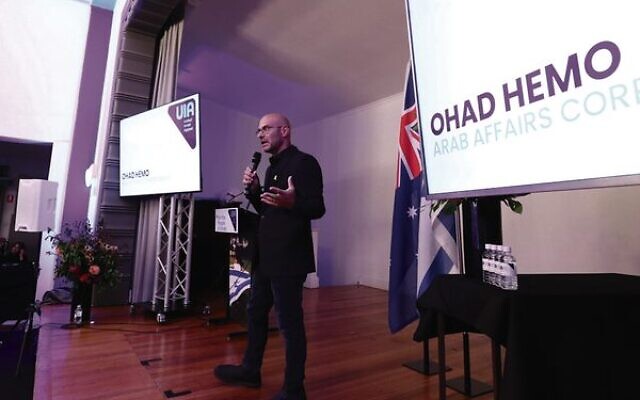
Thank you to UIA Australia for this opportunity to speak at these events in Australia and to everyone who came.
Whenever I’m heading through southern Israel to report from Gaza, I always feel the fingerprints of UIA’s great projects. So, as an Israeli, I’d just like to say, thank you very much.
comments