




There is a particular kind of magic that happens when you stand in Jerusalem’s Old City and look around. Within a few hundred metres you can find the remnants of a Herodian wall, a Crusader arch, an Ottoman gateway and a modernist Israeli government building, all jostling for space on the same limestone hill.
Israel might be one of the world’s newer official nations, but its built environment is among the oldest and most layered. To walk through it is to take an unplanned but utterly captivating tour through thousands of years of human ambition, faith, war and reinvention.
In the Beginning
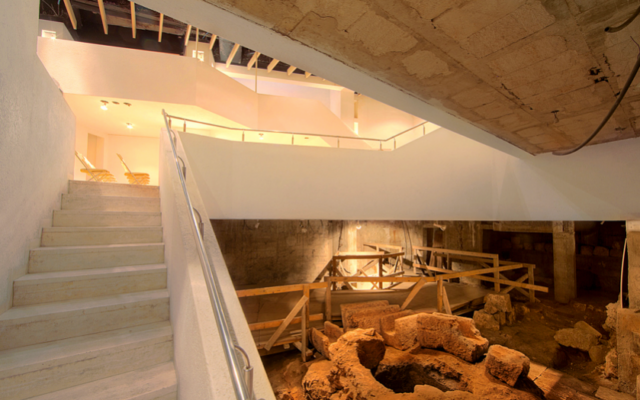
The oldest building in Jerusalem is something of a surprise. Known as the Siebenberg House and located in the Jewish Quarter of the Old City, it dates back roughly 3000 years, to the era of King David and the First Temple. Discovered beneath a private home, its underground ruins include ancient mikvaot, pottery and coins that speak directly to a Jewish life centred entirely around one structure: the Temple.
The First Temple, built by King Solomon, was a Canaanite-influenced sanctuary — a building of cedar wood, ivory and gold, grandly proportioned and laden with symbolic meaning. It didn’t survive. The Babylonians destroyed it. The Second Temple was initially a modest structure that was reimagined by King Herod, who transformed the Temple Mount into a vast Hellenistic-style pilgrimage complex of breathtaking scale. The Romans destroyed it.
What remains is the Kotel, the Western Wall, the most sacred site in Judaism to this day.
Looking across the region, ancient builders used two main materials, limestone and sun-dried mud brick. Limestone, specifically Jerusalem stone, gave the land its characteristic golden warmth. It’s something that still remains today, strong enough to last millennia yet soft enough to carve in the olden days by hand. It’s remarkable how much of this ancient stonework still stands.
Conquerors and builders
After the Roman destruction of Jerusalem in 70 CE, the land entered a new architectural chapter. It was a chapter not necessarily defined by Jewish builders but by imperial powers who each left their mark.
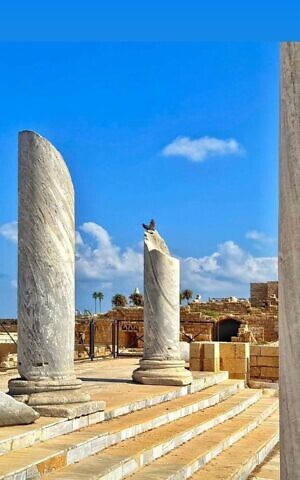
The Romans introduced columns, forums and aqueducts. Their engineering is still visible in the ruins of Caesarea, the Mediterranean port city ambitiously created by Herod, where an entire artificial harbour was constructed using hydraulic concrete, a technology not widely rediscovered until centuries later.
Israel’s architectural story is, in many ways, the story of the world itself. Every great civilisation that has touched this land has left something behind in brick and stone and tile and glass.
The Byzantine era brought the church-building tradition to Israel. Byzantine churches, with their rounded apses, mosaic floors, and light-catching domes, began appearing across the landscape. The most significant was the Church of the Holy Sepulchre in Jerusalem, originally built under Constantine and later rebuilt by the Crusaders in 1149. It remains to this day one of the most architecturally complex, and contested, buildings in the world.
Then came the Crusaders. The European knights who captured Jerusalem in 1099 brought with them the Romanesque and Gothic styles of Western Europe, building enormous fortresses on hilltops that were as much about intimidation as they were about defence. The city of Akko became a Crusader stronghold, and its labyrinthine old city, with its medieval khans and underground halls, still survives largely intact.
The Golden Dome and the Ottoman City
Of all the structures in Israel, the one that stops you in your tracks is the Dome of the Rock.
Built by the Umayyad Caliph Abd al-Malik on the Temple Mount, right atop the site of the destroyed Jewish temples, it is one of the oldest surviving works of Islamic architecture in the world.
Byzantine architects were reportedly commissioned for the project, and their influence is unmistakable. Inside, wall and ceiling mosaics cover every surface. In the 16th century, the Ottoman Sultan Suleiman the Magnificent added the breathtaking Persian tilework that still sheathes the exterior today.
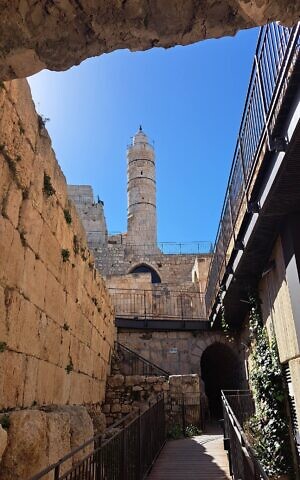
The Ottomans, who ruled the region from 1517 to 1917, reshaped cities in their own image. Suleiman rebuilt Jerusalem’s city walls, the ones still standing today, and dotted the landscape with mosques, hammams and khans. In Akko, the Al-Jazzar Mosque, built in 1781, is one of the finest examples of late Ottoman architecture in Israel.
Under Ottoman rule, Arab builders continued an ancient and pragmatic tradition: stone houses on hillsides with flat or domed roofs designed to manage heat, small windows to keep out the sun, and interior courtyards that created shade and privacy.
These buildings grew organically, without master plans, as communities expanded.
Eclectic styles and the first neighbourhoods
The modern story of Israeli architecture really begins in 1860, when the Jewish philanthropist Sir Moses Montefiore built Mishkenot Sha’ananim — “Tranquil Dwellings” — the first Jewish neighbourhood outside Jerusalem’s Old City walls. Its terraced rowhouses with red roof tiles, influenced by the Mediterranean, became a prototype for Jewish residential architecture across the region. In fact, the act of building outside the walls was itself a statement.

As waves of Jewish immigrants arrived in the late 19th and early 20th centuries, each community initially replicated the styles of their homelands — Eastern European shtetl buildings, German bourgeois townhouses, Yemenite courtyard homes. But something more interesting was also happening. Architects like Alexander Baerwald, who designed Haifa’s original Technion building, began experimenting with a fusion aesthetic — combining Western multi-storey concrete buildings with Byzantine domes, Moorish arches and Islamic tilework.
The YMCA building on King David Street in Jerusalem, designed by the same American firm responsible for New York’s Empire State Building, is a stunning example: a tower that is somehow simultaneously Art Deco, Byzantine and Islamic.
At the same time, the kibbutz movement was creating an entirely different built environment, deliberately designed in contrast to traditional Arab villages. They were rational, ordered, collective. Architecture as ideology.
Bauhaus arrives in Tel Aviv
If you want to understand how a political catastrophe can accidentally create a cultural treasure, look at Tel Aviv’s White City. In the 1930s, as the Nazi regime tightened its grip on Germany, Jewish architects who had trained at legendary German design school, the Bauhaus, arrived in British Mandate Palestine. They brought with them the Bauhaus gospel of modernism: flat roofs, clean white surfaces, ribbon windows, no ornament, form following function.
What they found was a city that had a 1925 urban master plan by Scottish planner Patrick Geddes, laying out wide boulevards and garden plots just waiting to be filled.
So, they filled it.
If you want to understand how a political catastrophe can accidentally create a cultural treasure, look at Tel Aviv’s White City.
Over the next decade and a half, more than 4000 buildings in the International Style went up across Tel Aviv. They adapted their European training to the local climate, designing deeper window recesses for shade, elevated ground floors for ventilation, pilotis (stilts) to allow breezes underneath. The result was a city unlike any other — a sun-bleached, white-walled urban landscape that UNESCO designated a World Heritage Site in 2003.
Tel Aviv’s cinemas are a perfect example of the changing architectural landscape. The Eden cinema of 1914 mixed European and Arab styles. The Mugrabi of 1930 was pure Art Deco. By the late 1930s, the Esther, Chen and Allenby theatres were gleaming Bauhaus showcases. The buildings were as much a declaration of a new Jewish identity as they were practical structures.
Architecture under pressure
The establishment of the State of Israel in 1948 brought with it an urgent, overwhelming challenge. The country would soon house hundreds of thousands of new immigrants arriving from Europe, North Africa and the Middle East in a very short time. Idealism gave way to pragmatism. Vast estates of concrete apartment blocks — brutalist in their bluntness, if not always in their formal architectural ambitions — went up across Israeli cities and development towns throughout the 1950s and 60s.
Most Israelis, to this day, loathe these buildings. They call them “egg boxes.” They are monotonous, poorly insulated and ageing badly.
Yet alongside the utilitarian blocks, something more ambitious was also taking shape. The leading architects of the early statehood era – Dov Karmi, Zeev Rechter and Arieh Sharon – were designing buildings of real distinction. Interior designer Dora Gad was commissioned to furnish the Knesset, the Israel Museum, and even El Al aircraft. The Supreme Court building in Jerusalem, completed in 1992 and designed by siblings Ram Karmi and Ada Karmi-Melamede after an international competition, is a genuinely masterful building, blending Jerusalem stone, natural light and symbolic spatial geometry that speaks eloquently of the country’s legal ideals.
Contemporary Israel
Modern Israel is, in architectural terms, a thoroughly global story. The skyline of Tel Aviv’s Ramat Gan district now bristles with glass and steel towers that would look equally at home in Dubai or Singapore. The Azrieli Sarona Tower is now the tallest building in the country, part of a mixed-use development that also encompasses a preserved historic German Templer colony — old limestone houses nestled surreally beneath the gleaming towers. Only in Israel.
There is also, encouragingly, a growing movement towards heritage conservation and sustainable design. Tel Aviv has invested significantly in restoring its White City Bauhaus buildings, many of which had been left to deteriorate for decades.

Jerusalem continues to enforce its famous stone-cladding law, which requires all new buildings to be faced in Jerusalem stone, ensuring the city retains its millennia-old visual coherence even as it grows and that Jerusalem stone endures.
It is the material thread that ties 3000 years of building together. Walk through the Old City, and you are quite literally walking on the same stone as King Solomon’s court, Saladin’s soldiers, Ottoman merchants and British Mandate officials.
A living museum
Israel’s architectural story is, in many ways, the story of the world itself. Every great civilisation that has touched this land has left something behind in brick and stone and tile and glass. They do not sit in neat chronological order, neatly separated in designated zones. But rather, they are jumbled together, layered on top of each other, repurposed and adapted and fought over across millennia. That is the chaos and the beauty of it.
It may not be a museum in the conventional sense, but Israel is indeed a museum. Rather than exhibits behind glass though, they are lived in, prayed in, argued over, and built upon. Moment by moment.
comments