



The courage to be sincere
Tchaikovsky's Eugene Onegin speaks powerfully to modern audiences, breaking down walls and showing how vulnerability can be a positive thing.
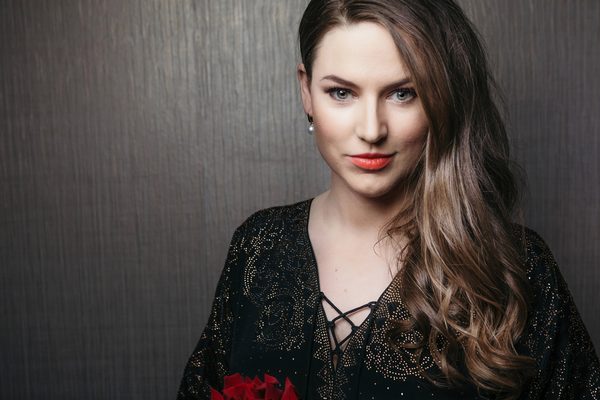
Australian soprano Eleanor Lyons has sung on some of the world’s finest stages, but when it comes to Tchaikovsky’s Eugene Onegin, her connection runs unusually deep.
Lyons, who studied at the Sydney Conservatorium of Music before training in Russia and the United Kingdom, has seen the opera performed at St Petersburg’s Mariinsky Theatre at least 20 times. Now she is bringing that intimacy to West Australian Opera’s production, playing the lead role of Tatyana.
It is a role she has long felt drawn to, and not only for the music.
“She doesn’t die at the end!” Lyons pointed out. “In so many operas the female character dies, so I guess that made her stand out immediately.”
But it is Tatyana’s emotional courage that truly captivates her.
“She is brave enough to reveal herself completely before she has any proof she will be loved in return by Onegin,” Lyons said. “What is difficult is keeping that openness alive without making her naive. She is young, but not foolish. She sees more than people give her credit for.”
Then there is the music itself. Tchaikovsky gives Tatyana the opera’s most celebrated passage, the ‘Letter Scene’, in which she pours out her feelings in a late-night letter to Onegin. Lyons described it as feeling Tatyana’s thoughts as they form in real time.
“It is not just a beautiful aria; it is a young woman discovering the force of her own heart. That is irresistible to sing,” she said.
Lyons believes the opera speaks powerfully to modern audiences, saying that people are often scared of sincerity but Onegin breaks down those walls.
“Detachment can look sophisticated. Irony can look intelligent. But Onegin shows the cost of that,” she said. “It asks what happens when we protect ourselves so well that we become unavailable to our own lives.”
The production, directed by Cameron Menzies and originally staged by Northern Ireland Opera in 2024, reframes the story through Tatyana’s eyes. An 86-year-old Tatyana, on her birthday, turns on a Walkman and listens back over her life.
“The fact that it is all happening inside the elderly Tatyana’s head heightens the emotions considerably,” Lyons said.
To unlock the character’s final scenes, Lyons turned to a Jewish teaching she holds close – moach shalit al halev, the mind rules over the heart. “I understand it less as domination and more as guidance: in moments of conflict, the mind must guide the heart,” she said.
“Her love for Onegin is real. She does not deny it, diminish it, or pretend it never existed. In fact, part of what makes the final scene so devastating is that her feelings are honoured. She tells the truth about them.
“But her mind, her conscience, and her moral clarity prevail. She chooses not to destroy her life, her husband’s life, and her own integrity for the sake of a feeling, however powerful. That is not coldness, but spiritual strength.”
Ultimately, Lyons hopes the opera leaves audiences thinking about the courage it takes to be sincere.
“The opera does not offer us an easy moral. It is not simply ‘follow your heart’ or ‘be sensible’. It is more painfully real than that,” she said. “It asks us to consider the moments when life opens a door, and whether we are brave or humble enough to walk through it.”
Baritone Samuel Dundas sings the title role alongside Paul O’Neill as Lensky, Ashlyn Tymms as Olga and Teddy Tahu Rhodes as Prince Gremin, with Christopher van Tuinen conducting the West Australian Symphony Orchestra. The opera is sung in Russian with English surtitles.
Eugene Onegin is at His Majesty’s Theatre August 6-15. For more information and tickets, visit waopera.asn.au/book/whats-on/eugene-onegin
comments