



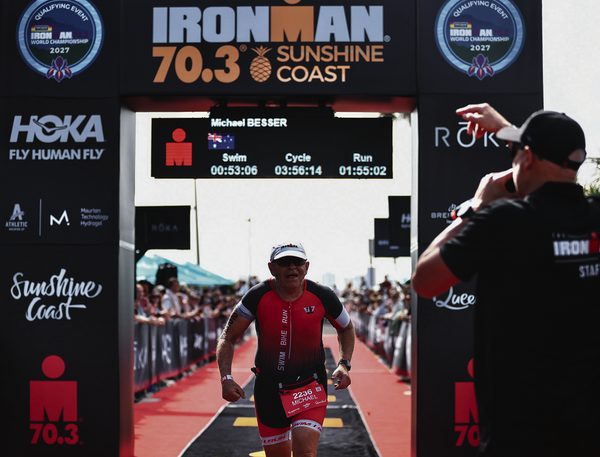
Four-time Maccabiah Games masters triathlete Professor Michael Besser, now 80, had made his peace with Ironman events.
The 2018 Ironman World Championship in Kona, Hawaii – where he had placed 30th in the men’s 70-74 age category – was meant to be his 10th and final competitive race.
For the last eight years, his eight time-trial and training bikes sat in storage and the last significant endurance event he had completed was a half marathon at the 2021 Great Barrier Reef Masters Games.
Then a friend’s diagnosis with a terminal illness – brain cancer – changed everything.
“It had been a long time since what was supposed to be my last Ironman race, but I’d still exercised regularly,” the retired neurosurgeon and chair of Brain Cancer Australia said.
“But what really got me going to do one more, now, was Professor Richard Scolyer.”
Besser first knew Scolyer in the 1990s, when the young pathologist trained at Royal Prince Alfred Hospital in Sydney, where Besser was head of neurosurgery.
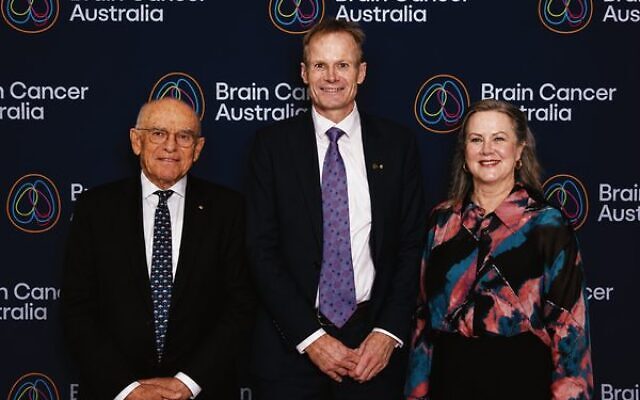
Scolyer became a world-leading melanoma pathologist, a keen triathlete and endurance sports enthusiast and the 2024 Australian of the Year.
When Scolyer was diagnosed with brain cancer in 2023, Besser thought that it was “so unfair”, especially after all he had done in his field of melanoma cancer research.
Despite that shattering diagnosis, Scolyer kept contributing to research. In fact, he chose to document becoming “patient zero” for a radical brain cancer treatment involving immunotherapy before surgery – an approach borrowed from melanoma treatment.
It extended his life by many months beyond his initial prognosis.
Scolyer supported Brain Cancer Australia at functions and in his writings and he also kept up cycling when he felt well enough.
In March, just months before he died, Scolyer rode 500km in four days through his home state of Tasmania in the 2026 Tour de Cure, which raised more than $46,000 for cancer research projects – a feat Besser remains in awe of.
Throughout all this, Scolyer and Besser became closer than ever.
“Richard knew he was dying at some stage and I’d spoken to him a few weeks before what was obviously coming and it was then that I’d said to him that I would do this year’s Sunshine Coast Ironman 70.3 for him and raise money for brain cancer research in the process,” Besser recalls. “I felt an obligation to.”
Scolyer, a married father of three, died on June 7 this year, aged 59 and was given a state funeral at the Sydney Opera House.
But Scolyer was not the only person Besser carried to the start line in his heart and mind.
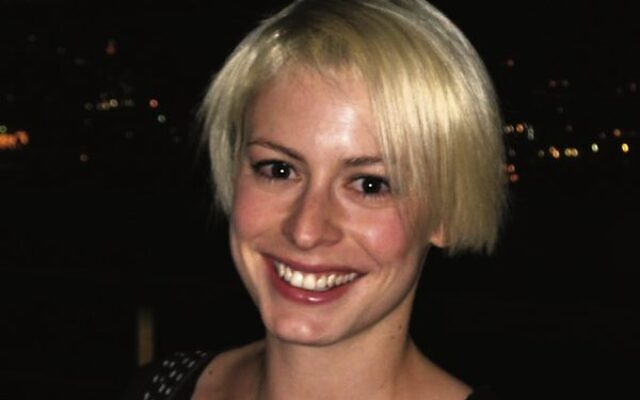
There was also the daughter of Brain Cancer Australia’s founder Robyn Leonard, Lucie Leonard, who died from brain cancer in 2012, aged 34.
“As a neurosurgeon, you try not to get too close to your patients, but Lucie was very charismatic and you couldn’t help it,” Besser said. “So, her death was quite a blow”.
And there was also, as always, extra motivation inspired by the memory of Besser’s Holocaust surviving parents.
“They lost everything they could have lost, but they didn’t lose their ability to love,” Besser said.
“The fact that they survived and had me is a bit of a miracle in itself.
“To honour them has really been my driving force throughout my life and it’s something I think about every day.”
Getting to the start line at 80
Three months of solid yet carefully paced training by Besser followed Scolyer’s death.
“I knew the biggest risk for me was not getting to the start line, because at my age, with that amount of training, I was at a higher risk of sustaining an injury,” he explained.
“So I had to build up my training very slowly.”
He recruited his old coach, Julie Tedde, and added Pilates to his training routine for the first time plus plenty of stretching and a weekly massage.
As a result, his only pre-race injury happened after busting a toe on the base of his sofa when he and wife Anne first moved in to their Mooloolaba apartment, which they now live half of each year in.
“That was quite painful, but the pain of that took away the pain of all the other things that were hurting!”
On race day, he faced a 1.9km swim, a 90km ride and a 21.1km [half marathon] run, with a strictly enforced official eight-hour cut-off time, as it was a world championship qualifying event.
When he last competed in the event, in 2018 as a warm-up for the worlds, he’d crossed the finish line in just six hours and 37 minutes to win silver in his age division.
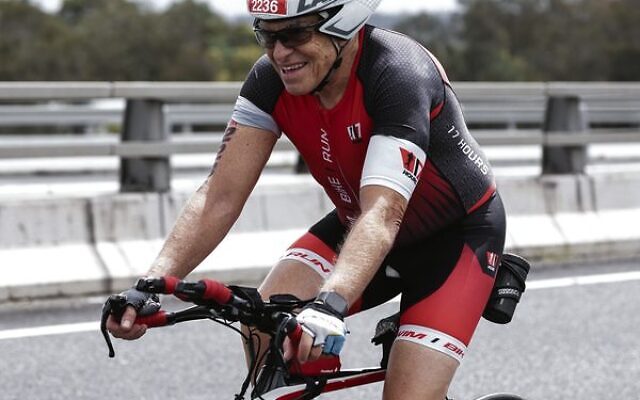
The opening swim leg went badly.
“I sort of got dumped at the beach when getting out and got a cramp in my quadriceps, so the transition took me 11 minutes instead of about five.”
Fortunately, things did improve for him on his favourite leg – the cycling.
It turned out to be his best, even when losing a couple of minutes when taking a wrong turn near the end.
He began the run leg well too, but a race official pulled him aside with 9km to go, when estimating he’d finish about 10 minutes beyond eight hours, which would result in a “did not finish” in the official results.
“I can usually make up some time in the second half of an endurance run, as I’m just built that way, but he wouldn’t give me an inch!” Besser said.
Anne was watching on at that moment and when she quizzed the official about it, he told her not to worry, as there was another Ironman he could enter in just a few months.
“You can imagine Anne’s response to that!” Besser quipped.
While he copped the dreaded “DNF” status, the official let Besser continue to run, at his own pace, to the finish line and still earn a finisher’s medallion – which Besser is grateful for.
And when he did get his moment to run down the finishing chute, he received an overwhelming reception.
“Maybe it was because it is so unusual to see an 80-year-old finish that race,” Besser said.
“But whatever it was, everybody stood up and clapped, which was so nice.
“I even got a huge hug from the race commentator, Pete Murray, right after I’d finished. He really pumped the crowd up, so I sort of got another standing ovation!
“I’m still disappointed at not officially finishing, but that’s the rules.”
What he is proudest of is raising $26,000 for Brain Cancer Australia.
“At no point did I expect that,” he said.
“I thought to myself, well, if I get $5000 or $10,000 raised, I’d be lucky – but everybody was so supportive. And yes, I’m also proud that I did the race, but geez it was hard.
“While I felt quite okay at the finish, the day afterwards I felt like I’d been hit by a bus! Absolutely no more races for me. I’m glad I did it, but it’s now on my bucket list of things never to do again.”
Reflecting on 25 years of triathlon
Besser was a late bloomer when it came to triathlon, but he certainly made up for lost time in the multi-discipline endurance sport.
Anne had taken up triathlon in the late 1990s, initially with Maccabi and qualified for her first world championships in 2000 and his job at that point was tagging along to carry her bike.
Then, at age 54, he decided to enter one of the Maccabi NSW Cycle and Tri Club’s monthly triathlons on a 1956 Speedwell track bike he’d kept from his teenage years, that had no brakes or gears.
“That was the start of it for me, with Maccabi,” Besser said.
He went on to compete in triathlon at four Maccabiah Games in Israel between 2005 and 2017, winning bronze at one and became the first Australian to compete in the “Maccabi Man” endurance series and the oldest finisher.
Anne also competed at three Maccabiah Games, in triathlon and swimming – winning a silver in the 400m freestyle – and they both won golds at the 2007 Pan-American Maccabi Games.
Still in triathlon, he qualified for his first of several world championships in 2004.
Anne is still a top masters swimmer – most recently competing at the 2026 Queensland State Championships.
“Through it all, Anne has been such an incredible support and I can never thank her enough.”
The next phase of his athletic journey came when he tried a few half Ironman events and then dreamed of completing a full one.
He achieved that when he was 65 and although he ended up in the medical tent, he was “hooked”.
After completing a few more, he “figured out how to do it” and podium placings followed, including silver in the 2017 Busselton Ironman 70.3 in the 70-74 men’s group.
That’s what earned him a Kona slot the following year – such an iconic event in which to supposedly bid farewell to competing forever.
“Kona was brutal, but it was an amazing experience.”
Reflecting on it all, Besser modestly said, “I think that I’ve presented myself well and I hope I’ve sort of helped the Jewish community as well.
“It’s been an interesting journey and as I said before, I dedicate everything to my parents.”
Investment the key to unlocking a cure
In 2001, Besser was appointed a Member of the Order of Australia for services to neurosurgery.
And after more than 30 years as a neurosurgeon, he retired from clinical work in 2008.
He clearly recalls the turning point being the death of his friend Chris O’Brien, founder of Lifehouse at Prince Alfred Hospital, 2.5 years after he had operated on him.
“It was just so disheartening to see brain cancer not having the advances in treatment that occurred in other cancers. People get dependent on their family and community and they die very quickly. Brain cancer kills more children than any other cancer and it is the biggest killer of people under 40.
“As soon as that diagnosis is made, you know they are going to die and there’s still no cure. It’s just terrible and has such an impact on entire families.”
After retiring, Besser studied medical ethics and the philosophy of science and began teaching neuroanatomy at the University of Sydney, where he is a clinical professor.
Then Robyn Leonard called him to say, “We have to do something about it … the problem is not enough tissue samples and not enough science.”
Besser agreed and became Brain Cancer Australia’s chair, two years after Leonard founded it.
The organisation began with biobanking – collecting tumour samples for research laboratories.
A recent $6 million government grant supports three platforms: biobanking, a clinical quality registry and supplying organoids, which are miniature cancers grown in a petri dish to test new treatments.
Brain Cancer Australia also funds a national integrated scientists group of more than 100 clinicians, pathologists and researchers.
Elsewhere, Besser laments, the field tends to be “siloed, which really annoys me, because we should all be one big group cooperating together to achieve a breakthrough”.
So what will it take to find a brain cancer cure?
“Unless you have the laboratories, the research scientists and the money to properly fund the basic research it, it’s never going to change,” Besser said.
“I’ve often said to people, if the biggest philanthropists in the world gave one billion dollars, we’d have a cure for brain cancer in about five years – I’m absolutely convinced of that.
“Each brain cancer cell is different in every person, so individualised medical treatment for specific types of glioblastoma is going to be the answer and it’s going to be found through genetic profiling.
“We’re on the cusp of a revolution in brain cancer – we just need the investment.”
To help Michael Besser reach his new fundraising target of $30,000, visit braincanceraustralia.org.au/fundraisers/michaelbesser415/ironman-for-brain-cancer
comments