




Jerusalem photographer Sharon Gabay has spent 15 years walking the city’s streets with a small, old Fujifilm camera that has a crack in its body. The result is Jerusalemites, his sixth book, which gathers about 300 photographs of the people he has met along the way.
Gabay was born in Jerusalem and grew up in Nachlaot. His family has lived in the city for 15 generations.
“My grandfather was born there and spoke Arabic, and when I was five I was already walking with him through the Old City,” he told The AJN.
He studied psychology and worked in management, sales and marketing until he was 38. In 2011, he turned to photography and taught himself. Today he photographs portraits of public figures, politicians and business leaders in his studio, and spends one day each week on the streets of Jerusalem.
Asked what draws him to the medium, Gabay answered without hesitation.
“The truth in it,” he said. “On the street I never stage anything. I am a viewer. I come, I see, I take the picture, and the moment stays exactly as it was. The camera does not decide for you and does not make things prettier. It shows what was there.”
He takes the same approach into the studio, telling The AJN that even with politicians and CEOs, he uses the same tools that he employs outside on the road to encourage expressions and body language that isn’t posed.
That commitment shapes the way he works. Photos aren’t staged so in the back of his mind, Gabay knows that a missed moment can never be recovered.
“I never stage a photograph, so a moment I miss is gone for good. That is why it took an archive of more than one and a half million frames to make a book of about 300 photographs,” he said. “It doesn’t frighten anyone, and most people never notice me.”
The beautiful thing is that some of his subjects sometimes later find themselves in his work and get in touch. Gabay said he always sends them a copy of the photograph.
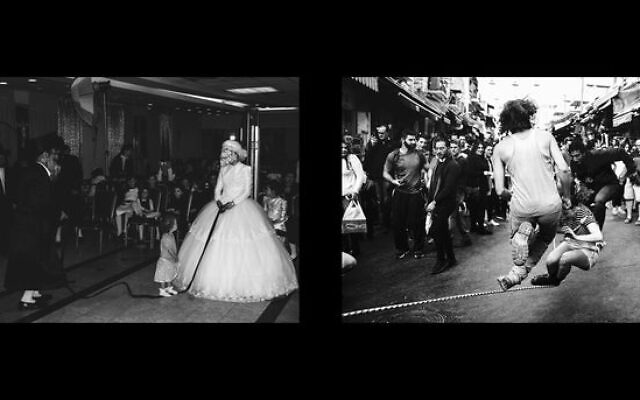
Jerusalemites follows five earlier books. Gabay said the decision to make it came after October 11, 2023, when he went into Kfar Aza with ZAKA teams to document what had happened there.
“My earlier books showed the Jerusalem everyone knows, its stones and its monuments. This one is about its people. The decision came at a dark time,” he said. “Afterwards, for a long time, I could not pick up my camera. In that period I decided to make this book.”
In terms of the editing process, Gabay described it as slow and solitary.
“I went through the archive frame by frame, day after day, with my cat next to me, and into the shelter when the missiles came. From one and a half million frames to 2000, and from 2000 to about 300,” he said. “It is not a collection of pictures. It is one story from beginning to end, and every photograph connects to the one before it and the one after it. Making the book is what brought me back to the streets.”
The book’s design follows its own logic. Every photograph is set against a black background, and the short text accompanying the images appears in Hebrew, English and Arabic.
It’s a conscious choice by Gabay.
“In Jerusalem the only light is the people, and that is why the background of every photograph in the book is black,” Gabay said.
Photographs of strangers are paired side by side, without names. “The story is in the pairing. The rest I leave to the viewer,” he said.
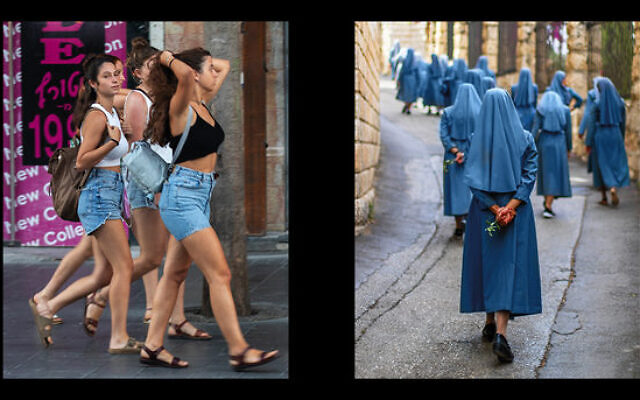
After 15 years of photographing Jerusalem, Gabay said the city, which he believes never repeats itself, still surprises him.
“There is always something new. And these are my people. When I walk through the market, the Old City or Mea Shearim, I am not a visitor. I grew up with these people and I know them,” he said.
Yet for all his history with the city, what stands out to him most, he said, is Jerusalem’s mix of communities.
“Jews, Muslims and Christians, all the tribes, in the same streets every day. Beauty and pain live right next to each other,” Gabay said, while also addressing how Jerusalem is seen from abroad.
“We live together. The people of this city live side by side 99 per cent of the time, and it works. What the world sees in the news is the other one per cent. Jerusalem is not an apartheid city. Everyone lives here,” he said.
He said politicians from across the Israeli political spectrum visit his studio, and that he shows each of them the book.
“Not one of them has told me it takes a side. Yes, we have been at war for three years, but Jerusalem is still vibrating.”
In September, Jerusalemites was selected through an anonymous open call for the PhotoBook Exhibition at the Indian Photo Festival in Hyderabad. Gabay said the jury did not see his name or country.
He said that a few hours after the festival published its list, with “Sharon Gabay / Israel” printed on it, his name was removed. According to Gabay, the festival has said the decision had nothing to do with the work.
“A book that sees everyone in Jerusalem was taken down because of the passport of the man who made it,” he said.
Gabay has published an account of the episode on his website, including a timeline and his correspondence with the festival. According to the account, the selection was announced on September 18, his name was missing from the public list by the afternoon, and the festival cancelled the selection by email that evening, Israel time.
The cancellation email, as published by Gabay, said the decision was separate from the artistic evaluation of his work. In a written response on September 22, the festival said concerns were raised after the announcement by people outside the jury process. In a public statement on September 19, the festival said its open call uses an anonymous selection process.
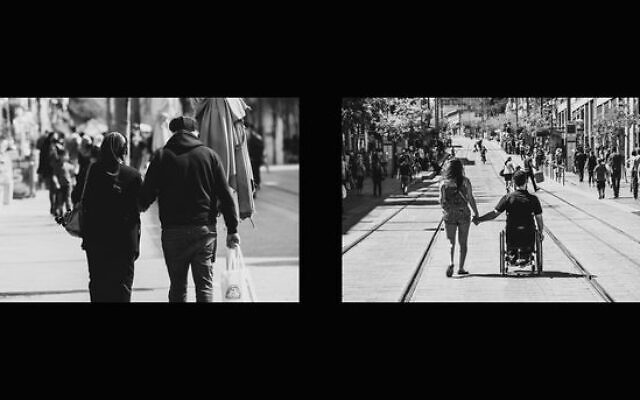
Gabay still spends one day each week on the streets of Jerusalem, in the market, the Old City and Mea Shearim. It is the same Old City he first walked as a five-year-old, holding his grandfather’s hand.
The city has now been at war for three years, he said, and Jerusalemites was made in the middle of it.
“Yes, we have been at war for three years, but Jerusalem is still vibrating,” Gabay said.
“Jerusalem is a hope that if you let people just live, they can live together.”
For more information, visit sharongabay.com
comments