



First responder’s empathy
Bondi terror attack first responder Alexandra (Lexi) Edmondson told the summit that helping the wounded at Bondi gave her her first real understanding of the fear Jewish Australians live with.
“As soon as I went and helped someone, I felt a target on my back,” Edmondson said on a panel titled When Tragedy Strikes, the Courage to Respond.
“I understood the fear. And you don’t get to escape that fear. Your value system is something that all Australians should be taught in school … You’re the strongest and most resilient bunch of people that I’ve met.”
Edmondson recalled walking to a Christmas party at the Bondi surf club with her colleague and now partner Jimmy McIntosh when the shooting began. Once it stopped, the pair went out to help the wounded.
“I was very fortunate and privileged to have just finished my life saving course, my bronze medallion,” she said. “I remember the whole time during my course, my trainer talking about how you don’t rise to an occasion, but you fall back on your training and that’s exactly what happened.”
After the panel, Edmondson presented ZAKA, the Israeli volunteer search, rescue and recovery organisation, with the inaugural Jerusalem Post Award for Courage, Compassion and Human Dignity, accepted by ZAKA CEO Dubi Weissenstern.
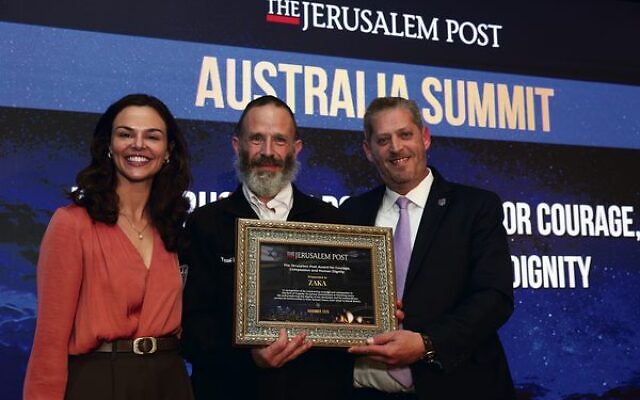
Representatives from ZAKA travelled to Sydney immediately after the Bondi terror attack to help preserve the dignity of remains of the deceased in accordance with Jewish law.
“Your organisation is an incredible way to look after lives that have been lost, to treat them with dignity that they deserve and their families with care and compassion,” Edmonson said. “It’s not just a service; it’s a true act of humanity.”
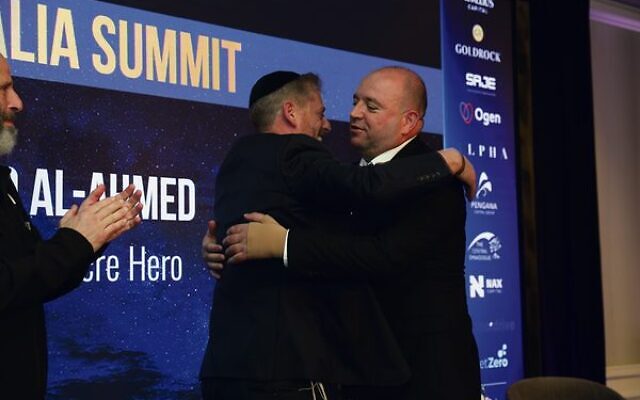
ZAKA’s Yossi Landau, who shared the panel, is a survivor of the September 11 attacks in New York, where he spent seven hours under the rubble. He said that experience drove his commitment to ensuring “every human being gets the full dignity” they deserve.
The summit also recognised Ahmed al-Ahmed, who was shot multiple times after wrestling a weapon from one of the gunmen. He received a standing ovation.
“On behalf of the Jewish people … we want to say thank you for your courage, for your humanity,” summit organiser Maayan Hoffman said.
97 per cent spike in threats
Australian businessman and philanthropist Steven Lowy told how his family recorded more than 15,000 online attacks in a year, with threats spiking after he gave evidence to the Royal Commission on Antisemitism and Social Cohesion.
Delivering the opening keynote, Lowy said that in the month after his June appearance before the commission, there was “a 97 per cent spike in the volume of online attacks as well as real-world threats”.
“Antisemitism is not a distant, abstract issue for me … it is personal and it is that close,” said Lowy, whose grandfather was murdered at Auschwitz-Birkenau.
He said relations between the Australian and Israeli governments were “cooler than they have been for decades, maybe ever” and that it was “shocking” that in 2026, Australian Jews were contemplating “the same decision, to stay or to go”.
“No Australian Jew should ever have to pass a political test about Israel to participate fully in Australian life,” he said.
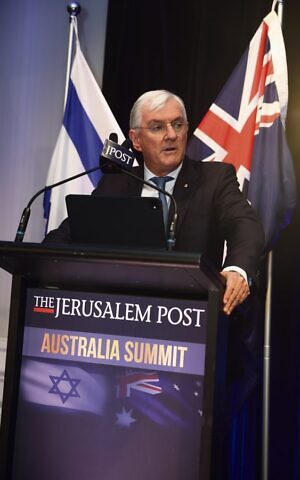
Later in the morning, outgoing Zionist Federation of Australia president Jeremy Leibler credited the government with “very significant security funding”, anti-doxxing laws and the Royal Commission, but said it had failed to see the link between street incitement after October 7 and the attacks that followed.
Looking ahead to the Royal Commission’s report in December, Leibler said: “The implementation of the recommendations and dealing with this issue of antisemitism is and should be the responsibility of Australia. It is not the Jewish community’s responsibility … It is not a problem we’ve created.”
University of Sydney chancellor David Thodey, interviewed earlier in the program by The Jerusalem Post’s Maayan Hoffman, said he shared Lowy’s concerns.
“I worry about Australia. This is not what we stand for. We’re about inclusion. We are not about antisemitism,” he said. “Australia has always been about a fair go, about people coming together and making a difference and that’s what we’re going to get back to and especially to the Jewish people who are giving so much to this country.”
Asked where the line lay between legitimate protest and intimidation on campus, Thodey said the university “will not stand for antisemitism and any hate speech on campus”.
“We’ve got a lot to do, because it’s not going away. Unfortunately, it’s been a lot of policy settings about protests, about encampments, but we are trying to move to the positive, which is about talking about civility, educating our educators about what antisemitism really is, because people don’t understand where that division is between freedom of speech and academic freedom and where it moves into hate speech and bigotry.”
Zionism is for builders
Zionism is “the attitude of people who have come to build”, former Knesset member Einat Wilf told the summit, urging supporters to draw a clear line between “builders and destroyers”.
Speaking on a panel titled The Eighth Front, Wilf said the task of winning over the next generation began with that distinction.
“Zionism is compelling, Zionism is the ideology, is the attitude of people who have come to build, people who have seen a malarial land and say we can make something of this … people who, in the face of trauma and difficulties, create, build, innovate.
“Zionism is ultimately the attitude of people who look at the adversity of life and say, I’ll deal with it. I’ll assume responsibility. I’ll make something of it.”
Its opposite, she said, was the ideology of “whiners” – “people who, as they look at life, all they can do is blame others for their failures”.
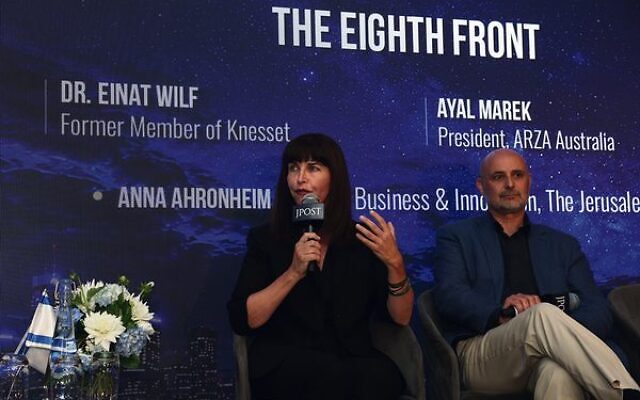
“People whose attitude to life is to blame everyone else will always go for antizionism as a way to explain why everyone is responsible but them,” she said. “We need to appeal in every culture – Arabs and Muslims and Western culture and everywhere – to those people whose human attitude to life is to build, to create and that’s Zionism.”
Asked how to confront antizionism now that it had entered the mainstream, Wilf said Jews needed to respond in two parallel ways. The first was to “prepare for some extreme possibilities”, because Jews had historically suffered from “a timing problem”.
“By the time that the rest of the world wakes up to the disaster that the ideological insanity is, Jews have often suffered the brunt of the damage,” she said. “This is a time to take care of our own in whichever way you see fit.”
The second was to find and equip non-Jewish allies.
“Everywhere that antizionism rose to become an institutionalised ideology, Jews were gone,” she said, citing the Arab world, Iran, the Soviet Union and Eastern Europe.
“We need non-Jews to realise that antizionism, like antisemitism before it, is the ideology of failed and failing societies.”
Fellow panellist Ayal Marek, president of ARZA Australia, said the pro-Israel community was “playing defence … on a field that was determined by others”.
“We have to move from defending to defining, from being reactive to setting the narrative,” he said.
“What we’re lacking, in my opinion and research confirms that, is strategy and coordination.”
He said Zionism should be defined affirmatively as the right of the Jewish people, “as the indigenous people”, to sovereignty in their ancestral land. “If everybody else is entitled to it, why do you exclude us specifically?” he said. “If they deny it, the burden is on them.”
From Hormuz to Taiwan
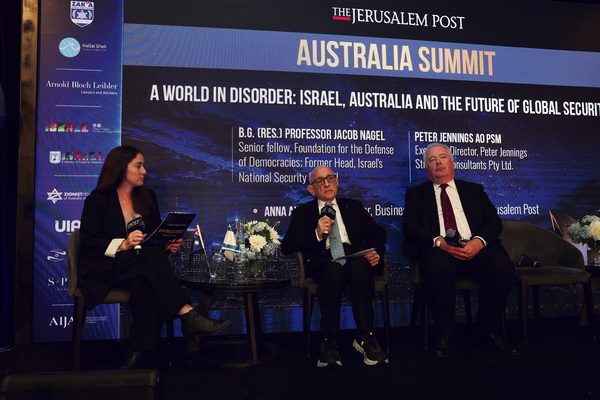
Iran’s regime may launch a pre-emptive strike rather than face collapse under sustained economic pressure, former head of Israel’s National Security Council Brigadier General (Res.) Professor Jacob Nagel said.
Speaking on a panel titled A World in Disorder: Israel, Australia and the Future of Global Security, Nagel described Iran as “the source for almost every evil and terror support in the world” and said its stated aim of annihilating Israel had to be believed.
Despite heavy blows to its nuclear program, missile arsenal, air defences and scientists, Nagel said Iran still held about a third of its missiles. He outlined three scenarios, putting percentages on each.
The first, which he called “the most disturbing”, was a return to negotiations, which he put at a 10 to 15 per cent chance. “If you go with the Iranians to a room to negotiate, you are going to lose anyway,” he said.
The second, which he rated the most likely at 60 per cent, was a pre-emptive strike. He said the regime understood that a situation of “no war and no agreement” would bring about its collapse and might attack American interests in the Gulf first.
“Israel will probably join a war like this,” he said. “We will join if we will be attacked directly, or if the United States will ask us to join.”
The third was that sustained economic pressure from the Trump administration could drive Iranians back onto the streets within six to nine months.
Looking further ahead, Nagel said future wars would be shaped by AI, robotics, hypersonic missiles and swarms of cheap, mass-produced drones, but insisted that “there will be man in the loop” for life-and-death decisions.
Nagel said the world was watching Iran’s leverage over the straits of Hormuz and Bab el-Mandeb closely, drawing a link to Asia. “We have Malacca, we have Taiwan, we have different straits. Everyone understands the importance of those straits to the world economy.”
Turning to the Indo-Pacific and following Nagel’s lead in putting odds on the future, former Australian Strategic Policy Institute executive director Peter Jennings said there was “probably a 50-50 chance that China is going to contemplate military operations against Taiwan sometime between 2027 and 2028”, likely beginning with a blockade.
He said Beijing saw a closing window of opportunity, as China faced demographic and economic pressures while Japan and Taiwan strengthened their militaries. “Inevitably that will draw in Australia,” he said.
“Australia is not a country which is thinking strategically about these issues. We don’t have a national security adviser. We don’t have a national security plan.”
Jennings said he agreed with former US National Security Agency director Admiral Michael Rogers, who in an address earlier in the morning warned that growing digital dependency left societies exposed and that bad actors were applying artificial intelligence more aggressively than defenders.
Rogers, who advised on Australia’s 2023 cyber security strategy, described sitting in a Tel Aviv restaurant when a rocket alert sounded. Diners calmly moved to the centre of the building and returned to their meals seven minutes later. “I’ve never seen a society so resilient,” he said. Jennings said Australia was “not a particularly resilient society, not compared to Israel” and that only about 1 per cent of defence investment was going into autonomous systems and AI.
“We could learn a lot from Israel in terms of our ability to think more laterally and more quickly and I deeply regret the fact that our government is not minded to do that right now.”
Confronting antisemitism
Four panellists from universities, the military, the arts and local government shared first-hand accounts of the past three years, in a segment moderated by Joel Burnie of the Australia-Israel and Jewish Affairs Council (AIJAC).
Professor Catharine Lumby of the University of Sydney, who is not Jewish, said she had watched campus encampments that echoed those at American Ivy League universities, with “the same chants”.
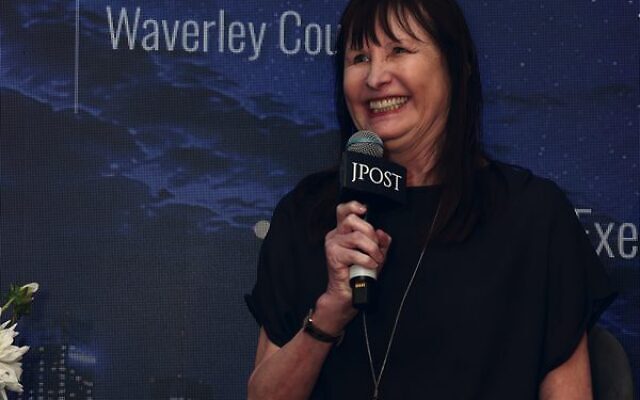
Soon after October 7, she saw a young woman wearing a Star of David sobbing on a bench at night and comforted her. Lumby also photographed, in a central on campus pedestrian underpass known as the “graffiti tunnel”, a scrawled message that called for the university to be “Jew free” and said Jewish colleagues had told her stories of trauma, including one who took 11 months’ stress leave.
Lumby said she began writing newspaper columns about it “because we know what happens when non-Jewish people do not stand by the Jewish community”.
Her call to action focused on social media as a priority, where algorithms are “driving us down information rabbit holes”, with AI “turbocharging it”.
Colonel Michael Scott, a 32-year Australian Army veteran who lived in Jerusalem from 2019 to 2021 when serving as a UN peacekeeper in the Middle East, spoke candidly about courage.
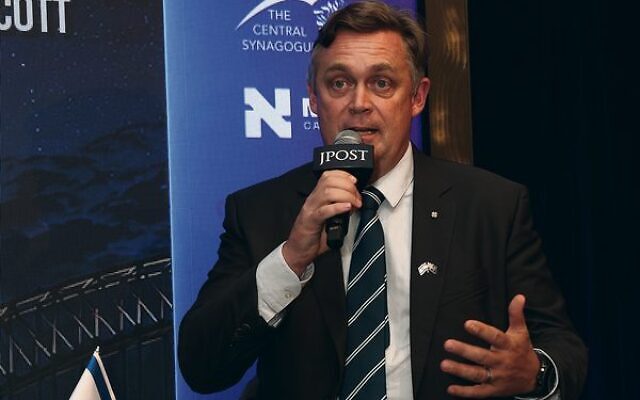
“None of us are naturally courageous, including this 32-year veteran,” the 2023 Foundation founder, who is also not Jewish, said.
But he asks himself whether something he is too frightened to do today will be any easier for his children in 10 years, as “the trend line is pointing the wrong way”.
He urged the audience to see the issue as a national one. “Antisemitism is not a Jewish problem – it’s an Australian problem.”
He pledged: “I am with you in good times and in bad – as long as it takes until we win.”
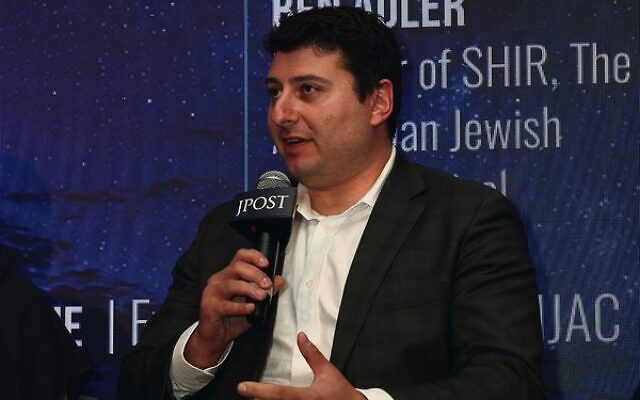
Ben Adler, director of the Australian Jewish Music Festival SHIR, described a career in which being publicly Jewish and especially Zionist, has long been risky.
When the festival took its concert to Melbourne Town Hall last year, he said it faced a torrent of online abuse and threats. The venue withdrew eight days before the event.
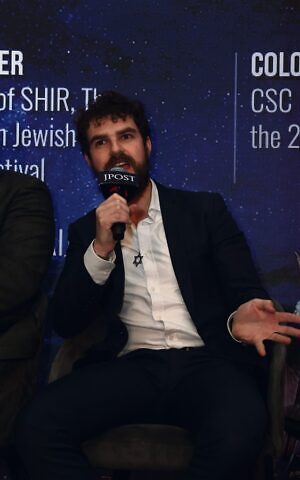
A smaller venue was found and the concert went ahead, but Adler said the episode showed how easily bullies can pressure otherwise neutral institutions and that he has watched senior leaders “cower”. He argued that Jews are most targeted and discriminated against by antizionism and that the community must name the problem each time.
“We can’t fix a problem if we can’t name it.”
His own response is simple: “I keep playing music everywhere and I’m not going to stop.”
Councillor Will Nemesh, the immediate past mayor of Waverley, described “the unravelling of social cohesion and social harmony”.
He said governments at every level had failed to stand up in word and action, allowing hatred to become normalised.
Antisemitism, he added, “spread like wildfire” after October 7, 2023, and Waverley endured “a summer of terror” of firebombings and assaults, culminating in the Bondi Beach Chanukah massacre.
Nemesh quoted NSW Premier Chris Minns’s remark a few days after the attack that the community had refused to let darkness consume it and had been a light to others.
“We need to see more of that,” Nemesh said.
Choosing what is right
Australian journalist and broadcaster Erin Molan opened with a family moment, introducing her young daughter to the audience, saying how she was “very relevant” to why she was speaking about the topic of courage and finding your voice.
Molan described courage as something she learned by watching her late father, a major general in the Australian Army and later a senator.
“He told me from a very young age that even when it’s difficult, you must do what is right.”
Molan recalled first learning about the Holocaust in year three and what had appalled her most was that “so many bystanders stood by”.
She never imagined that would be repeated, she said, until she saw people celebrating the October 7 massacre outside the Sydney Opera House and the silence that followed.
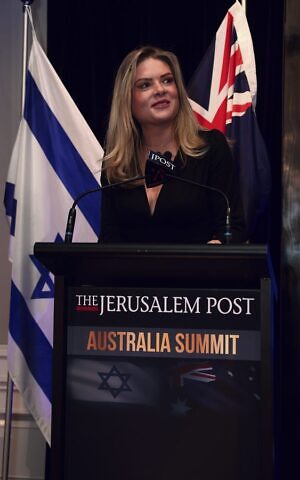
“If you had said to me, ‘Your country will remain silent in the aftermath of it,’ I would have said no chance. But they did!”
Being non-Jewish, Molan said the attention often falls on what she has lost for speaking out about antisemitism and antizionism, but she said it was “never a choice to speak up”, but rather a conviction and a necessity.
“It is good versus evil.”
She rejected the idea that this is only a Jewish or Israeli problem.
“When they [terrorists] drive a car into a crowd, they are not checking whether you’re wearing a cross or a star.”
And if her daughter, or anyone’s children, are unsafe, she added, “no one is”.
Molan acknowledged that “standing on the right side of history can be very lonely”, but what she had gained was “tenfold”.
She praised the Jewish community as “the most resilient, incredible people” and the political class “has failed us miserably”.
Molan’s proudest moment since October 7, she said, was not meeting presidents or prime ministers, but the little things, giving an example of an email she received from a 60-year-old Western Australian miner who had watched one of her videos.
“My morals and my values have not changed, but the side I now realise they align with has” was that man’s message.
Her message to the audience was that change can “start with one conversation”.
Winning the online battle
Zach Sage Fox began by acknowledging in the audience Michael Britvan, father of 10-year-old Matilda, who was murdered in the Bondi terror attack and said how it impacted him deeply and the Jewish Diaspora around the world “felt what you guys felt”.
Fox and his business partner first met at Jewish day school at age six and went on as adults to build a production company that made content for Disney, Amazon, Hulu and HBO.
After October 7, he said they applied those entertainment industry skills to the information war, because “we were just not going to be Jews with trembling knees”.
Working with Jewish organisations, they recorded around 10 billion views and impressions during the Gaza-Israel conflict.
Fox, who studied political communications at UPenn cited recent Pew Research findings that 90 per cent of young people’s social media use is for entertainment, while 76 per cent of their news and education comes from those platforms.
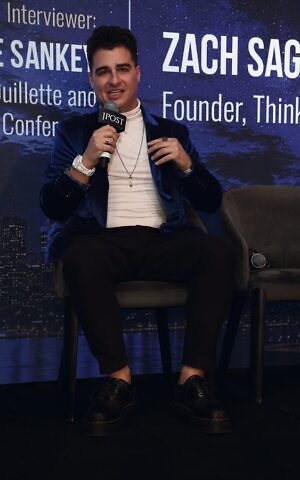
Think Again – a nonprofit launched six months ago with a budget of about $4.5 million – now draws 50 million views a month and about 80 per cent of its audience is non-Jewish.
His team’s data suggests entertaining content is not only shared more widely, but helps people absorb new information.
Fox said his favourite piece of content was his filmed visit to the West Bank, where he almost ended up kidnapped on camera. He said he spent five hours there and reported finding no one he spoke to wanted peace.
He argued this showed that education was the key issue.
“I don’t know how we go and fix the education system in the West Bank and in Gaza, but nothing is going to change until that happens.”
He closed on a more hopeful note.
“There are way less young people that are actually hateful people than there are people who are being misinformed.
“We just have to make the truth go viral online.”
- Features
- News
- Jerusalem Post Australia Summit
- Bondi terror attack
- Lexi Edmondson
- Ahmed Al Ahmed
- ZAKA
- Steven Lowy
- Royal Commission on Antisemitism and Social Cohesion
- Jeremy Leibler
- Campus Antisemitism
- Einat Wilf
- Zionism
- Erin Molan
- Ben Adler
- SHIR
- Zach Sage Fox
- Online antisemitism
- Australia-Israel relations
- Iran
- Taiwan
- global security
comments