



The last battle over East Jerusalem
In following the story of the building of Har Homa, which broke ground in 1998 and gradually continues to be developed today, the US government's modern policies towards Jewish construction in East Jerusalem can continue to be tracked and analysed.
By Ahron Shapiro
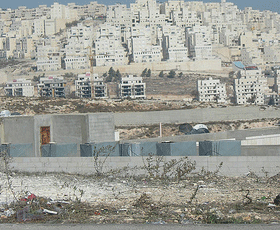
IN November 1998, during Binyamin Netanyahu’s first term as prime minister, Israel went ahead with the construction of the Jewish neighbourhood of Har Homa in East Jerusalem, situated between Kibbutz Ramat Rahel and Bethlehem.
The Oslo Accords were already several years old and there had been further agreements between the Israelis and the Palestinians that had moved forward during this period – most recently the Wye Memorandum that was ratified by Netanyahu and Palestinian Authority President Yasser Arafat on October 23, 1998.
The Palestinians objected strenuously to the building of Har Homa. In March, 1997, the Clinton Administration had used its veto power on two different United Nations resolutions to defend Israel regarding construction at Har Homa. The US was the only country of the 15 members on the council to vote against the resolutions.
On November 12, 1998, in a press conference, a State Department spokesman under the Clinton Administration, James Rubin, toed the line that typified the longstanding US understandings on Jerusalem.
Allow me to quote at length directly from the transcript of that press conference.
QUESTION: Given Netanyahu’s decision to continue construction in East Jerusalem, what type of action, if any, is the Clinton Administration taking to, I guess, pressure putting on the Israelis to continue with the peace accords?
Rubin prefaced his comments with a short discussion about the encouraging news about the recently signed Wye Agreements and then addressed East Jerusalem construction as follows:
MR. RUBIN: With respect to your specific questions about Har Homa, let me say that we have said it before in March, and I will say it clearly again: we are against this decision; it would have been better if it had not been taken. For permanent status negotiations to succeed, we need to create a climate of trust and confidence between the parties. This step hurts that process and it will make it more difficult for us to negotiate than it would have been already, which was quite challenging.
That said, it’s essential that we move ahead and accelerate permanent status negotiations so that the parties can begin to deal with the core issues.QUESTION: Has the State Department determined yet where Har Homa is, because it makes a big legal difference, as you know.
Here, this is interesting, because both Rubin and the journalist posing the question are working off the initial assumption that Har Homa is in East Jerusalem. What the journalist is asking is whether the US had determined Har Homa to be outside of Jerusalem’s boundaries and therefore a West Bank settlement not covered by US-Israel understandings.
MR. RUBIN: Right. I’m not talking about this from a legal standpoint. What I’m saying is that we think that this step hurts the climate and the environment in which negotiations need to proceed; and we will obviously be working diplomatically to minimise that effect. But with respect to the legal question, I’d have to get a legal response which I don’t have available.
Rubin avoids the ultimate question of both location and legitimacy and instead repeatedly falls back upon on the much softer criticism that the timing of the construction is unhelpful for advancing the peace process.
THE United States has traditionally refrained from describing Jerusalem neighbourhoods as settlements, but the Bush Administration’s Secretary of State Condoleezza Rice was critical of building tenders in Har Homa announced after the Annapolis summit.
“The United States doesn’t make a distinction” between settlement activity in East Jerusalem and the West Bank, Rice told The Jerusalem Post in January, 2008.
In spite of Rice’s comments, no moves were taken by the Bush Administration against Israel over Har Homa or any Jewish construction in East Jerusalem and President George W Bush was widely considered to be sympathetic to Israel’s position on Jerusalem.
Last week’s statement by State Department Spokesperson Ian Kelly that regarding the relevance of the settlement freeze to Jerusalem, that “we’re talking about all settlement activity, yes, in the area across the [1949 Armistice] line” does therefore not in itself represent new territory for US policy.
Indeed, the State Department’s subsequent back-pedalling on the issue may well be a sign that nothing has changed. The answer will not be known conclusively until US policy is tested on the subject in a direct and unambiguous fashion.
comments