



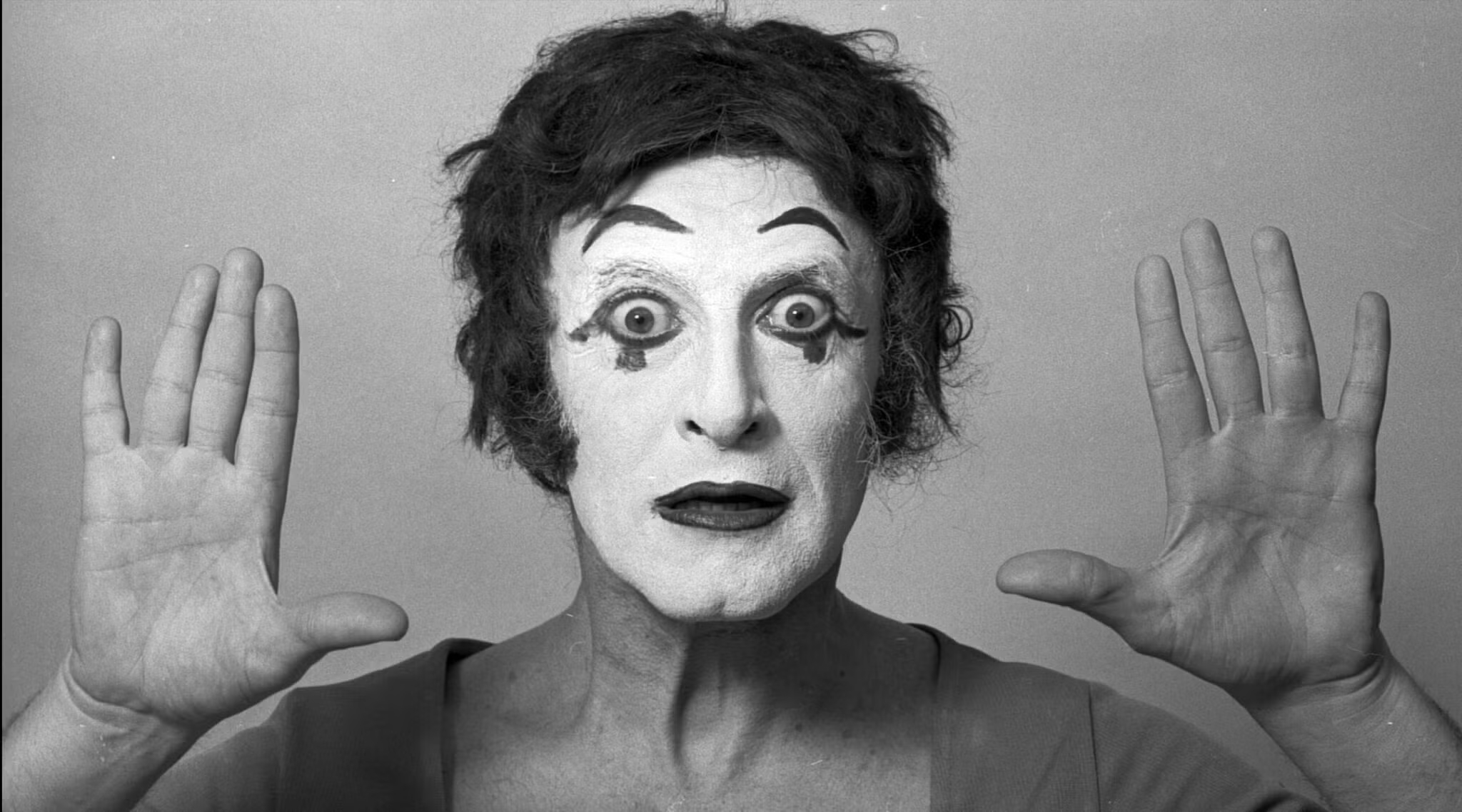
Most people know Marcel Marceau as the white-faced mime in the striped top and battered hat, the man who could make a crowd of thousands hold their breath without uttering a single word.
What far fewer know is that long before Marceau became the world’s most celebrated mime, he was a young Jewish man in Nazi-occupied France using silence as a weapon, and saving hundreds of children’s lives in the process.
Audiences across the globe were transfixed by his character Bip the Clown, but few of them knew how his artistry with mime evolved during World War II as a member of the French Resistance. It’s a story that deserves to be told far more widely, and thanks to a new children’s picture book, a new generation is about to discover it.
Marceau was born Marcel Mangel in Strasbourg on March 22, 1923. When it seemed likely the Nazis might invade France, his family relocated to Limoges, in west-central France. As a Jewish teenager, he had to hide from the Germans, or else he would be sent to a camp where he would most likely die.
He didn’t hide for long.
Alain Mangel, Marcel’s brother, had already joined the Resistance when his cousin Georges Loinger recruited Marcel. The brothers adopted the surname Marceau, in honour of General François Séverin Marceau Desgraviers, who fought in the French Revolution. It was a name that, unlike Mangel, was not identifiably Jewish, and therefore helped their Resistance work. Initially, the younger Marceau used his artistic skills as a forger, creating new identities and altering documents for Resistance members and others as needed.
But his most remarkable contribution was still to come.
Marcel and Alain joined a special group dedicated to saving Jews in hiding throughout France by smuggling them out of the country. This work involved making contact with Jews in hiding, mostly children whose parents had been shipped off to the camps in the hope that their children would survive. Once in contact, they forged passports and other documents necessary to travel throughout and then out of France.
It was during these missions that mime stopped being an art form and became something altogether more urgent.
Documentary filmmaker Philippe Mora, son of a resistance fighter who worked alongside Marceau, explained that Marceau began miming to keep children quiet as they were escaping.
“It had nothing to do with show business,” Mora said. “He was miming for his life.”
He disguised himself as a Scout leader to lead younger children over the border to safety, keeping them calm with dancing, singing, and stories told in mime. The crossings were fraught with danger. On one occasion, as Marceau and a group of children neared the French border and attempted to cross into the Swiss Alps, their presence was detected by German soldiers. It was nighttime. Partly hidden by dense trees, Marceau pretended he was the commander of a French battalion and barked orders at the Germans to lay down their arms. The bluff succeeded, and the Germans retreated. The group crossed into Switzerland unhindered.
His father, Charles, was not so fortunate. Marcel’s parents were arrested and his father ended up being murdered at Auschwitz.
After the war, Marceau performed for the first time as a mime in front of an audience for 3000 American troops. The career of one of the 20th century’s greatest performers had properly begun, born, in no small part, from the work of keeping terrified children quiet in the dark.
Now, that story is being told to children themselves.
The Not So Quiet Life of Marcel Marceau, written by Jenn Bailey and Sherry Bushue and illustrated by Pamela Zagarenski, was published earlier this year. It tells how Marcel was drawn to the flickering images of Charlie Chaplin in the movies as a child, and had a gift for imitating the birds around him, the people, and even the wind, before his safe, creative childhood was shattered by the advent of World War II and the antisemitic laws that targeted his Jewish family.
The book traces his flight from Strasbourg deeper into France, his time at art school, and the moment his artistic talents turned to forging identity cards for the Resistance. From there it follows him leading groups of Jewish orphans to safety in Switzerland, miming along the way to entertain his young charges, and builds to the liberation of France and his career-launching post-war performance.
Zagarenski’s surrealistic illustrations, painted on wooden panels with crisp lines and pale swatches of colour, balance seriousness and whimsy. Her Chagall-like images carry symbolic weight throughout, including a Star of David, lions and butterflies, and the scene where Marcel becomes “Marceau” is rendered as a Cubist portrait depicting him as half youth, half sad clown.
Marceau himself was always somewhat humble about what he’d done.
He went on to become one of the most acclaimed performers in the world, giving voice, through silence, to what it means to be human. But long before the white face paint and the battered hat, there was a young man in the dark, keeping children calm and quiet with nothing but his hands and his courage.
That’s the real story.
comments