



The Plough and the Rifle: A Eulogy for the Frontier
Moshe Dayan told mourners at a young man’s grave that quiet is not peace. Seventy years on, Nahal Oz was attacked again and the warning returned
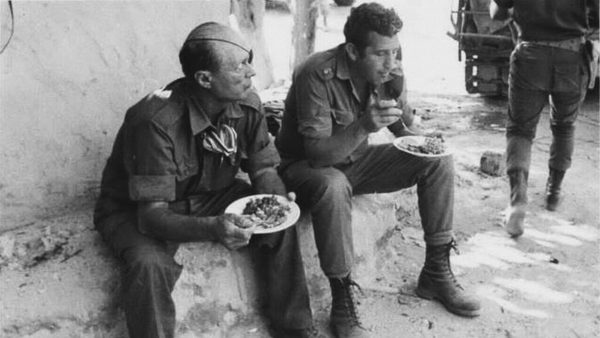
There are speeches that explain a moment. There are others that outlive the moment and become part of a civilisation’s inner vocabulary. Moshe Dayan’s 1956 eulogy for Roi Rotberg belongs in the second category. It was short, severe, unsentimental and unforgettable. It did not console in the ordinary sense. It did not soothe the mourners with easy promises. It did not offer the illusion that grief could be made bearable by rhetoric. Instead, Dayan stood at the grave of a young Israeli killed near Gaza and told the living something much harder: if they wished to build, plant, plough, marry, raise children and live as a sovereign people in their ancestral homeland, they would have to look reality in the face.
Moshe Dayan was one of the defining figures of Israel’s founding generation. Born in 1915 in what was then Ottoman Palestine, he grew up in the world of Jewish agricultural settlement, frontier defence and national revival. He served in the Haganah, fought with British forces in the Second World War, lost an eye in combat in Syria, and later became one of the most recognisable military leaders in the modern world. By 1956, he was Chief of Staff of the Israel Defence Forces: austere, brilliant, controversial, and deeply shaped by the conviction that Jewish sovereignty could only survive if idealism was joined to hard realism. When Dayan spoke at Roi Rotberg’s funeral, therefore, he was not speaking as a detached commentator. He spoke as a soldier of the Jewish return, a commander of a young state, and a man who understood that the dream of normal life in Israel would have to be defended by abnormal vigilance.
Roi Rotberg was twenty-one years old. He was the security officer of Kibbutz Nahal Oz, a frontier community near the Gaza Strip. On 29 April 1956, he was ambushed near the kibbutz fields, killed, and his body was taken into Gaza before being returned with United Nations assistance. Dayan delivered the eulogy at his funeral. The speech later became one of the most famous and influential texts in Israeli history.
The reason the eulogy endures is not only that it was eloquent. It endures because it was morally and strategically adult. Dayan did not merely condemn the murderers. He did something more difficult. He forced Israelis to confront the condition into which they had been born: a generation required to be farmers and soldiers, builders and sentinels, dreamers and realists. That tension remains at the heart of Israel’s story. It is also why the eulogy continues to speak to those trying to understand Israel after 7 October 2023.
I came to this eulogy more deliberately after recently hearing the renowned Israeli historian, author, and former Israeli Ambassador to the United States, Dr Michael Oren, draw attention to it. Oren is not merely a commentator offering a passing opinion on Israel’s present crisis. He is one of Israel’s most respected historians of war and diplomacy, and the author of Six Days of War, one of the most important modern studies of the 1967 war. When Oren argues that Dayan’s words should be read again after the events of 7 October 2023, he is placing the eulogy within the longer arc of Israel’s strategic history. His observation prompted my own self-directed research: first into Dayan’s eulogy itself, then into Roi Rotberg as a young man, and finally into the frontier context of Nahal Oz, Gaza, and Israel’s earliest years of sovereignty. What emerged was not merely a historical episode, but a text of continuing strategic and moral force. Oren’s point is not that history repeats mechanically. It is that certain warnings, once dismissed as harsh or outdated, can return with terrible force. In his reading, Dayan’s words seem not merely relevant, but prophetic.
comments