



The protesters are not the problem
'What the demonstrators primarily demonstrate is their continued commitment to the country.'
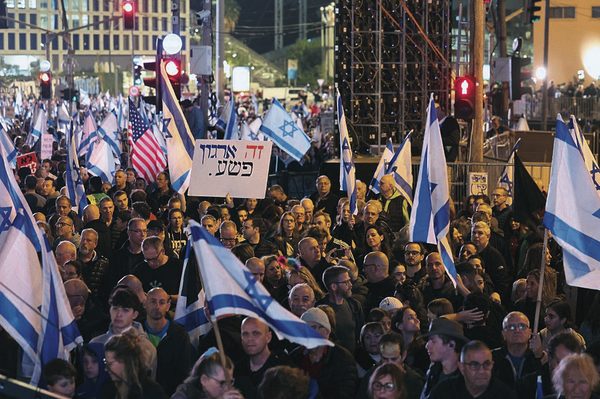
In his article in The AJN on May 12, Eyal Reuveni set out to discredit the mass protests against the Israeli government’s judicial overhaul plan.
He accused the protesters of inventing a bogus threat to democracy in a campaign to defend their interests as a privileged class “mostly of the top decile in the Israeli secular sector”. How he knows what is in the minds, and bank accounts, of hundreds of thousands of people is not clear. At any rate, impugning your opponents’ motives rather than addressing their arguments has its perils.
One of them is summed up by the Hebrew saying (of Talmudic origin) “haposel bemumo posel”, which roughly translates as “we condemn others for our own flaws”. Benjamin Netanyahu wants a “Get Out of Jail Free” card; the settler movement wants to expropriate Palestinian-owned land; the Charedim want exemption from military service; government ministers want looser restraints and to appoint cronies to plum jobs. The Supreme Court obstructs, or is liable to obstruct, these things, so the Supreme Court has to be neutered. What unites the governing coalition on this issue is not devotion to constitutional principle, but a convergence of personal and sectoral interests.
Another peril is that you underestimate your opponent. Recent opinion polls have found that a majority of Israelis oppose the government’s planned changes to the legal system. Opinion polls are not elections, we know, but these polls at least indicate that the protesters against the changes do not represent a narrow faction. They evince passionate patriotism and deep concern. Characterising them as merely self-interested is not just a mistake, but an affront.
As for the reality of the threat: Minister of Justice Yariv Levin has himself said that his original proposals have no place in a democracy. And indeed they don’t, as they would in effect give the prime minister – who dominates the government, which in turn dominates the Knesset – the ability to appoint and dismiss the members of the only body in Israel that currently acts as a check on executive power and protects individual rights, namely the Supreme Court. But people can only react to what they see, not to what Levin might possibly do in the end. If they are perturbed by the prospect of their country’s bulwark against arbitrary, corrupt and inequitable government becoming weaker, losing independence, and being manned on the basis of political conformity rather than professional competence, that is more than sufficient justification for them to take to the streets.
The court’s status in this respect has been enhanced by Israel’s Basic Laws, chiefly by the Basic Law: Human Dignity and Liberty, which the Knesset passed in 1992, under a Likud government. Section 8 of that law states: “There shall be no violation of rights under this Basic Law except by a law befitting the values of the State of Israel, enacted for a proper purpose, and to an extent no greater than is required.” The Supreme Court duly began, on rare occasions, to strike down laws that it found would violate human dignity and liberty disproportionately. The court’s approach has its critics, but Reuveni’s statement that, 30 years ago, “the Supreme Court … granted itself nearly unlimited power over the parliament and the government together”, insinuating that it has acted in a self-aggrandising way with no basis at all in law, is a distortion. Israeli democracy has evolved to give expression to the idea that the power of the state should be counterbalanced by justice. What the Knesset gave, the Knesset can take away, but Israelis are entitled to try to persuade it not to turn back the clock.
A third peril of defaming your opponents is that you become impervious to criticism, blaming them instead of yourself when things go wrong. In this context, it is worth mentioning that when rating agency Moody’s recently downgraded Israel’s credit rating outlook, largely because it saw the judicial overhaul making Israel a less desirable investment destination, it actually cited the protests against the government’s moves as a point in the country’s favour, a sign of democratic health. The point, though, is that Reuveni can’t have it both ways. If he asserts, as he does, the duly elected government’s right to govern, he must also acknowledge the government’s responsibility for the consequences of its actions. And the consequences, for Israel’s economy, political culture and international standing, do not look good.
It is not the demonstrators and those warning that the reform laws “are leading Israel to an economic, social and security disaster” who are “the ones causing damage to Israel”. What the demonstrators primarily demonstrate is their continued commitment to the country. The damage is liable to come from government policies that persuade talented and productive people to despair, and quietly leave.
David Gillis was a Melbourne resident in the early 1990s. For the past 29 years he has lived in Israel, where he works in journalism and engages in research in medieval Jewish thought.
comments