



Every record has been destroyed or falsified, every book rewritten, every picture has been repainted, every statue and street building has been renamed, every date has been altered. And the process is continuing day by day and minute by minute. History has stopped. Nothing exists except an endless present in which the Party is always right.”
George Orwell’s vision of totalitarian censorship in 1984 depicted a Ministry of Truth that systematically erased people from history, airbrushing dissidents from photographs and expunging their names from records.
The chilling effectiveness of this strategy lay not just in silencing voices, but in making it appear as though those voices had never existed at all.
Here and now, segments of the Australian Jewish community find themselves engaged in a similar process of erasure. But this time, we are wielding the airbrush ourselves.
Across the country, Jewish Australians are systematically removing their names from articles, declining media coverage, scrubbing their digital footprints, and paying companies to erase evidence of their Jewish identity from the internet.
Some of us are doing the Ministry of Truth’s work for it.
The irony is as bitter as it is tragic.
Shane Desiatnik has been sports editor at The Australian Jewish News long enough to remember when covering Jewish athletic achievement was uncomplicated celebration.
An impressive performance on the field, a community member making a state team, a young athlete headed to national championships – these were stories that inspired pride and connection.
“Prior to October 7, there wasn’t really a need to check whether athletes were okay with coverage,” Sydney based Desiatnik explains.
“It never came up as an issue.”
Since the October 7 attacks and the subsequent surge in global antisemitism, everything has changed.
Now, before publishing even routine sports coverage, Desiatnik must navigate a delicate process of permissions, not just for minors but for adult athletes as well.
The question is no longer whether someone achieved something noteworthy, but whether they can afford to have their Jewish identity connected to their name in searchable digital space.
“I’ve had at least a dozen instances since October 7 of individual Jewish sportspeople – from adults in professional sport, to a debut Olympian teenager, to parents of junior athletes competing at national championships – request that they not be covered in any AJN sport reports,” he says.
The requests come from athletes who once took pride in being featured.
One athlete who previously welcomed the recognition now feels they cannot risk it.
Professional athletes competing overseas worry that publicly known Jewish identity could make them targets in certain parts of the world.
Parents of junior athletes make the calculation that celebrating their child’s achievement isn’t worth the potential consequences.
Desiatnik complies with every request, though each one stings.
“It feels sad,” he admits. “Both on a personal level not being able to cover their achievements and let the Jewish community know and be inspired by them, but also to have them missing from the official ‘Jewish record’ in sport, so to speak.”
A professional woman active in the Jewish community – who spoke to The AJN on condition of anonymity, which itself speaks volumes – recently made an agonising decision.
She requested that her name be removed from a feature article about a program bringing Israelis to Australia.
She also asked a major Jewish organisation to delete her name from a public list of volunteer award winners.
“I’m a proud Jewish Zionist woman,” she says, the contradiction evident in her voice.
“But I don’t want to have the association, because I feel like the associations are impacting work, and I just can’t let that happen, because I need parnasa [livelihood].”
Her decision came partly from conversations with a Jewish therapist who recently moved from London to Melbourne.
Despite London’s large Muslim population and visible Arabic signage, the therapist reported experiencing more overt antisemitism in Melbourne – casual comments from colleagues about not wanting to live near Jewish areas, about moving families away from Jewish neighbourhoods.
The woman’s voice breaks when discussing what her choice means.
“In terms of legacy of children and grandchildren, we’re whitewashing our own history. We don’t even need the antisemitic and anti-Zionist world to do it for us.”
She said we’re actually doing it ourselves.
“It makes me sad. It feels like my wings are being clipped.”
She personally knows three people who have paid companies specialising in digital footprint removal – individuals in high-level corporate, legal and government positions who have decided their Jewish visibility is professionally untenable.
Another anonymous woman who runs an organisation that sends Diaspora Jews to perform support work on IDF bases found that advertising in The AJN triggered consequences she never anticipated.
“Little did I know that even if it went into the Jewish News … I think unfortunately Jewish people take the information out and pass it on to other people that might think it’s worthwhile investigating,” she says.
The advertisement unleashed a torrent of abuse.
Her phone number, published in the ad, became a conduit for harassment. Callers accused her of supporting “baby killers”. The number proliferated across social media, attracting people who rang simply to be a nuisance.
She involved the Community Security Group and police but found little recourse as the threats targeted her cause rather than her personally, creating a legal grey area.
She blocked the number, redirected it to a message bank, and waited for the storm to pass.
It did, eventually. But her organisation no longer advertises in The AJN.
“What’s the use of putting an ad in if you don’t have your company name or you don’t talk about what you do?” she asks.
Now the organisation relies on word of mouth and carefully manages its social media presence – without phone numbers.
Gareth Narunsky, editor-in-chief of The Australian Jewish News, has developed an unwelcome routine.
“At least once a week, we’ll get an email to the letters inbox saying, ‘I was in a story, can you please take it down?'”
The stories vary in age – sometimes a year old, sometimes five years, occasionally a decade.
The reasons are consistent – a new job, an industry where Jewish association might be problematic, careers in which a mere presence in a Jewish publication could present obstacles.
Most poignantly, there have been cases of proactive refusal.
A high-profile Jewish athlete recently declined an interview request.
“They told us, ‘Thank you, but no thank you. I just can’t do this right now,'” Narunsky recounts.
“Our community yearns for inspiration,” he reflects.
“When people who can provide that inspiration are unwilling – and I’m sure they have their reasons – it deprives our community of that chance to actually maybe be distracted from the last two years and celebrate something.”
Narunsky notes that journalists at The AJN with established social media followings from previous careers have paid heavy prices for working at a Zionist paper.
Senior journalist Carly Adno knows this reality intimately.
With a significant following on X built during her previous career as a sports journalist, Adno has essentially abandoned the platform.
“On the odd occasion I have posted something – not even controversial – I just [get] too much backlash, and it’s the uneducated backlash that’s the real problem,” she explains.
“Trying to engage with people who have such a limited understanding of things just gets too frustrating and tiring.”
Former colleagues prove equally challenging.
“I’ve had a few former colleagues who I have tried to engage with about things. And these are Australian journalists who’ve never stepped foot in the region. And yeah, I’ve got nowhere with them, and it’s definitely affected my relationships with them.”
The professional implications are stark.
Adno believes having The Australian Jewish News on her CV would disqualify her from positions at the ABC, SBS or The Guardian.
“I think people would see Jewish News on my CV, and … they probably just wouldn’t want to risk any backlash to them by hiring someone who used to work at the Jewish News.”
What troubles her most is watching fellow journalists “abandon what it means to be a journalist”.
She said, “The whole point about being a journalist is listening to other people’s lived experiences and trying to tell all sides of the story and not be blinded by anything else … That’s been the most disappointing thing – to see journalists become activists.”
Simone Abel, head of legal at the Executive Council of Australian Jewry, said this phenomenon predates October 7.
“For those Jews working in civil society, unions, political parties, the educational sector, and many other areas, their Jewish identity – while a matter of pride – was one they tended not to broadcast,” she notes.
Fifteen years ago, applying for a human rights organisation role, Abel herself deliberated about keeping her Jewish school and AJN affiliations on her resume.
When she did, the first interview question addressed her views on the Israeli-Palestinian conflict, which was irrelevant to the position.
Abel refuses to judge individual choices.
“There is no wrong or right. Everyone faces different circumstances.”
Telling someone in a hostile workplace to “be loud and proud” when they risk discrimination or job loss is no answer.
Instead, she wants to redirect the focus.
“I think we need to refocus away from the Jewish people making the decision to conceal their identity and onto the people creating an environment that pushes Jews to feel they need to hide.”
She invokes the myth of King Christian of Denmark wearing the yellow star – a story that never happened but contains essential truth.
It emerged because Danish citizens, their government and king actively protected Jewish people.
“The point is that if non-Jews around us showed strength and conviction, they could help reverse this trend. It’s time for others to stop being bystanders,” she said.
What makes this moment particularly painful is the inversion it represents.
Throughout history, antisemites have worked to erase Jewish presence – expelling us from countries, excluding us from professions, removing our names from honour rolls, burning our books and records.
The fight for Jewish recognition, for acknowledgment of Jewish contributions, for the right to exist in public space, consumed generations.
Now we’re doing it to ourselves.
Out of fear, out of pragmatism, out of the calculation that survival requires invisibility.
The anonymous woman’s words are haunting.
“We’re whitewashing our own history.”
Every removed article, every scrubbed digital footprint creates an absence in the record.
Future historians researching Jewish Australian life in the 2020s will encounter gaps they cannot explain.
This is the insidiousness of contemporary antisemitism.
It doesn’t need to build camps or pass explicit exclusionary laws, it simply makes Jewish visibility so uncomfortable, so professionally costly, so personally threatening, that Jews volunteer to disappear.
Yet Abel is right that if the response becomes universal self-erasure, we concede defeat before the battle is even joined.
“Antisemitism is less likely to thrive in an environment where Jews are loud, proud and strong,” she declares.
Perhaps the answer lies in those who refuse to hide.
Desiatnik noted that while some athletes now avoid coverage, “some Jewish athletes have been as, or more willing to be ‘publicly’ Jewish in AJN coverage than prior to October 7.”
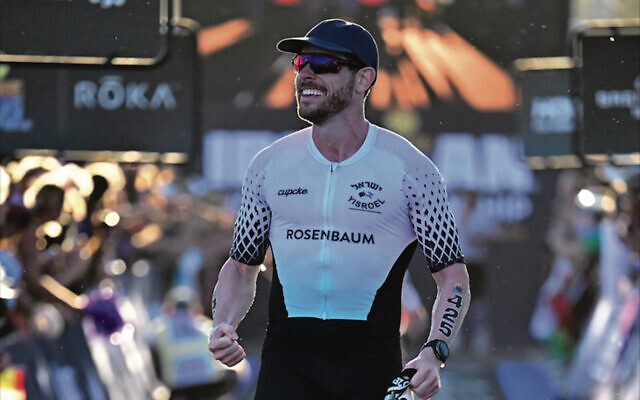
Yisroel Rosenbaum raced the Ironman World Championships in a jersey featuring both Australian and Israeli flags, sending a close-up photo specifically for publication.
There’s also the surge in Maccabi and AJAX club membership, evidence that communal solidarity can counter fear.
The Ministry of Truth succeeded because it was totalitarian – no alternative narratives could exist.
Our situation, however bleak, remains different. For every Jew erasing themselves, another stands firmer. For every name removed, another insists on inclusion. The woman who removed her name from an AJN article captured the essential tragedy.
“It’s killing off our impact in the world, and to be an or lagoyim [a light unto the nations]. We’re not meant to do that.”
No. We’re not.
comments