



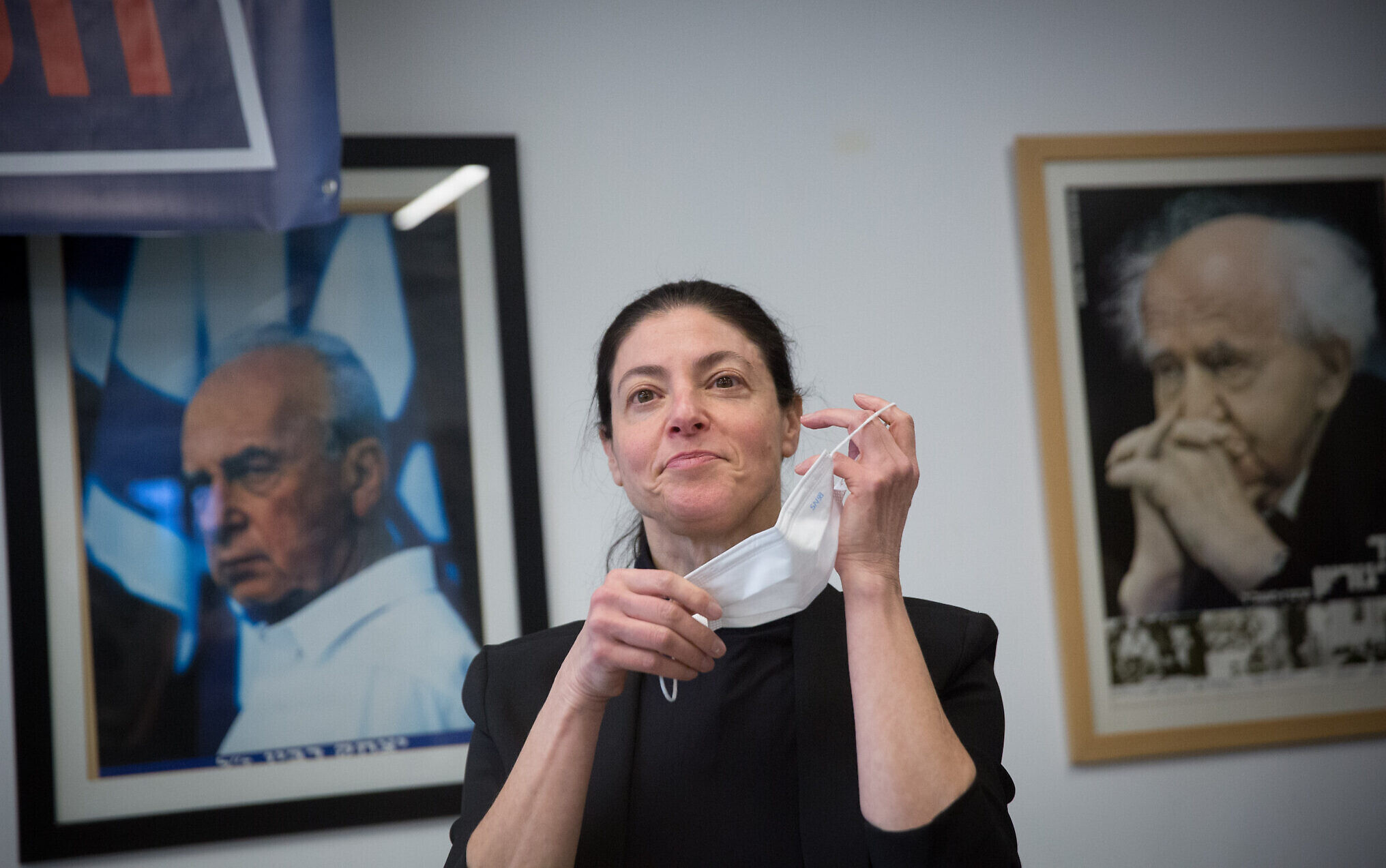
DURING the leadup to Israel’s election in March, few predicted that both Labor and Meretz would make it into the next Knesset, let alone into government.
Labor leader Merav Michaeli breathed some life back into Labor; then it was Meretz’s turn to plunge in the polls towards oblivion. Not for the first time, the party launched a “gevalt! campaign” to “save Meretz!” – hoping to shame recalcitrant leftists into turning out to vote for it.
Yet both parties exceeded expectations, easily crossing the threshold of 3.25 per cent of the vote.
Two months later, they joined the Bennett–Lapid coalition and helped unseat Benjamin Netanyahu, who had been in power for 12 long years. After being written off as dead, the Israeli left had been miraculously reborn.
But it is a tenuous rebirth. Labor and Meretz celebrated their gains, but the election result remains a far cry from their past glories.
The last time the parties of the left, Labor and Meretz, together with Arab parties, won a majority in the Knesset was in 1992. Labor and Meretz together won 56 seats in that election. Now they have 13. But Michaeli is convinced that, having “brought Labor back from the dead”, she can again make it a party of power.

Michaeli is different from previous Labor leaders. It’s not just her biography – Tel Aviv glamour girl transformed into radical feminist activist and now into mainstream politician, determined to return Labor to its heyday as the party of power. Michaeli is also much more clear-eyed than her predecessors on where Labor went wrong and the size of the mountain her party needs to climb to again challenge for power.
Privately, she admits that it will take longer than just a couple of election cycles. Unlike her predecessors, who tried to rebrand Labor as centrist, she doesn’t shy away from the “leftist” label.
Until 1977, Labor’s narrative was clear. It was the only party to be trusted with sailing the ship of Israel, navigating it through the treacherous shoals of the Middle East. Even after losing elections in 1977 and 1981, Labor tried to use the disastrous war in Lebanon and the near meltdown of Israel’s economy in the early 1980s as proof that Likud could not be trusted with power.
But that message was only persuasive enough to gain a draw in 1984, after which Labor spent six years in unity governments with Likud, effectively conceding that they could indeed be trusted.
Then came the 1990s, during which Labor finally won two elections, spending half the decade in power, this time as “the peace camp” with the Oslo Accords. But the collapse of the Oslo process in 2000, after the failed Camp David summit between Ehud Barak and Yasser Arafat and the outbreak of the bloody Second Intifada, destroyed Israelis’ belief in peace with the Palestinians.
“It’s clear that since 1977 we’ve lost our narrative and Barak finished off the peace narrative,” Michaeli says, referring to Barak’s comment after Camp David that “Israel doesn’t have a Palestinian partner for peace.” “I don’t have a clear answer on what the narrative is yet,” she admits disarmingly.
Michaeli is unusually reticent on two issues. She isn’t very interested in talking about where the party stands on the occupation and the Israel–Palestine conflict more generally. The party’s official policy is still to support the two-state solution, but it doesn’t feature prominently in any of its leader’s speeches.
Michaeli repeatedly calls Labor “the party of Yitzhak Rabin” but, when asked which parts of Rabin’s legacy she values the most, she highlights the social reforms his governments carried out, rather than Oslo. And then there’s the issue of the party to the right of Labor, the one that now occupies the centre ground – once Labor’s natural habitat.
Since its foundation in 2013, Yair Lapid’s ultra-centrist Yesh Atid (“There is a Future”) party has steadily eaten away at the urban middle-class base that was once Labor’s core constituency.
At first, Yesh Atid looked like just another centrist party, a breed that has never lasted long in Israeli politics. But Lapid has defied expectations, not only by keeping his party together for six elections, but also by evolving as a politician, becoming the architect of the government that has finally toppled Netanyahu. Taking Likud down was supposed to be Labor’s job; now Lapid has taken that away as well.
If the government stays together, Lapid will replace Naftali Bennett as prime minister in August 2023, further boosting his chances of increasing Yesh Atid’s hold on the middle ground and cementing Labor’s relegation to small-party status.
The question of whether Labor still has a role, perched uneasily between Yesh Atid and Meretz, remains open. In 2008, Amos Oz announced that “Labor has come to the end of its historic path. It no longer presents a national agenda and joins every coalition.”
Thirteen years later, Labor is still around, thanks largely to Michaeli’s efforts. But she is yet to answer Oz’s challenge and come up with a new agenda for the party.
Meanwhile, Meretz is still around, despite fears that every election could be its last. Back in 2008, when Oz announced that Labor had ended its historic role, he did so at the launch of “the New Movement”, essentially a rebranding exercise for old Meretz. It was a dismal failure, with Meretz winning just three seats a few months later.
Now, all of a sudden, Meretz is back – with six seats, equalling its best result in the past two decades. For the first time since 2000, it is in government. But just like with Labor, it’s unclear what it stands for in a coalition dominated by the centre-right and in a political environment where, squeezed by Yesh Atid, Labor is increasingly encroaching on its territory.
In some aspects, the left, especially Meretz, became the victim of its own success. On LGBTQ rights, for example, few now remember that, once upon a time, only Ratz founder Shulamit Aloni had fought for them in Israeli politics. Meretz was the first party to have an openly gay MK. But now, over 100,000 Israelis take part in Tel Aviv’s annual gay pride parade, and in recent years the most prominent LGBTQ politician wasn’t Meretz leader Nitzan Horowitz, but staunch Likudnik minister Amir Ohana, who is so sycophantically loyal to Netanyahu that the then prime minister himself gave the traditional congratulatory remarks after his maiden Knesset speech.
And then, under Netanyahu, the conflict with the Palestinians was set aside, and the Oslo process became not much more than a distant, rather embarrassing memory, and it began to seem as if little remained of the Israeli left.
So what is the Israeli left today?
That depends on whether you’re looking at the political or the social level.
“Far fewer Israelis are willing to identify as ‘left’ today, but many more hold views that could be defined as left-wing,” says Dahlia Scheindlin, a pollster and, over the years, a campaign adviser to various left-wing parties and organisations.
“The proportion of Israelis who in principle support things like the two-state solution, separation of state and religion, and public health and education is much higher than the vote share of the so-called left-wing parties. In some cases, a majority of Israelis support these things.”
So why have Israelis tended less and less to vote for the parties that represent those issues? Partly because of the lack of any hope in ending the occupation, which remained the left’s main plank for so long. But also, according to Scheindlin, because of the increasing religiosity of Israeli society. All politics, everywhere, is tribal. But as more Israelis join the middle class, and the Ashkenazi–Mizrahi divide becomes less pronounced due to intermarriage, Israel’s tribes – and therefore its political categories – are increasingly defined by religion.
“In all the polling I’ve done in Israel,” she explains, “the iron law is that the more devoutly religious Israelis identify as, the more right-wing and nationalist they are.” Couple that with the much higher religious birthrates, and the shrinking of the left becomes a natural phenomenon.
“The left’s electoral base is the children of the previous generation’s left-wingers, but that’s not a monolithic bloc,” says Scheindlin. “When someone from a Likud-voting working-class family leaves their neighbourhood, goes to university, joins the middle class and, most importantly, becomes more secular, they tend to become less right-wing. Though not necessarily. There are plenty of secular people on the right. But much fewer religious left-wingers.”
Perhaps there’s nothing the Israeli left can do to change the tide: the two main Jewish religious communities in Israel, the ultra-orthodox Charedim and the national-religious Datiim, have been growing, both in numbers and in their levels of nationalism, for decades. The only thing that can change that is a move away from Orthodoxy. There are some early signs this may be happening, but it could take a generation to have any real political effect.
None of this should be surprising. After all, the rise of the Zionist left corresponded closely to increased secularisation among Jews – first in Eastern Europe from the late 19th century, and then in Israel during its early years. Ben-Gurion and most of his fellow founders had been born into observant families, replacing religion with a new set of beliefs as young men and women. But can their combination of Zionism and socialism, progressivism in a Jewish sovereign state, even work today?
This is an edited extract of Anshel Pfeffer’s essay “The Strange Death and Curious Rebirth of the Israeli Left” from the latest issue of The Jewish Quarterly. For more information, visit www.jewishquarterly.com.
comments