



Ten Commandments and Shavuot
HOW relevant are the Ten Commandments in the modern age?
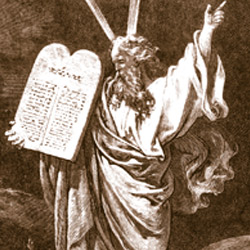
DESPITE its centrality in Jewish history and the yearly festival cycle, Shavuot, affectionately dubbed “the cheesecake festival” by the gastronomic Jew, is regrettably the festival with which people are least familiar.
Given that it requires no major preparatory cleaning, lengthy fasts or outdoor meals consumed beneath palm branches with the mosquitoes, it is mysterious that Shavuot isn’t more popular. Perhaps centuries of anti-Semitic persecution have conditioned us to only take seriously those Jewish events that, by their very nature, border on the dramatic.
Maybe if some severe restrictions were suddenly imposed upon Shavuot, the festival’s popularity would increase. After all, in contrast with the other festivals, no-one tried to kill us on Shavuot. So what justification is there for a feast?
Shavuot marks the anniversary of the Jewish people’s first encounter with God. Invited to the reception at the base of Mount Sinai, the nation was given the unique opportunity to meet and be spoken to by God. “Unique”, for Judaism stands alone among the faiths of the world with the chutzpah to declare that all Jews — in contrast to a solitary inspired individual — heard God speaking to them and singling them out as the nation chosen for the honour and challenge of keeping the Torah.
Given that the Torah contains 613 commandments, what is the significance of those 10 that were selected for the Sinai reception? While many Biblical commentators regard the Torah’s relevance as timeless, it could be argued that it is also timely. With the challenge of looking at the commandments in this manner, let’s reflect upon a few of them.
“I am Hashem your God” opens the Decalogue, however, it would be more accurate to describe this as God’s opening greeting rather than a commandment. Incorporated into this statement is a call to believe in the existence of God, “who took you of Egypt”. If some kind of Richter scale were devised with which miraculous events could be measured and compared, it would be quite clear that God’s creation of the world ex nihilo was far more impressive than stage-managing the liberation of the Jewish people.
It is interesting, therefore, that in the process of introducing Himself to the nation, God refers to the less dramatic miracle in His CV, seemingly ignoring the more impressive act of creation. Acts of power and grandeur performed for all of humanity, however, pale in comparison with kindnesses arranged for you personally. And therefore, it was the caring — rather than the powerful — God who introduced Himself here.
While this idea is timeless, how is it timely for us as 21st-century Australian Jews? While ours is a community forged predominantly by Holocaust survivors, we, the succeeding generations, have the challenge of balancing our need to glance both behind us and into the future. The imperative to remember and honour, as important as it is, should not blind us to the fact that generations Y and Z are going to choose to live as — and marry — Jews because they regard Judaism as a fabulous, enriching and empowering lifestyle, which they are keen to pass on to the next generation.
The guilt-saturated demand to be Jewish “because bobba survived” is quite simply not going to be sufficiently compelling. Perhaps the call “I took you out of Egypt” is a subtle reminder that we, who are fortunate not to be slaves, must make a concerted effort to live as a nation redeemed, rising to meet the challenges that await, and not investing all creative energy in the past.
“Remember the Sabbath day and keep it holy”, one of the few commandments that appear uniquely Jewish, calls upon us to remember one of the greatest of God’s creations: rest. After six days of world-building, only abstinence from creative work made this possible. While being told to slow down and close up shop might sound delightful, in the fast-paced, 24/7 world of today, inaction is often regarded as occupational suicide and unforgivable laziness.
Yet intuitively, we know that moving less slowly has manifold benefits, particularly for quality family time, the endangered species of the 21st century. Why would God mandate rest? When asked what Judaism regarded as the main difference between man and an animal, I used to say “clothing”, until I realised that my neighbour’s poodle enjoys better clothing, pampering and weekly grooming than me! And then it occurred to me that one of the main differences is that man has the ability to elevate and sanctify time. While hours and days blur in the context of a hectic working schedule, the contrast is marked when one acts, dresses, eats and thinks totally differently on one day of the week.
In fact, the smallest, most trivial thing can be elevated to a high level of significance when set aside for a special day. As a child, joy knew no bounds when the Devondale apple cider appeared on the Shabbat table, each glass being relished and savoured. Why, then, would the nature of how one rests on this day be mandated, when all of us have very different opinions regarding what makes a day restful? Because if one person spent the day playing golf, another shopping, while the third was surfing at the beach, all might be enjoying recreation, but this would be entirely self-serving.
The Jewish people are only here today because of the strength of our families and our nation. Holy days, which we observe as families and as a community, strengthen this far more than acts of private pampering. While Shabbat is about abstaining from creative work, it is also about strengthening the bonds that connect us to God and our loved ones.
“You shall not covet” is the closing commandment. While some laws challenge us to sanctify our bodies, certain places and occasions, this is about elevating thought. This is about realising that there are things that money, charm and force cannot — and should not — buy. While Judaism has no issue with commitment to constant improvement and the desire to attain happiness, if that hunger becomes so insatiable that one is incapable of being content with where they are currently, then there’s a problem.
Let’s face it: there is likely to be someone out there with a better watch, car, house and body than you. However, if gazing at their pleasures blinds us to our treasures, then we’re dooming ourselves to perpetual misery (and a scary credit card debt). There are some things that are off- limits. In this consumer-driven, buy-in-bulk world, less might actually be more.
Unlike those of us living in the information age, who have easy access to the wisdom of the Ten Commandments and other Jewish treasures, those at the base of Mount Sinai had only a vague idea what it was they were going to receive on Shavuot. And so, with little idea about kashrut and all things Jewish, they chose to consume only dairy foods in the three-day lead-up. This is the basis for the cheesecake tradition. Shavuot is a wonderful festival, for it is a celebration not only of dairy delights, but also of our love of learning. At the Passover seder, we say, “All who are hungry, come join us and eat.”
On Shavuot, we can trump this invitation, saying, “All who are intellectually curious, come to Tikkun Leil Shavuot and not only will you enjoy food for thought, there might also be cheesecake!”
Adina Bankier-Karp is a Jewish studies and English teacher at Mount Scopus Memorial College, Melbourne.
ADINA BANKIER-KARP
comments