



Somewhere in Gaza, a 19-year-old Israeli soldier taught herself to recite Jewish prayers in Arabic. She could not sing in Hebrew without punishment, so she found another way. When there were quiet moments, she and her fellow hostages would sing together, very softly, just to remind themselves they were still human.
Next month, that young woman, Daniella Gilboa, will step onto an Australian stage and sing as loudly as she wants, encouraging everyone to sing alongside her.
Gilboa, now 22, is the headline act of SHIR: Australian Jewish Music Festival’s Unbreakable concert. She will debut her single Where Everything Ends, released in February after co-writing it with musicians Gil Vain and Uri Sachiv, for one of her first international audiences.
It is the opening chapter of an album she is now recording, and the realisation of a dream she has carried since she began writing songs at seven years old.
“In all of my hard times in life, and also the happy times, it’s always been there, the music, to heal me, to be my therapy,” Gilboa told The AJN. “To be my way to express my feelings when nobody understands.”
Gilboa was abducted from the Nahal Oz military base on October 7, 2023, along with fellow surveillance soldiers Naama Levy, Karina Ariev, Liri Albag and Agam Berger. She spent 477 days in Hamas captivity before being freed on January 25, 2025. Before that day, she had co-written a song called Maybe the Door Will Open with two of her fellow lookout soldiers, Yam Glass and Aviv Hajaj. Both were killed on October 7.
Gilboa said the opportunity to perform in Australia carries particular significance, pointing to the antisemitism that has affected the local Jewish community, including the Bondi Beach terror attack on December 14 last year.
“The Jewish people are unbreakable. And I’m here to show that too,” she said. “When all over the world there is antisemitism and hate, we’re still together and united.”
But Unbreakable is not a one-woman show.
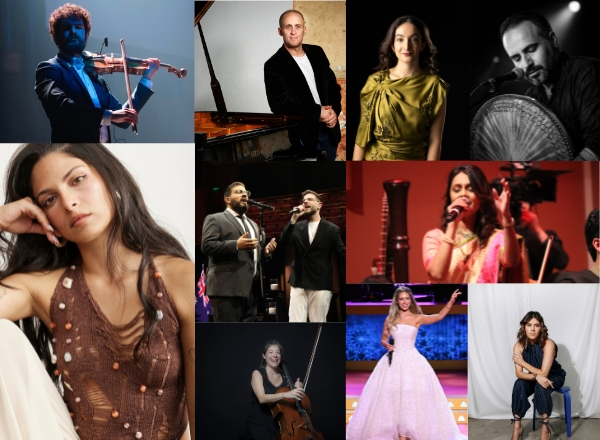
Around Gilboa, SHIR festival director and violinist Ben Adler has assembled a lineup that spans classical piano, opera, cantorial tradition, soul, contemporary Israeli pop, and, for the first time, guest artists from Indian, Iranian and Samoan backgrounds. The result is a concert that shows Australia what social cohesion really looks like.
“Everyone is talking about social cohesion at the moment, but what does it mean? How do we achieve it?” Adler said. “This year, we have decided to begin answering these questions by building, within our concert, our vision for a socially cohesive Australia.”
The concert’s title, he said, carries a dual meaning.
“Unbreakable in reference to the unbreakable spirit of the Jewish people, embodied by Daniella Gilboa, who has emerged from 477 days of captivity and has transformed into an extraordinary artist,” he said. “And also in reference to the bonds that we share with our fellow Australians, and our shared commitment to a socially cohesive future.”
It is a remarkable trajectory for a festival that did not exist two years ago. Since its first concert, SHIR has grown into Australia’s only national Jewish performing arts platform.
“The Jewish people are unbreakable. And I’m here to show that too. When all over the world there is antisemitism and hate, we’re still together and united.” Daniella Gilboa
“This is all thanks to the support from the Jewish community, who have bought tickets and turned up,” Adler said. “As we now expand SHIR’s attention to include the wider non-Jewish world, to serve as a cultural emissary and humanising influence, I want the Sydney and Melbourne Jewish communities to remember that you built us, and we represent you.”
Ask the Jewish performers on this year’s bill what it feels like to stand on stage as a Jewish musician in Australia right now, and the same word keeps surfacing.
“Complicated,” pianist Simon Tedeschi, one of Australia’s most acclaimed classical musicians, told The AJN. “I think many Jewish Australians have felt much more exposed over the past few years, and certainly more conscious of being Jewish in public. For me, that has also brought a stronger sense of connection to Jewish history, culture and community,” he continued. “As a musician, I’m increasingly aware that this tradition isn’t something abstract or inherited at a distance. It’s alive, and we’re responsible for carrying it forward.”
Cellist Rebecca Herman, who moved to Sydney from London two years ago and now plays regularly with the Sydney Symphony Orchestra, described a more isolating reality. Previously a member of the Philharmonia Orchestra, Academy of St Martin in the Fields and BBC Symphony Orchestra, Herman said the spaces she once felt at home in no longer feel welcoming.
“As a professional musician, it’s completely normal to be the only Jewish person on stage,” she explained. “I’ve never experienced hostility at work, but it can definitely feel uncomfortable when colleagues share very strong views that lack nuance or understanding of the complexity of the current political climate.”
For Herman, SHIR represents something she has not had before in her career. It’s the chance for two strands of her identity, being a musician and being Jewish, to come together for the first time.
“As we now expand SHIR’s attention to include the wider non-Jewish world, to serve as a cultural emissary and humanising influence, I want the Sydney and Melbourne Jewish communities to remember that you built us, and we represent you.” Ben Adler
Cantor and vocalist Ezry Israel explained it in terms of purpose. “I think music gives us a very natural way of responding to that,” he said. “Not politically, and not necessarily with words, but simply by being who we are and celebrating it.”
That determination to celebrate rather than retreat extends beyond the Jewish lineup. Among the most distinctive elements of Unbreakable is the inclusion of artists from outside the community performing alongside their Jewish counterparts.
Australian-Iranian singer Mustafa Karame, who has performed at the Sydney Opera House and concert halls across Iran and the Middle East, said the collaboration felt instinctive.
“I believe that, beneath our differences, we are all part of one human family,” he said. “When we come together through music, something powerful and spectacular can happen.”
Australian-Indian vocalist Rucha Lange, who grew up in a musical family in Gujarat, and trained in Indian classical vocal under the guidance of her gurus, brings a repertoire spanning raags, film songs, ghazals and devotional music. Her voice has featured on the ABC television series Wakefield, whose soundtrack was nominated for an ARIA award, and in the 2015 film Un-Indian alongside cricket icon Brett Lee.
In a detail that speaks to the concert’s spirit, Lange and Adler recently discovered they had both performed on the Wakefield soundtrack without knowing it at the time.
“Music is for soul,” Lange simply said.
The Chutney ensemble, which brings together artists from Samoan and other cultural backgrounds, will also appear on the bill. Adler, who gave testimony at the Royal Commission on Antisemitism and Social Cohesion earlier this year, described the cross-cultural collaborations as a step towards something meaningful.
“I am proud to have crafted a space where we can sit and celebrate our Jewishness, not religiously, not politically, but culturally and existentially,” he said.
The Jewish artists themselves span genres and generations, and not one of them sounds like another.
Melbourne-born mezzo-soprano Sidra Nissen, winner of the 2025 IFAC Handa Australian Singing Competition and a 2026-27 Young Artist with Opera Australia, said SHIR offers her something rare in her classical career, that being the chance to perform alongside musicians from entirely different musical worlds.
“I’ve always felt that Jewish people are wonderful storytellers, and that there is often so much heart, humour and soul in the way we share our stories,” she said. “Being able to bring my own experiences as a Jewish person into my work is something I really value.”
Melbourne vocalist Jemma Cher, whose debut album includes a collaboration with singer-songwriter Lior and who appeared as a soloist at Vision Australia’s Carols by Candlelight on Channel 9, is drawn to the storytelling at the heart of the evening.
“As a musician, I’m increasingly aware that this tradition isn’t something abstract or inherited at a distance. It’s alive, and we’re responsible for carrying it forward.” Simon Tedeschi
“As musicians, music is one of the ways we tell our stories, sometimes without needing to explain a single word,” she said.
Mizzi Israel, who spent several years living in Israel, will take the stage alongside his brother Ezry. Soul singer Sarit Michael rounds out a bill that moves between sacred and secular, European and Middle Eastern, classical and contemporary without breaking stride.
Tedeschi captured the breadth of what the lineup represents.
“Jewish musical life has always been extraordinarily diverse, sacred and secular, European and Middle Eastern, classical, folk, jazz, popular music, everything in between,” he said. “So there is something wonderful about being together without having to reduce Jewishness to any one definition.”
At a time when Jewish identity is often discussed through the prism of politics or conflict, Tedeschi said SHIR offers something different.
“It feels especially important to celebrate Jewish culture on its own terms: its beauty, argumentativeness, humour, sadness, multiplicity and enormous appetite for life.”
“I’ve always felt that Jewish people are wonderful storytellers, and that there is often so much heart, humour and soul in the way we share our stories.” Sidra Nissen
When it comes to what the performers hope audiences take away, Ezry Israel offered perhaps the most vivid answer. Jewish music, he said, has a rare ability to collapse time.
“You can sing a melody that has existed for generations and have a teenager singing it next to somebody in their 80s,” he said. “You can perform an Israeli song written decades ago and suddenly it means something completely different because of what is happening in the world today. Then five minutes later, everyone can be dancing to something completely contemporary.”
Several performers spoke about the moment in live performance when the audience stops watching and starts participating. Ezry Israel described it as the moment you cannot rehearse. Nissen hopes people feel transported. Herman wants belonging and joy. Cher wants a shared sense of connection that needs no explanation.
Mizzi Israel said the measure is simpler than it sounds.
“You don’t necessarily have to understand every word of a song to feel what it’s saying. If someone can sing along, get emotional, smile, or just forget about everything else for a few minutes, then I’ve done what I came to do.”
Adler, however, frames it in the most direct terms.
“Your time is your most precious commodity and I do not take it from you lightly,” he said. “My job is to make you feel something.”
Gilboa, whose journey from captivity in Gaza to a stage in Australia encapsulates everything the evening stands for, put it most simply.
“I hope to bring with my music, a light to people who are still in the darkness, so they can find also the light.”
Unbreakable is in Melbourne on Thursday, October 22 and Sydney on Sunday, October 25. For bookings, visit shir.com.au
comments