



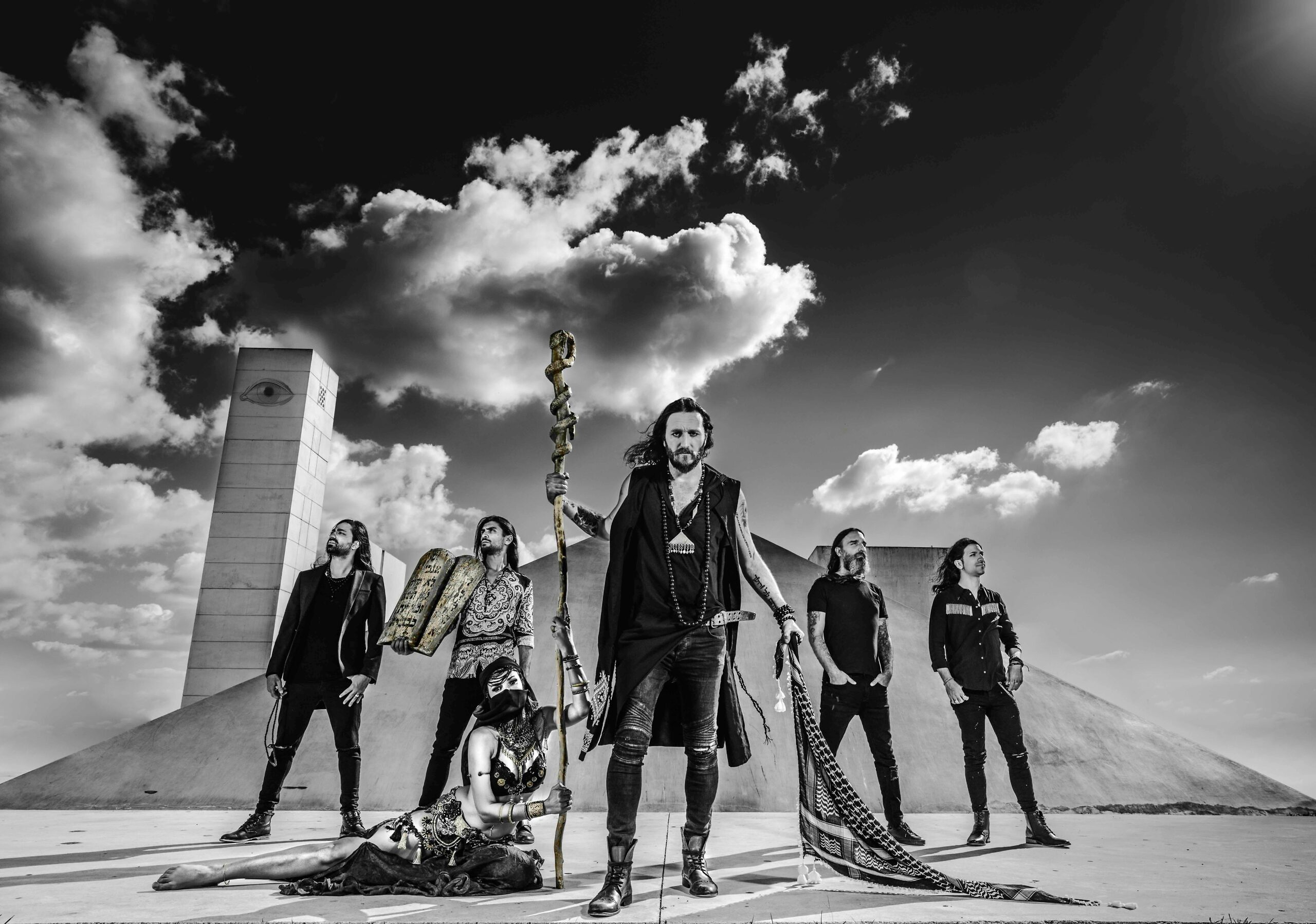
At 6.29 on the morning of October 7, 2023, Kobi Farhi was brushing his teeth at his mother-in-law’s house in Rishon LeZion when the sirens started. At first he thought it might be a false alarm. Then came the first boom.
“It’s not a false alarm,” he thought. “Something is going on.”
They grabbed the children and ran for the bomb shelter, for the first of ten times that day. The picture assembled slowly. Hamas-led terrorists crossing the southern border. Kibbutzim attacked and their residents slaughtered. The Nova festival massacre. 1200 murdered in a day and 251 hostages abducted into Gaza.
“We started to realise the scale of what happened,” the Orphaned Land frontman said. “It was the feeling that if this is not stopped, they will kill and kill and kill all of us.”
Though he didn’t know it at the time, the destruction in southern Israel would also come to mark a turning point for the singer and his band.
Since co-founding the Israeli heavy metal band Orphaned Land in 1993, Farhi has been at the coalface of fostering co-existence between Jews and Arabs. The band, which describes its style as “oriental metal”, has gained thousands of dedicated fans all over the Arab world. They made history in 2014 by sharing a tour bus with a Palestinian band and have received awards for their work in bringing people together.
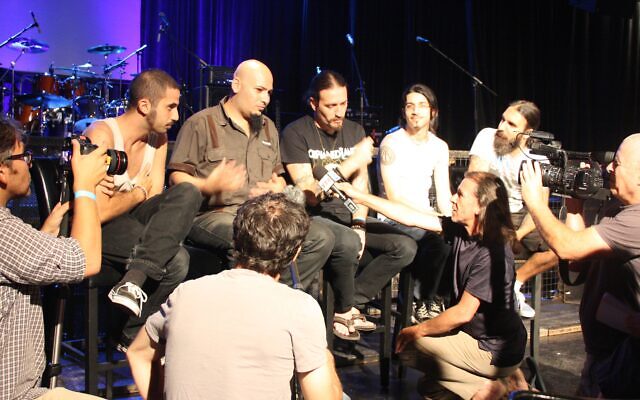
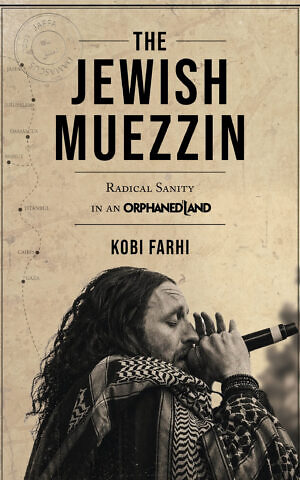
Farhi, who last spoke to The AJN in 2014, when Orphaned Land toured Australia, has just published his memoir, The Jewish Muezzin, in English. It appeared first in Hebrew as Goodnight, My Orphaned Land and has since been translated into English, French and Arabic, with a Spanish edition underway.
He told The AJN that reaching the age of 50 was one reason for writing the book. The other, he said, was when following October 7, activists in Barcelona tried to have an Orphaned Land show cancelled. Through a series of emails, Farhi set about convincing the club owner to keep the booking: he told him of the tours with Palestinian musicians, the award shared with a Palestinian band, the more than five tours with Muslim bands.
“And then I asked myself, why aren’t all these stories gathered in a book?,” he said. “Tell him go to page 55, page 73.”
Farhi grew up in the melting pot of Jaffa, where the local mosque, synagogue and church were all within sight of one another. His grandmother’s best friend was an Arab woman she sewed beside at the family’s textile factory. At five he sat on his grandmother’s lap at an Arab wedding. He writes in the book of his father throwing blankets to Egyptian prisoners of war in 1973.
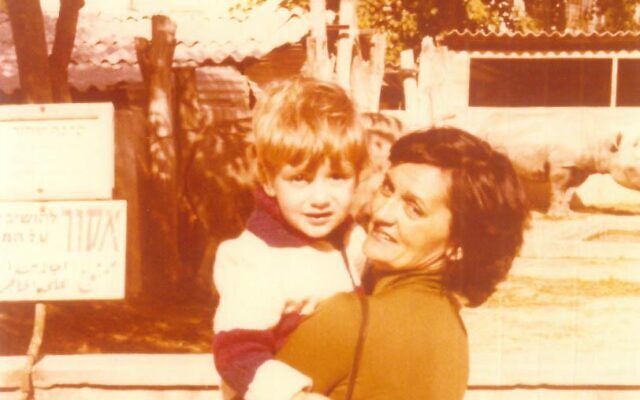
But then there was also his father’s cousin – who Farhi also refers to as his uncle – who came home from the 1967 war with post-traumatic stress disorder (PTSD) and became a junkie. He recalled being in the car with him as a boy when an Arab taxi driver smiled at them. “He may have smiled at you,” his uncle said, “but deep in his heart he wants to kill you.”
Coming up from the shelter with his wife and children on October 7, Farhi suddenly again saw his uncle – though he had been dead for years – in the living room.
“It was as if I opened the door, seeing him in my mind’s eye sitting on a sofa, injecting heroin, looking at me and telling me, ‘What did I tell you in the car when you were a kid? I told you they all want to kill you’.”
Farhi had long ago abandoned such a narrative. But it was not always so. He was 17 in May, 1992 when 15-year-old Israeli teenager Helena Rapp was stabbed to death by a Palestinian terrorist. Farhi didn’t personally know her, but he knew her friends. She was almost the same age as his sister.
He went to the funeral. Afterwards he joined a dozen teenagers at a construction site near the cemetery, looking for wooden planks. Farhi found one with a rusty nail through it, and they set off for the industrial area of Bat Yam, where rumour had it there would be Arab workers.
“I am now ashamed to say it, but this is what happens when you are brought up with such violence, when you know nothing else,” he writes in the book. “Our decision? Revenge. We would find an Arab and murder him.”
At a petrol station they saw a man who looked Arab and ran at him. The station manager got there first, bundled the man into a room and locked the door. Farhi conceded he doesn’t actually know what he would have done if he had gotten his hands on him.
He threw away the plank, bought black spray paint and waited for nightfall. While he waited he wrote the first song lyrics of his life, addressed to the man who killed Helena Rapp, and called it “Unburied Corpse”.
After dark, he sprayed “Death to Arabs” and “Free Ami Popper” on the walls of the Bat Yam shopping centre — the second a reference to the Israeli who had murdered seven Palestinian labourers two years earlier — and that night came back and sprayed the lyrics of “Unburied Corpse” across the whole building.
It would become Orphaned Land’s first song – recorded but never released, and performed only once a month later.
The band had come together after Farhi had fallen in love with heavy metal music having heard the Iron Maiden album Seventh Son of a Seventh Son. At around the same time, his attitudes towards the conflict had started to change.
The catalyst, of course, was music.
“It was always music that changed me and changed the people that I had succeeded to change,” he said.
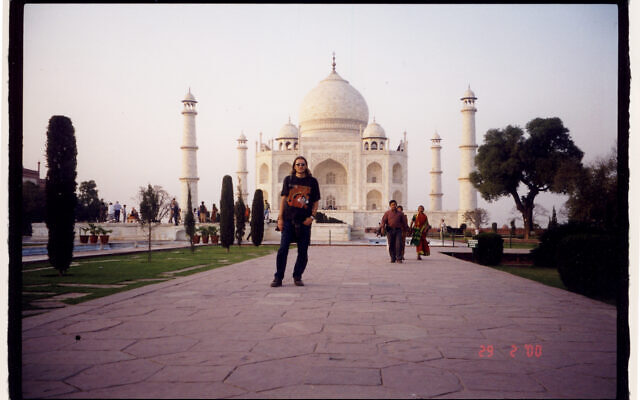
Since childhood he had been enamoured with the Muslim call to prayer that he heard from his grandmother’s house in Jaffa, for its melody and “sheer distorting volume”. Years later, he would record himself singing it – illegally at the Taj Mahal in India, no less – and it would feature in the song “Ocean Land” on the album Mabool.
Then in his late teens while at Liquid nightclub in Tel Aviv, Farhi heard a song from Mami, Hillel Mittelpunkt’s rock opera which describes the Israeli-Palestinian conflict from both sides. “Everyone was getting lost within themselves and dancing,” he recalled.
In 1993, Orphaned Land got a record deal. As they prepared to work on what would become their debut album Sahara, Farhi asked the army if he could combine two of his weeks of leave to go into the studio. When his request was refused, he left the base to record the album anyway.
Upon returning, he was court-martialled and sent to military prison, where he was put on guard duty over some Palestinian detainees. He watched them, wanting to understand what moves a person to do what they had done. “It’s like criminology. You want to understand what moves the criminal,” he said.
They began to sing, drumming with their hands on the table, with their feet, and on the iron door.
“I didn’t have sympathy towards them or their deeds. I want to be very accurate about it because I don’t want to be misquoted,” he said. “But I could find empathy for the song that they sang. I could find a spot of hope that they might have had in their hearts.”
Released in 1994, the album Sahara featured the inside ceiling of a mosque on its cover.
“It’s something that had never been done before on the metal scene, which is always with skulls and swords and wars,” Farhi said. “We felt okay, we have our own war, but we want to bring these people to us. We want to build a bridge.”
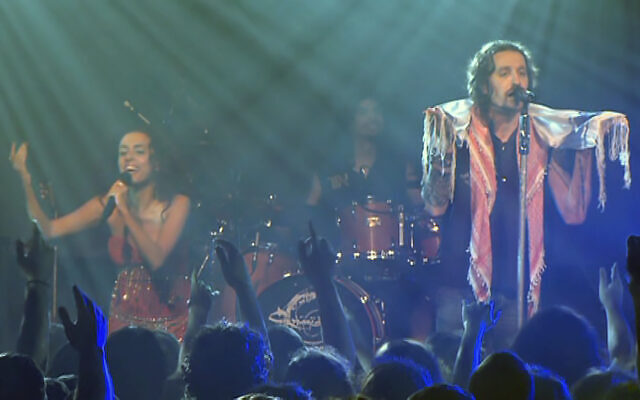
In came Middle Eastern instruments the oud and the qanun. Farhi read the Quran in English and took phrases from it, set them beside Jewish poetry and the New Testament, and began combining all three Abrahamic religions in the lyrics.
In 1994, he was first photographed with a keffiyeh.
“Imagine – I did it in ’94, before these people would even have been aware of the conflict, or some of them, like Greta Thunberg, were even born,” he said. “But I’m not doing it from a provocative place. I am the son of the conflict. I have friends who were injured in suicide bombing attacks. I have skin in the story.”
After their second album El Norra Alila in 1996, the band fell into an indefinite hiatus. Then, in 2001, an email arrived from a Muslim fan in Jordan. In the attached video, the man pulled back his sleeve to show the Orphaned Land logo tattooed on his arm.
“I’m leaning back and saying, whoa, what? A Muslim Jordanian with a tattoo of my Israeli band? How could that be?” Farhi said.
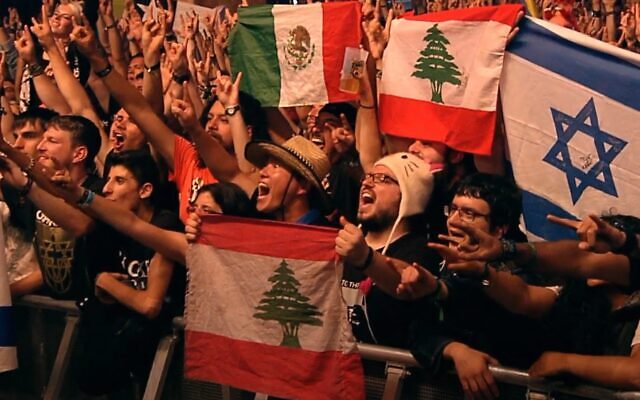
He wrote back to discover there was a man in Lebanon with the same tattoo, and another in Dubai. Their CDs had been smuggled across borders, because Orphaned Land was the one metal band that had put a mosque on a cover and a keffiyeh on its singer. One Egyptian fan was even jailed for six months after police found an Orphaned Land CD in his collection.
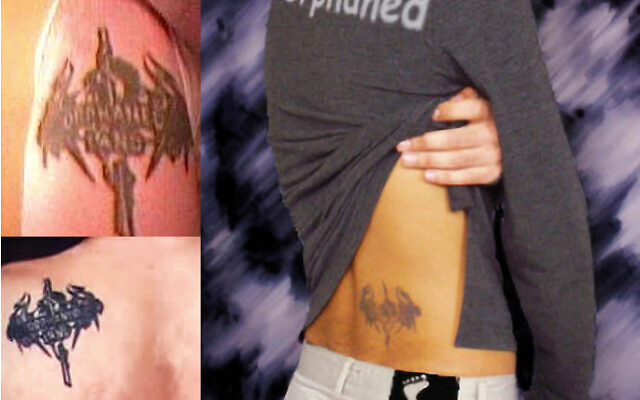
“The band was not active for the past six years. How could that be?,” Farhi asked.
The band’s second coming was inspired. From 2001 until October 7, 2023, Farhi said, they did not stop: the albums Mabool (2004), The Never Ending Way of ORWarriOR (2010), All is One (2013) and Unsung Prophets and Dead Messiahs (2018); some 30 concerts in Turkey, three peace awards there, fans travelling in from Saudi Arabia and Egypt, more than five tours initiated with Muslim bands, and more than ten collaborations with Palestinian artists.
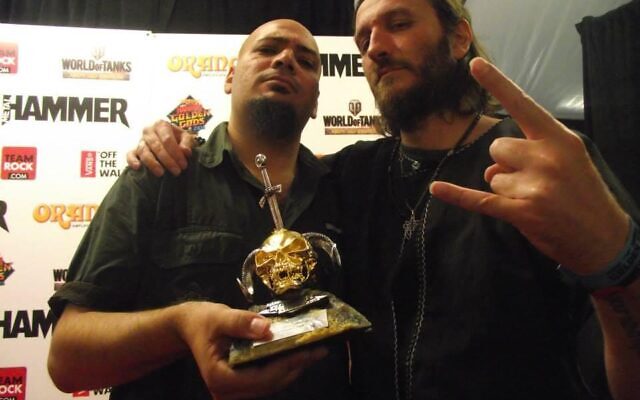
When Orphaned Land won the Metal Hammer Golden Gods Global Metal Award in 2014, Farhi asked to share it with Khalas, the Palestinian band they had just spent a month on a bus with.
“We washed our clothes together. We made coffee for each other. We made food for each other. We broke bread together,” he said. The lesson he draws from the experience is that “the world is not black and white”.
He is strongly critical of the current Israeli government, but scathing too of Palestinian leaders for continually rejecting peace offers. “We shouldn’t be scared to criticise both sides, and we shouldn’t be scared to show empathy for both sides.”
He called the boycott movement “a complete failure” and also took aim at so-called pro-Palestinian protests.
“If [they] would demonstrate for peace between Israel and Palestine, that would have been more pressure, and more Israelis would even support it,” he said. “But when people on the street are always into the mentality of f**k Israel, f**k Zionism, f**k the IDF, the Israelis become very defensive. They have their own triggers and traumas, to know that they are alone.”
He said it also played into Hamas’s hands. “They could have released the hostages much earlier. They could have ended the bombing and killing of their children and innocent people much earlier. But they got a boost from the worldwide demonstrations, and that’s the truth,” he said.
He also took aim at other musicians and public figures who have waded into the conflict. “They wrote posts … I have songs of Orphaned Land tattooed on Palestinian people. Will anyone tattoo your post on Instagram?,” he asked.
“They are entitled to have their opinion. They are entitled to stand with the oppressed. But they are also entitled to have the humbleness to admit that they are not in the skin of this conflict the way that I am.”
In the days after October 7, everyone wanted Orphaned Land to say something. “They forget that we are also human beings,” Farhi said. “We have our traumas, we have our weaknesses, we have children.”
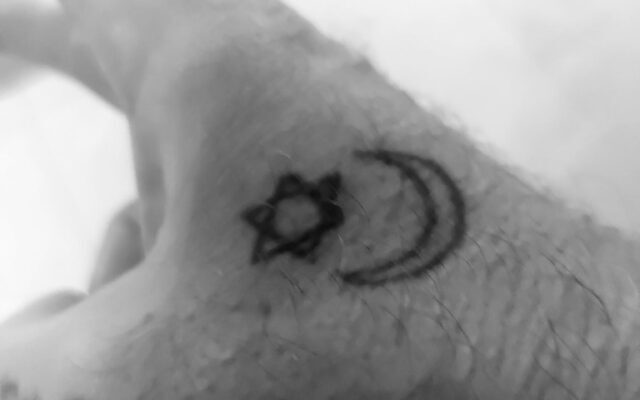
What the band managed first was this: “They don’t let us mourn.”
He posted a photograph of two of his tattoos, a Star of David and a crescent, with a line saying the band stood with its Israeli brothers and sisters and mourned with them — and a sentence immediately after it saying “but not against the Palestinians”.
It wasn’t enough for some. Fans left the band’s social media pages in their dozens, cursing on the way out, promising to bin their albums or burn them. They called Farhi a hypocrite and a traitor and said the mask was off, and quoted George Orwell at him about some animals being more equal than others. There were also death threats.
In the meantime he was counting his own dead. A fan murdered at Nova was wearing an Orphaned Land T-shirt in the photograph his family chose to publish. Another fan was shot at home and bled to death in front of his wife and children behind a security door. “Can anyone imagine that I can stand against those people at this time?,” Farhi asked.
Then came the requests from bereaved families: no more keffiyeh, don’t sing that song, no more Arabic. After 30 years with the keffiyeh tied to his microphone stand, he took it off. “From all over we are attacked, and it felt like, how can the band continue from this point?,” he said.
“I couldn’t stand against the Israelis. I do not support the Israeli government, actually I never did, but I will not stand against the people. They are my flesh and blood.
“When I’m putting the keffiyeh, and when I’m putting the mosque, and when I’m singing in Arabic, and when I’m reading the Quran, I’m always doing it from a perspective that I am first and foremost Jewish and Israeli. That’s not negotiable. I didn’t come to change my identity. I came to build a bridge between me and the so-called enemies, and I had succeeded. But October 7 smashed everything.”
Some bandmates “flipped”, he said, and he can’t blame them. Among musicians elsewhere, perhaps 80 per cent said nothing at all. A member of one band checked in weekly. One well-known band quietly unfriended Orphaned Land without a word of explanation; he won’t name them.
But the band isn’t finished. There’s their traditional annual Chanukah show planned in Tel Aviv and a heavy metal cruise out of Miami, and Farhi still hopes to play Turkey again, and Dubai if anyone asks.
New music is harder. He doesn’t yet know who Orphaned Land is after October 7. So for now there is the book, which he said “is exposing the band story to many people who are not into metal”.
“Orphaned Land is a story that should be told, especially in times like this,” he said.
The Jewish Muezzin is digitally available via Amazon or on hardcopy via Lemon Soul Publishing lemonsoul.com.
comments