



There’s something about Catfish
FOR every Aaron Sorkin or Quentin Tarantino, there are thousands of starving artists, who, despite their best efforts, talent and application, never have any tangible success.
For an industry seen as a sparkling millionaire factory, the reality for the overwhelming majority of hopefuls is that it can be harder to crack than the JFK assassination. Initial success is usually the result of a perfect storm comprising interminable self-belief, an unflagging work ethic, finely honed skills and, perhaps most importantly, a heap of luck.
So when the universe presents one with an irresistible serendipitous slice, one is compelled to make hay while the sun shines, take the bull by the horns, not look the gift-horse in the mouth, and other cliches.
“You couldn’t make this stuff up,” says Ariel Schulman, co-director/producer of the controversial documentary sensation Catfish.
“If this movie is fake, then my brother is the next Marlon Brando and I’m the best writer in Hollywood.”
Ariel is referring to the subject of the film, his brother Yaniv, and speculation that Catfish is, in fact, a total fabrication, not a genuine documentary as the brothers Schulman maintain.
But despite the filmmakers’ earnest defence of their film’s authenticity, it’s easy to see where the problem lies.
“It all started when this one journalist at Sundance said to us, ‘it was really great, for a fake documentary’. It caught me completely off guard, and ever since then, the seed of doubt was planted,” Ariel says.
The distributor and the filmmakers behind Catfish have requested that reviewers avoid spoilers and not reveal the film’s twist, but suffice it to say that if ever the idiom “fact is stranger than fiction” has applied, it’s here.
The journey begins way back in 2007, when Yaniv, a professional photographer, starts to receive paintings in the mail of his photos that have appeared in publications around America.
The accompanying correspondence explains that the art is that of Abby, a nine-year-old resident of Ishpeming, a small town in Michigan. Intrigued, Yaniv, or Nev as he calls himself, befriends the girl and her mother Angela on Facebook. It is on the social networking site that he meets Abby’s sister Megan, and starts a passionate, near year-long, online affair.
But Megan is not what she seems, and what happens thereafter has to be seen to be believed. There is Hitchcockian suspense, drama, comedy and tragedy that would make accomplished screenwriters blush.
“We didn’t intend to make a movie, that wasn’t the goal. We were just filming our lives like we always do, and then it started to present itself as a bigger story. Ultimately, we didn’t need to adjust anything because the story was so wild,” Ariel explains.
And, indeed, it is. Part of the reason the film’s bona fides have been called into question is that it all just seems too perfect.
“I’m happy to chalk a lot of it up to luck and it will probably never happen again, but the truth is you can’t write this stuff. I can’t think of many Hollywood films that have that many human elements. It’s just lucky.”
Ariel credits his brother’s innately trusting nature and openness with the film’s quirky narrative. He describes Yaniv as a “documentary waiting to happen”, because of his endearing naivety and willingness to “say yes to adventure”.
This is starting to sound like the pitch for a sequel.
“If you follow him around long enough, something will happen. And the truth is I’ve missed a lot of documentaries by not filming his life. So when the first painting turned up in the mail, I said ‘let’s not miss another one’.”
So how does a young, intelligent, confident New Yorker get involved in an internet relationship with a girl he’s never met? Moreover, how does it feel to be known around the world as “the guy who was duped on Facebook”?
“Very few people who have seen the movie, who have been in touch with me either through fan email or Q and As, have ever really pointed out that, for the most part, I was sort of foolish,” Yaniv explains.
“Usually, people want to tell me that they’ve done something like that or they’ve been tricked before. Also, by the end of the movie, people forget that I just blindly walked down that path, so I don’t find it embarrassing at all. In fact, people identify with it so much that it creates a compassion for me in a lot of people.”
Another of the film’s strokes of luck is the relevance of the social networking discussion. The effect Facebook and Twitter is having on the way we communicate is a hot topic, and there are few better examples than the story at the heart of Catfish – another happy accident, according to the brothers.
It is this fascination that has led to a deal with MTV to develop a pilot for a reality show that examines other people’s “Catfish moments”. Yaniv says that since the release of the film, there have been countless documentary-worthy interactions with freaks and geeks on the web, not surprising when you consider he has more than 7000 people who “like” him on Facebook.
“I get a lot of propositions on Facebook. Girls see me as the sweet guy who had his heart broken. They all know something about me and have questions, so it’s great because you don’t have to start the conversation.”
One such example involved an attractive graduate student who asked if she could interview Yaniv for a paper she was writing on the phenomenon of social networking. Lured by her attractive profile pic, he agreed, and after meeting the woman, the pair had a brief fling, which “fizzled out” quickly. Yaniv says he later found out the contention of the paper was actually whether or not the woman could use social networking to meet, and then start a relationship with him, and how she had succeeded.
“After I heard that, I emailed her and asked to see her paper, but she sort of avoided the question and I just let it go. Partly because she was so beautiful and I was just so thrilled to have been able to make out with her.”
Prior to Catfish going galactic, the Schulman brothers, who were raised in a Reform household in New York, had a business doing edgy simcha videos.
“We did maybe 50 bar mitzvah videos and wedding videos and we would get NYU [New York University] film students to do cool graphics or edit it really nicely, with great music, and it kind of developed into this top-shelf, cool videography company.”
REPORT: ADAM KAMIEN
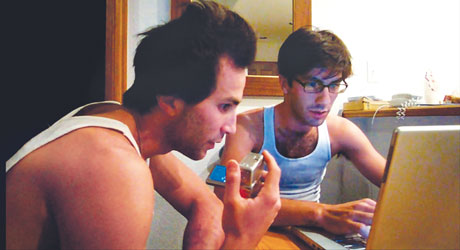
PHOTO: Ariel (left) and Yaniv Schulman during the filming of controversial documentary Catfish.
comments