



‘This is a bomb, this is the fuse’
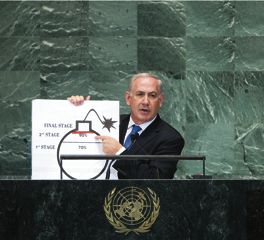
WHEN Israeli Prime Minister Benjamin Netanyahu took to the podium at the United Nations last week, his main objective was clear –he wanted to get the world to pay attention to the Iranian threat.
It wasn’t about swaying the people sitting at the UN, who already know where they stand on the Islamic Republic’s nuclear endeavours. Rather, it was about shaping the public debate about Iran, and trying to force the dangers posed by a nuclear Iran onto the radar of people everywhere – getting normal people to understand why Israel is so concerned.
And so, he took out a cartoon-style picture of a bomb, and spoke of the “three stages” necessary to make it nuclear. Iran is 70 per cent there, he said, having produced enough low-enriched uranium, and now just needs enough medium- and high-enriched uranium.
He produced a red pen and declared that the red line “should be drawn right here”, just before the end of the current stage – “before Iran gets to a point where it’s a few months away or a few weeks away from amassing enough enriched uranium to make a nuclear weapon”.
It’s not that simple, protested his critics afterwards. But Netanyahu’s point was that it is precisely that simple – if Iran completes stage two it becomes a danger to Israel’s existence and to world peace. For him, all the intelligence reports about what Iran may or may not do with a bomb are irrelevant – if Iran builds a bomb, Israel’s survival is in grave danger.
Of course many, including senior figures in Israel’s security establishment, disagree with Netanyahu’s understanding of the situation, and decry the idea of red lines past which Iran should expect a strike as backing oneself into a corner. But Netanyahu argued his viewpoint strongly, forcefully, and more importantly, in a way that normal people worldwide understand, generating an unusual UN photograph that made newspapers and news sites worldwide.
People whose minds are made up against his position ridiculed him. But he managed to thrust himself, and his deep concerns about Iran, onto the news agenda everywhere. This can impact popular opinion especially in America, where he wants to make Iran a bigger issue in the upcoming presidential elections. And could turn out to have been a kind of early investment in a wartime PR strategy – if Israel does strike Iran, he will hope that the diagram will be remembered and give the attack legitimacy.
Beyond Netanyahu’s diagram diplomacy, his speech was important for three reasons:
1. Obama
After a downturn in relations with American President Barack Obama, Netanyahu apparently tried to clear the air between them. He appeared to put to rest the idea that a unilateral Israeli attack may be imminent, indicating that Israel’s timescale was the Northern Hemisphere’s spring and not before. And though Netanyahu spoke of setting red lines, an idea that Obama has rejected, he was sure to praise Obama enthusiastically, saying: “Two days ago, from this podium, President Obama reiterated that the threat of a nuclear-armed Iran cannot be contained. I very much appreciate the President’s position as does everyone in my country.
“We share the goal of stopping Iran’s nuclear weapons program. This goal unites the people of Israel. It unites Americans, Democrats and Republicans alike, and it is shared by important leaders throughout the world. What I have said today will help ensure that this common goal is achieved. Israel is in discussions with the United States over this issue, and I am confident that we can chart a path forward together.”
He [Netanyahu]
managed to thrust
himself, and his deep
concerns about Iran,
onto the news agenda
everywhere.
2. Red lines
Netanyahu appealed to history to rebuff the argument that red lines would backfire. He insisted: “Red lines don’t lead to war; red lines prevent war.” He said that NATO, by taking the view that an attack on one member country would be considered an attack on all, has kept Europe peaceful, and that President John F Kennedy set a red line during the Cuban Missile Crisis, which “also prevented war and helped preserve the peace for decades”.
He said: “In fact, it’s the failure to place red lines that has often invited aggression. If the Western powers had drawn clear red lines during the 1930s, I believe they would have stopped Nazi aggression and World War II might have been avoided. In 1990, if Saddam Hussein had been clearly told that his conquest of Kuwait would cross a red line, the first Gulf War might have been avoided.”
3. Terror threat
In simple language and playing on fears of terrorism that exist across the Western word, Netanyahu equated Iran with terrorists. “It makes no difference whether these lethal weapons are in the hands of the world’s most dangerous terrorist regime or the world’s most dangerous terrorist organisation,” he said. “They’re both fired by the same hatred; they’re both driven by the same lust for violence.”
He said that Iran is guilty of crushing democracy demonstrations in Iran and, through its “henchmen”, supporting repression in Syria. “They abetted the killing of American soldiers in Iraq and continue to do so in Afghanistan. Before that, Iranian proxies killed hundreds of American troops in Beirut and in Saudi Arabia … In the last year, they’ve spread their international terror networks to two-dozen countries across five continents – from India and Thailand to Kenya and Bulgaria. They’ve even plotted to blow up a restaurant a few blocks from the White House in order to kill a diplomat.”
He continued: “So I ask you, given this record of Iranian aggression without nuclear weapons, just imagine Iranian aggression with nuclear weapons. Imagine their long-range missiles tipped with nuclear warheads, their terror networks armed with atomic bombs. Who among you would feel safe in the Middle East? Who would be safe in Europe? Who would be safe in America? Who would be safe anywhere?”
NATHAN JEFFAY
comments