



To cite the Talmud: Mai (what is) Chanukah?
There is so much more to Chanukah than meets the eye at first glance.
After many a yom tov, one hears comments such as: “Oh well, that’s over”; “Back to normal”; “Oh, we survived”. But in the eastern European yeshivah world dominated by the ba’alei mussar (the ethicists of Lithuania), the attitude was not that yom tov was “ariber” – “over”, but rather “es is tsugekumen a yom tov – “a yomtov has come to us and been added to our experience”. The implication was that even after the festival had passed, we would take away with us some of the spiritual baggage we had earned thereby.
So as the last of the candles/lights splutter and are extinguished this coming Sunday, other than of course our reaction to the fact that (as per the Haggadah) “they still seek to destroy us” what do we take with us from our Chanukah experience?
No doubt some will take calories and weight gain from the oily foods that characterise the festival. After all, who was it that defined Judaism as: “They tried to kill us. We won. Let’s eat.”? And what better excuse to eat hot and fatty foods than the miracle of the oil, allowing us to claim religious purpose exemption from dieting? However, there are undoubtedly some spiritual lessons to be taken away as the memory of the festival fades.
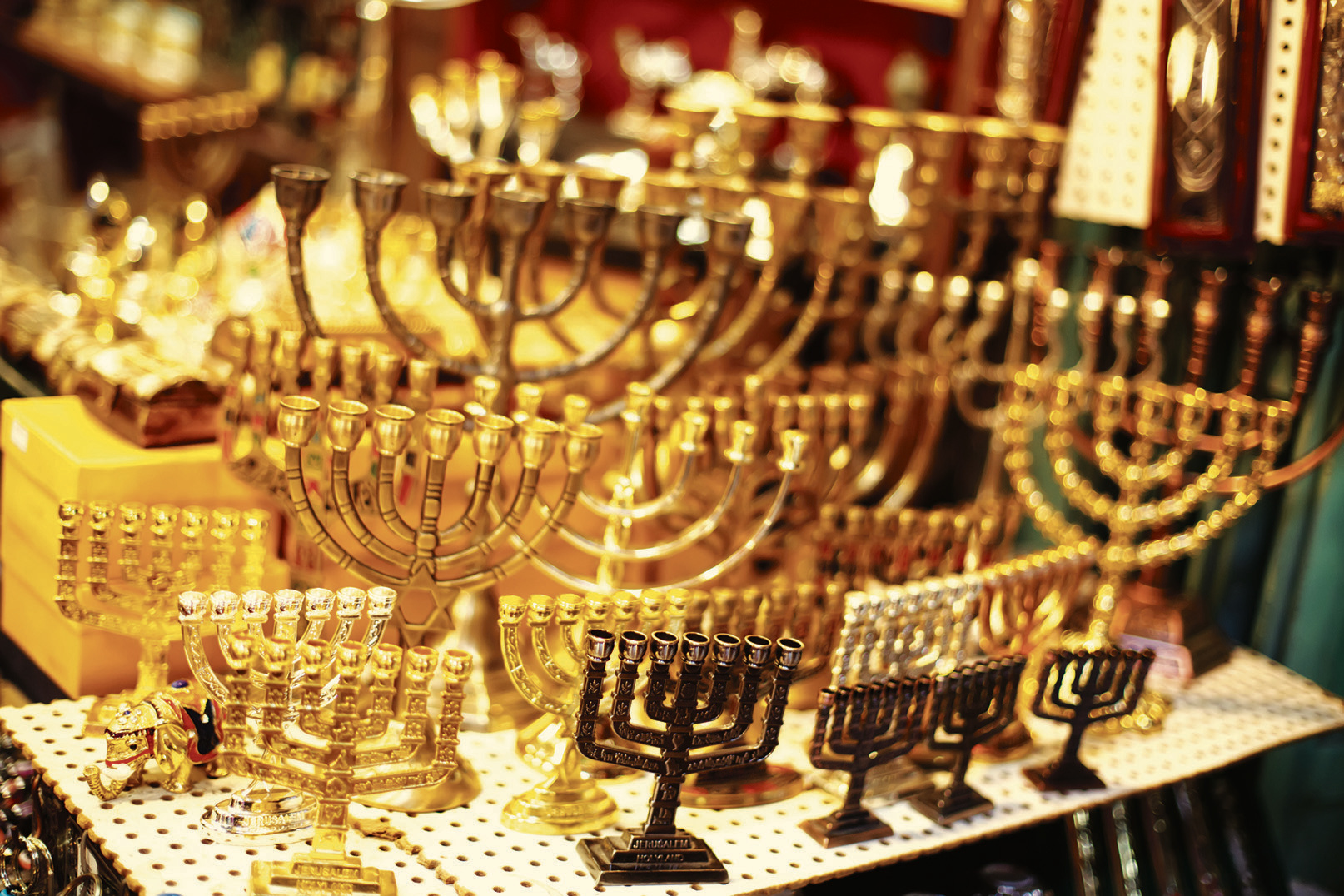
As is well known, the menorah lit on Chanukah reminds us of the reconsecration of the menorah in the Beit Hamikdash. But the interesting halachic detail that bears relevance is that the primary commemoration of the Chanukah miracle does not take place in the shule, the contemporary heir to the Temple of old. While a menorah is lit in shule as well as in homes to achieve “pirsumei nisa – publicising the miracle”, the most important element of Chanukah ceremonies is to light in the house in which one eats and sleeps.
Regarding the mishkan, the portable tabernacle in the desert, Israel was told “ve’asu li mikdash veshachanti betocham – and you shall make me a holy place and I will dwell among them”. The rabbis comment that it doesn’t say that when the mishkan was built God would dwell in it. Rather, it says that when they have constructed a holy place in their midst God will dwell among them – in the heart of each individual. Lighting the menorah in the home reminds us that we turn each home into a temple of God from which spiritual light shines forth. Nevertheless over centuries various rabbis have given us additional insights into this preference for the home despite what historically might have been preferred as the place to kindle the menorah – the shule.
Thus Rav Avraham Yitzhak Kook highlighted how the Torah refers to the Jewish people as “a kingdom of priests and a holy nation.” Suggested Rav Kook, every Jewish home is considered a temple, and every Jew a priest. Thus, we light the menorah within our own temple – the Jewish home.
Many decades earlier, Rabbi Samson Raphael Hirsch who lived in Germany in the 19th century was frustrated by the emphasis in the early Reform movement where Judaism was almost completely focused in the synagogues and the temples. He even went as far as saying that he would like to close all the synagogues for a month or two just to demonstrate that the primary locus of Jewish holiness, of Torah study, performance of the commandments, and Jewish education was in each person’s home not in the communal institutions of the synagogues and schools. By lighting the menorah in our homes, we express this same idea that continues way past those eight days when we specifically light the chanukiah.
But there is another lesson to take forward as well.
The correct position for a menorah is in the doorway of the house, facing the outside. The reason is the aforesaid “pirsumei nisa”, publicising the miracle to the world. Nowadays, this has taken a giant leap forward, with the placement of Chanukah lights in so many public places (albeit that seeing such does not fulfil the halachic requirement for individuals to light at home) – though sadly as Melbourne Jews discovered in regard to placement of a menorah at Malvern Town Hall, the current wave of antisemitism is interfering with this recent tradition.
However, that regrettable development aside, what is the lesson we Jews and so many other influential public officials and dignitaries involved in lighting ceremonies learn from those public candelabras? Is it just a reminder that there is a Jewish equivalent to other festivals at this time of the year and that in a multicultural society we all celebrate together? Or is it a reminder that this is a festival celebrating a real event that took place in a real temple that really existed on the Temple Mount in Jewish Jerusalem? There is much to be said in this regard. (Note: These lines were written before the horrific Chanukah eve event at Bondi Beach. Clearly a public Jewish event held for whatever reason is a potential target for our enemies. How this event – perhaps to be categorised as Australian Jewry’s “October 7” – will play out in the future in regard to Chanukah celebrations and other matters, remains to be seen.)
On a happier note let me however conclude with reference to some popular customs entrenched in Chanukah celebrations
Playing dreidel is not just a child’s game. Although our sources don’t mention it earlier than the 18th century, numerous reasons have been suggested for the custom in which many Chassidic sages indulged (and many still do). Others associated with this custom include the Chatam Sofer of Pressburg who is particularly known for emphasising the role of minhag – custom – in Judaism.
The most famous explanation is based on the historical Hellenist opposition to study of Torah, and this was a way for Jews under Hellenistic persecution to disguise their study of Torah by pretending to engage in gambling with tops, or by children pretending to be playing when they were actually assembling to study. On a different plane, The Chassidic great, Rav Zvi Elimelech of Dinov (the Bnei Yissoschor), who wrote much regarding Chanukah, saw the four sides of the dreidel as alluding to four kingdoms that oppressed and exiled the Jewish people: Babylon, Persia, Greece and Rome. The fall of the spun dreidel symbolises the ultimate fall of each empire, whereas its two constants, the points around which history revolves – the destiny of the Jewish people, and the Hand of God that spins from above – symbolise the future redemption. The opposition forces will be nullified, and the world will unite with the Jewish people in the service of God.
Surprisingly, given the significance of food at Jewish celebrations, on Chanukah there is no obligation to have a special meal. Talmudically it is simply a time of lighting a lamp (at least one) and recitation of thanksgiving for the miracle and Hallel. One reason suggested for the absence of a food related aspect of the celebration is that the threat of the Hellenists was primarily spiritual, not physical – assimilation as opposed to annihilation. This is in contrast to Purim when the threat was physical annihilation, and hence the celebration is primarily physical – food, gifts and wine. Having said that however, inevitably specific Chanukah customs developed related to food.
We are told that the daughter of Yochanan the High Priest, Yehudit, gave the Greek governor, Holofernes, cheese and wine when she was taken to him on her wedding night, (in accordance with a decree that brides be required to ‘spend time’ with the Greek governor). When he was drunk, she took his sword and killed him. In his glosses on the laws of Chanukah codified in the Shulchan Aruch (670:2); Rabbi Moshe Isserles (Cracow, 16th century) refers to this as a reason why it became customary to eat dairy foods on Chanukah. Notably his ruling is based on references found in writings such as that of Rabbenu Nissim of Gerona dated two centuries previous to his time.
In fact, one of the oldest Chanukah foods, dating back to the 13th century, was the cheese pancake, fried in olive oil. This food combined two elements of Chanukah, the cheese commemorating Yehudit and her courage, and the olive oil, commemorating the miracle of the menorah. However, once potatoes were introduced to Europe, they became a staple of the eastern European diet and were used to make latkes – albeit with oil but not cheese. The now ubiquitous sufganiyah (doughnut) only really became a Chanukah food just a century ago in the 1920s when it was pushed by the Histadrut trade union in Israel in order to provide much needed employment to workers. Unlike latkes, which could easily be made at home, sufganiyot were produced in bakeries and hence created an opportunity for employment.
May the light of the menorah continue to illuminate the whole world through the coming year.
Shabbat shalom, Chodesh tov,
v’Chanukah sameach,
Yossi
comments