



Tony Abbott’s way
PETER KOHN AND NAOMI LEVIN
CANBERRA has a habit of turning yesterday’s rooster into today’s feather duster — as deposed Liberal leader Malcolm Turnbull and his successor Tony Abbott discovered last week.
But what does the Liberal leadership change mean for the Jewish community and for Israel?
Undoubtedly, Abbott is a passionate advocate of Israel, believing it to be the flag-bearer of liberal democracy in a region known for authoritarian regimes and dictatorships.
Notably, Abbott, when he was health minister in the Howard government, told a State Zionist Council of Victoria meeting in 2003 that, given Israel’s democratic credentials, “reluctant” support for Israel in the West can only be attributed to “anti-Semitism”. It was a theme the Member for Warringah continued at a Sydney fundraiser some years later.
The Rambam alumnus also staunchly opposed awarding the 2003 Sydney Peace Prize to Palestinian activist Dr Hanan Ashrawi, a position not widely shared outside the Jewish community at the time.
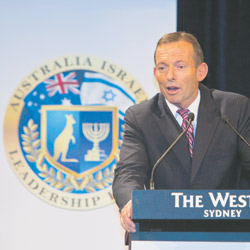
In an address to an Australia Israel Leadership Forum lunch in Sydney last week, Abbott observed that “except for the threat of terrorism, no Australians visiting Israel could think they are in a foreign country. It is a great country, and I think Australians naturally warm to the Israeli people.”
His message is one of affinity between the two countries, a way of seeing world events through the same lens -— something that goes beyond support.
That said, the leader Abbott replaced was also a great friend of the Jewish community and Israel, and even if Turnbull, as the Member for Wentworth, was directly representing his sizeable Jewish constituency, the consensus was that he did so in an intimate way that transcended the banality and platitudes that the politics of shared interest sometimes elicit from politicians.
Representing Wentworth in Parliament is a role Turnbull intends to continue, at least for the time being. His office confirmed to The AJN that he and his wife Lucy will spend the upcoming end-of-year break considering whether to contest the seat at the next election.
Jewish Canberra-watcher Dr Philip Mendes made the point that while Turnbull was a leader whose seat had a strong Jewish population, that is not the case with Abbott.
“He is a social conservative, with views on some issues that perhaps not many in the Jewish community might share, and there is the potential for some tension there.
“But these are not issues that the Australian Jewish community tends to run on much, and his strong support for Israel will gain him much support from Jews,” said Dr Mendes, who is associate professor of Monash University’s Department of Social Work and co-author of Jews and Australian Politics.
Reaction from the organised Jewish community to last week’s leadership tsunami has given plaudits to both victor and vanquished.
Executive Council of Australian Jewry (ECAJ) president Robert Goot expressed the community’s “deep gratitude” to Turnbull for his assistance and support, and “the extent to which he had made himself available to the ECAJ and generally to the community”.
Goot said he also looked forward to the continuing association of the ECAJ and Turnbull, as the Member for Wentworth.
As for Abbott, Goot said the community expected its warm relations with the Opposition Leader of the day to continue.
He noted that Abbott had visited Israel and was committed to its security, which “his speech at the Australia Israel [Leadership] Forum luncheon … made abundantly clear”.
Goot has written to the new Opposition Leader requesting a formal meeting early in the new year.
The Australia/Israel & Jewish Affairs Council (AIJAC), for its part, paid tribute to Turnbull as a figure in “the Liberal Party’s proud tradition of leaders who support the Jewish community and Jewish State, never afraid to speak out publicly for Israel’s right to defend itself”.
In Abbott, AIJAC executive ­director Dr Colin Rubenstein sees a continuation of the Liberal leadership as personified by former prime minister John Howard, and in leaders Brendan Nelson and Turnbull.
Dr Rubenstein last week recalled a speech Abbott gave at a Sydney rally during the depths of the Second Intifada. The 2003 State Zionist speech was also a touchstone for the AIJAC executive director, particularly Abbott’s reference to Israel’s “essential decency”.
Beyond Middle East issues, Dr Rubenstein lauded Abbott’s record in opposing One Nation, and noted that the new Liberal leader “greatly values the contribution of Australian multiculturalism to our harmony and vitality as a nation”.
Zionist Federation of Australia president Philip Chester said he hoped Turnbull would not be lost to federal politics. “He still has a lot to contribute. His record of support for Israel and local Jewish causes is outstanding and I want to acknowledge all that he has done to stand up for Israel’s position, even at times in the face of significant opposition.”
Chester was also struck by Abbott’s understanding of Israel as a robust democracy. “I have heard him speak at functions of the Zionist movement, in which he expressed a strong friendship for Israel and a good understanding of Israel’s important role as a democratic, modern state in a largely autocratic Middle East.”
But what makes Tony Abbott tick? Julian Leeser, who was an adviser to the Liberal leader in 2001 when Abbott was workplace relations minister, acknowledged the new leader’s forthrightness.
That is a characteristic, one might add, that last week triggered a recounting of Abbott’s news bites on everything from verbally assailing asbestos victim Bernie Banton to supporting 70 as the retirement age, and his opposition to the Government’s proposed Emissions Trading Scheme legislation.
Many see him as a bluntly spoken conservative, persuaded strongly by his devout Catholicism, and cast in the unfashionable style of the conviction politician.
Leeser views Abbott’s unwavering ideological jaw as a sign of moral clarity. “He is a person of strong values and strong commitments, and he is a person with whom the community will be able to have a good sense of where he stands. He is a person who you can always pick where he would be on a particular issue, which I think is a very reassuring thing.”
His former adviser said Abbott does not personalise ideological differences with others.
“The remarkable thing about him is that he is a person who has always got on very well with people who he disagrees with and always enjoys the company of those with whom he disagrees. He would rather have a good debate with someone. He is very much a ‘play the game hard’ person but, at the end of the day, has friendships with people.
“He is also a person who is very concerned with the written language. He has described the Liberal Party in the past as being ‘rhetorically challenged’,” said Leeser. “You could write a few ideas for him, but his written work is all his own and always has been, and I think that is very admirable.”
comments