



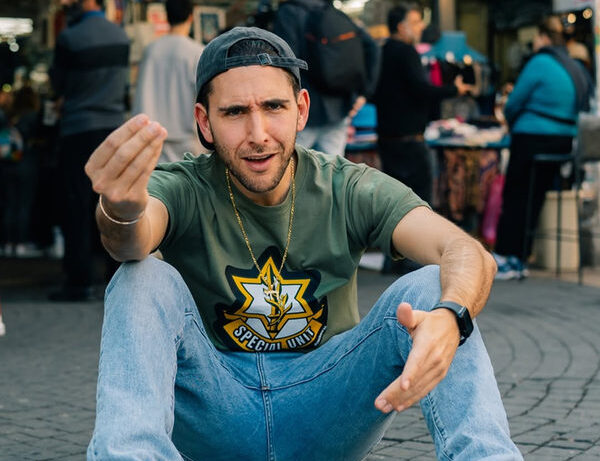
Zach Margolin once stood in front of a Hamptons audience and asked the local rabbi whether it was true he was known as the Tony Soprano of the Hamptons. The rabbi’s reply, as Margolin tells it, was short.
“He said, ‘You’ll find out after the show,'” Margolin told The AJN. “It was a really funny moment. I love getting it back as much as I love giving it.”
None of it was planned, which is how the comedian known online as Zach Margs likes the best part of his live show to go. Later this month, he will bring that format to Sydney for his first Australian performance, with a Melbourne show to follow.
“I’ve never been to Australia before. It’s my first time and I’m super excited,” he says. “I’ve wanted to come to Australia my whole life.”
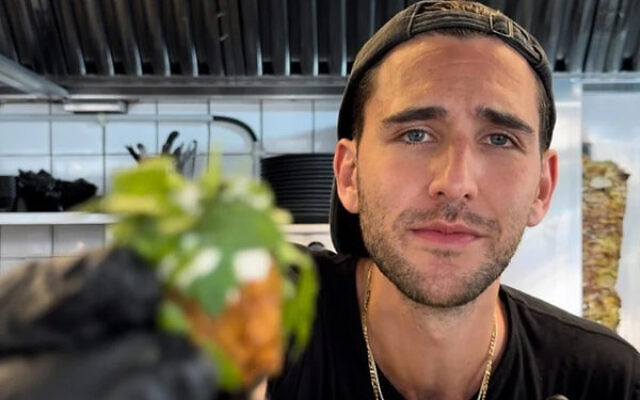
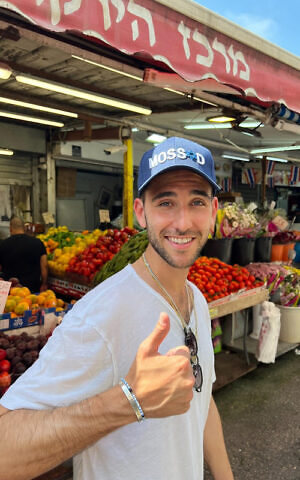
Margolin is a London-born comedian with more than 300,000 Instagram followers. He posts short videos in which he plays a rotating cast of characters: the Tel Aviv beach waiter with a casual approach to service, the taxi driver who smokes in the car and offers to find you a partner, the shuk vendor, the El Al security agent who treats every passenger as a suspect, and the El Al pilot who conveniently was a fighter pilot in the army so can handle any bumps in the sky.
Much of the material comes from life. Margolin says the original beach waiter was a real waiter, and the taxi sketches draw on rides he has taken.
“The first one, the waiter, was literally based off an actual guy who was my waiter,” he recalled. “I listen all the time to what people are saying. At the start I was just guessing, but now I ask Israeli friends, ‘What is the actual, authentic way to say this?'”
Margolin grew up spending summers and winters in Israel, with school trips and youth programs, and counts some of his best childhood memories from the country. His early videos, he said, were the observations of a tourist, and he later set out to make them authentic by practising Hebrew and building friendships with Israelis.
The instinct for comedy came from his mother’s side. His late grandfather, Gerry, worked as a stand-up comedian in his younger days, touring the United Kingdom until he married Margolin’s grandmother, whose parents made clear a comedian was not what they had in mind for a son-in-law.
“He gave it up in order to marry my grandmother. But he still loved comedy his whole life,” Margolin said. “I think I was the only grandchild who really took to it.”
By school he was the class clown. At 14, his father took him to see British comedian Michael McIntyre, which he still describes as the greatest thing he had ever seen. A high school yearbook entry asked where he wanted to be in 10 years. He wrote that he wanted to be a stand-up comedian.
“There’s a fine balance. But overall, I think it’s something people want and need. It’s something Jews do very well, finding humour and light in darkness.”
But, he didn’t pursue it. At first.
“I didn’t consider it a real career,” he admitted. “I decided to take a safer route.”
That meant a business degree, a master’s in real estate and a graduate scheme qualifying as a surveyor in the UK. But it didn’t bring him joy.
“I didn’t like wearing a suit and being in the office all day,” he said. After a stint at film school in London, the pandemic arrived, and he began posting on TikTok daily. When restrictions lifted, he went back to real estate.
The turning point came in 2023 on a Tel Aviv beach. Margolin had his friends in stitches as he mimicked a particularly bad waiter. One of his friends told him to film it.
“I edited it, posted it on my TikTok, made my Instagram public for the first time because I had a private Instagram, and posted my first TikTok in about 18 months,” he recalled. That video went viral.
Then came October 7.
In the weeks after the attack, he said, nearly everyone online was posting serious content and almost nobody was making anything light.
“I just decided to make fun content about Israel and continue what I was doing,” he said. “I think it really resonated with people.”
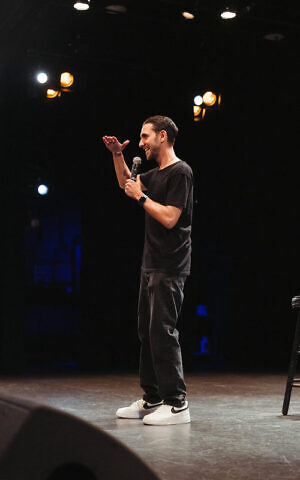
In December 2023, two months after the attack, he travelled to Israel for the first time since the war began. He told The Times of Israel the trip was organised by a diplomatic organisation and included visits to Kfar Aza and Nir Oz, two of the worst-affected kibbutzim. Videos he made on that trip, including the taxi driver, were widely shared, and the cast grew. He has also used his platform to tell the stories of survivors, including a Nova festival survivor whose video drew about two million views, and to campaign for the hostages’ release.
Invitations to perform live followed, including from a New York comedy club.
“I’d done stand-up at university, in the comedy society, and I used to host my friends’ weddings, so I was very comfortable on the microphone,” he said. “I wondered if I could apply that to Israel and Jewish stuff. I just went for it, and thank God it went well.”
His first New York show was at a deli in late 2024. By January 2025, he had left real estate and has worked full time in stand-up and content since. “It’s still my favourite thing to do,” he said. “It’s the scariest thing I ever do, but the most fulfilling thing ever.”
His rise has coincided with a long period of fear and grief for Jewish communities, and the question of when to post, and when not to, comes up often.
His hardest case came on the first night of Chanukah last year. He had spent months on The Gvinch, an eight-part parody of the Grinch in which a Jewish Grinch steals Chanukah, with one installment due each night of the festival. About 20 people worked on it. Then came the Bondi terror attack.
“I designed this thing for months, and set out to release it for one night of Chanukah,” he told The AJN. “And then there had literally been a terrorist attack, and people had been killed celebrating Chanukah. Is it now inappropriate to post a funny Chanukah video? That was really the hardest one.”
He went ahead, acknowledging what had happened in his post.
“I explained that I’m not being insensitive. I actually think this is exactly the type of thing we need, positive Jewish stuff out there.”
“There’s a fine balance,” he explained. “But overall, I think it’s something people want and need. It’s something Jews do very well, finding humour and light in darkness.”
He says he does not feel pressure about how his work is read, because he does not see it as political. The exception was the hostages. While they were held in Gaza, he posted regularly about them, which he has always regarded as a human issue rather than a political one.
“I’m just offering a different lens on Israel and Jewish people. I’m not telling you who to vote for or what I think of the conflict. This is what it’s like to order shawarma, this is what it’s like to go to the beach, this is what it’s like to get in a taxi. Once you laugh at someone, it becomes very hard to deny their humanity.”
While the majority of people love to laugh alongside Margolin, the online response has not been uniformly warm. The comedian receives hate messages, including death threats, alongside the support from a loyal base of non-Jewish followers.
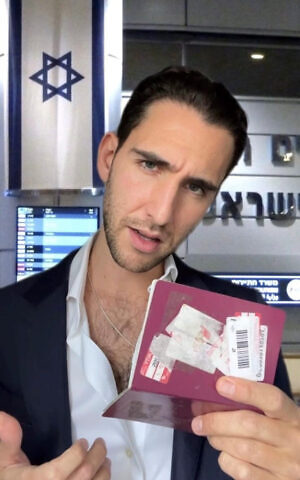
And since mid-2025, there has been more personal upheaval. Margolin was in Israel in June that year when the conflict with Iran began, and his apartment was all but destroyed by a missile. He then had spinal fusion surgery, an operation he told JFeed beforehand would keep him in hospital for 10 days. His return to the stage, in February at London’s Leicester Square Theatre, was titled Zach’s Back. He performed to a full house.
Margolin said though that while he loves sharing his shticks, the part of every show he is most excited about is also the part nobody can script.
At each and every show, Margolin steps into the El Al security agent, walks into the audience and asks personal questions. And whatever people say shapes what happens next. He names Sacha Baron Cohen as his idol, and says improvised character work is his favourite thing to do.
“It’s the best part of the show, hands down,” Margolin said. “I don’t know where it’s going to go, and the crowd don’t know where it’s going to go. It’s happening right here, right now in this room, and it will never happen again.”
He says the character makes it easier.
“When I switch into this Israeli character, I actually find it way easier to do improvised stuff, because I don’t feel like I’m me. I can be more chutzpadik and say things I wouldn’t necessarily say, but this character would.”
He says he researches each community before he arrives, so he can make local references he “really shouldn’t know about” if he were not from there.
It’s something he’s already preparing for with his Australian visit.
Margolin says ticket sales on past tours often start slowly and surge in the final week. Australia, he said though has been different. “I’m really feeling the love, and I really appreciate that, because sometimes it’s a hard sell to get people to come out on an evening and see a show.”
He also has friends from Australia living in Israel, and has formed an impression of what to expect.
“They’re huge characters, loud, proud, and so up for a good time,” he said. “That’s the vibe I’m hoping for. I feel like Australians love banter, and I think I’ll get it back from people in the crowd.”
When Margolin talks about the future, the ambitions are those of a working comedian: more shows, bigger rooms, perhaps a television platform. But he keeps returning to why he started posting the way he did.
He told The Times of Israel in 2024 that he had come to feel a responsibility to humanise Israelis and Jewish people after seeing the response to his videos.
Asked what he makes of the work now, his answer is short. “I love it,” he said. “Best job in the world.”
Zach Margs will be performing in Sydney on October 29 and in Melbourne on November 5. For tickets, visit zachmargs.com/pages/live-shows
comments