



UN commission quits Israel investigation
Resignations, including ex-UN rights chief and follow U.S. sanctions on anti-Israel investigators.
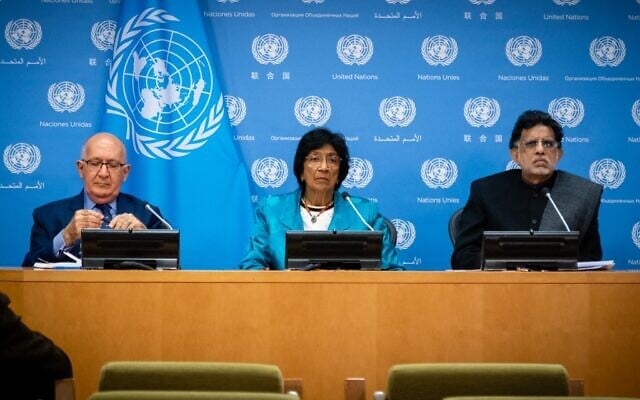
(THE TIMES OF ISRAEL) The three members of a United Nations commission tasked with investigating Israel quietly resigned earlier this month.
Navi Pillay, Chris Sidoti and Miloon Kothari — who made up the UN’s Commission of Inquiry on the Occupied Palestinian Territory — submitted their resignation letters to the president of the UN Human Rights Council. The letters surfaced on Monday.
Pillay, 83, the commission’s chair, said she was resigning “owing to age, medical issues and the weight of several other commitments” on 8 July.
Sidoti resigned a day later, calling Pillay’s retirement “an appropriate time to reconstitute the commission”, while Kothari said the group had reached an “understanding” the previous week.
The letters were posted on a back-end Human Rights Council website and first publicised by UN Watch, a nonprofit monitoring group.
The commission will continue to exist once new members are appointed. Jürg Lauber, head of the Human Rights Council, has asked member states to propose replacements by 31 August.
The commission has issued regular reports on the Israel–Palestinian conflict, overwhelmingly blaming Israel. Its most recent report was released in May.

Pillay, a South African jurist, served as UN High Commissioner for Human Rights from 2008 to 2014, during which she frequently criticised Israel’s actions in Gaza.
She chaired the commission of inquiry, which Jewish groups, Israel, the United States and other countries have condemned for alleged bias. It is the council’s first open-ended commission of inquiry — the UNHRC’s highest level of investigation.
The commission has consistently blamed Israel for the conflict and accused the Jewish state of additional wrongdoing, such as stealing natural resources.
Kothari sparked outrage in 2022 when he claimed social media was “controlled largely by the Jewish lobby” — invoking a common antisemitic trope — and questioned why Israel was allowed to be a UN member.
Pillay defended Kothari’s comments.
She has previously dismissed concerns about antisemitism as “a diversion” and “lies”, and labelled Israel’s security concerns “a fiction”.
In 2014, more than 100 members of the US Congress signed a letter to Pillay, denouncing the UNHRC’s bias against Israel under her leadership and stating the council “simply cannot be taken seriously as a human rights organisation” while it was investigating Israel but not Hamas.
The resignations come as the US steps up pressure on international investigators targeting Israel.

In February, the US imposed wide-ranging sanctions on International Criminal Court chief prosecutor Karim Khan after he filed arrest warrants against Israeli Prime Minister Benjamin Netanyahu and former defence minister Yoav Gallant. The court works closely with the UN.
Khan’s US-based assets were frozen, he was barred from entering the country, and his bank accounts and email access were blocked. American staff were warned they could face arrest if they entered the US, according to the Associated Press.
Earlier this month, the US also sanctioned UN special rapporteur Francesca Albanese, a vocal critic of Israel with a history of antisemitic remarks. Like Kothari, she has railed against the “Jewish lobby”.

Opponents of the commission welcomed the resignations.
“First, US Secretary of State Marco Rubio made the historic decision to sanction Francesca Albanese,” said UN Watch director Hillel Neuer. “Now the architects of the UN’s anti-Israel inquisition are fleeing the ship. The tide is turning.”
Anne Bayefsky, head of the Touro Institute on Human Rights and the Holocaust and Human Rights Voices, said Pillay “has spent almost twenty years championing antisemitic causes from the highest of UN roles”.
Both the UN General Assembly and the Human Rights Council continue to condemn Israel more than any other country each year.
AFP contributed to this report.
comments