



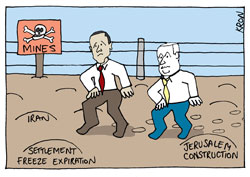
Washington summit a political minefield
BOTH US President Barack Obama and Israeli Prime Minister Binyamin Netanyahu have reasons to hope that Tuesday's White House meeting between the two leaders will go smoothly
ANALYSIS
WASHINGTON – Both US President Barack Obama and Israeli Prime Minister Binyamin Netanyahu have reasons to hope that Tuesday’s White House meeting between the two leaders will go smoothly, even as a minefield of issues threaten to derail it.
“The Americans and Israelis with whom we’ve met all seem quite optimistic that both sides are intent on having a positive meeting,” said the executive director of the American Jewish Committee, David Harris, who is in Israel this week. “Both sides understand that there’s a lot at stake in having a positive outcome.”
As opposed to the last two – or almost two – times.
Netanyahu’s last visit to Washington, in late March, was marred by the aftermath of the tensions that followed Israel’s announcement about two weeks earlier of new building in eastern Jerusalem just as Vice President Joe Biden was in Israel for a visit.
Top US officials called the announcement an insult, and when Netanyahu and President Obama met they kept their deliberations behind closed doors, failing even to issue a summary statement.
Both sides spent subsequent weeks easing tensions, and a follow-up meeting was planned for June.
But then came Israel’s May 31 raid on a Turkish Gaza-bound flotilla. Netanyahu, already in North America, cancelled the White House meeting and rushed back to Israel.
The Obama Administration gave qualified support to Israel during the widespread outrage that followed. The US blocked a United Nations Security Council resolution, but signed on to a weaker censure. Washington also pressed Netanyahu to set up an inquiry – complete with international observers – and substantially ease sanctions on Gaza.
The sides are likely to come to Tuesday’s meeting with two items unresolved: What Israel plans to do once its 10-month partial freeze on West Bank settlement building lapses in September, and how the sides plan to confront Iran.
The first issue is likely to be the most contentious: The Obama administration wants to keep the Palestinian Authority in the process, having finally lured it into proximity talks. But if Netanyahu doesn’t have direct talks to show for his efforts, it will be a hard sell to keep his right-leaning Cabinet on board.
Another potential bone of contention may be Jerusalem, whose mayor, Nir Barkat, is pressing ahead with East Jerusalem construction plans the US opposes.
On Iran, the difference may be more fundamental. Ostensibly the news for Netanyahu is good: The United Nations Security Council passed expanded sanctions this month to pressure Teheran to end its nuclear program, the European Union followed suit, while the US Congress trumped them all with the toughest sanctions yet.
However, Israeli officials are well aware that sanctions alone may not be enough to sway Iran and are eager to discuss what the US is prepared to do next, including military options. Obama thus far has shunned military discussions, preferring instead to “keep the door open” for diplomacy.
Israeli Defence Minister Ehud Barak toured the United States last week, and in his meetings with Clinton, national security adviser James Jones and Defence Secretary Robert Gates, Barak outlined what is shaping up as his proposal to synthesize the two emerging crises: Barak wants Netanyahu to announce a bold peace initiative with the Palestinians as a means of freeing Israel diplomatically to operate in the military sphere should the need arise with Iran.
It’s not yet clear how the US responded to the plan or even whether Barak’s strategy has broader backing in Netanyahu’s coalition.
Ron Kampeas
JTA
The AJN’s Ahron Shapiro contributed to this analysis.
comments