



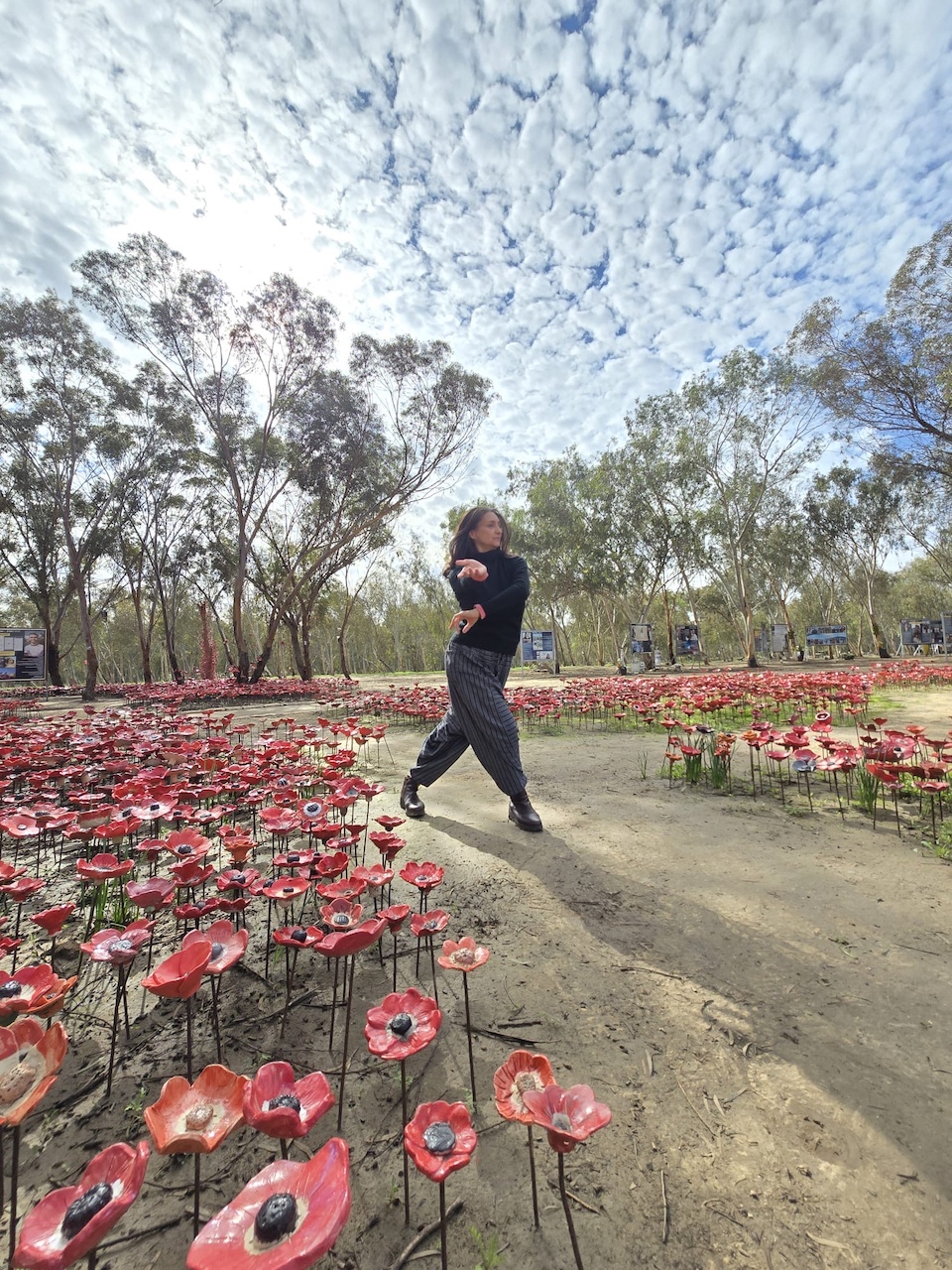
When flamenco dancer and choreographer Annalouise Paul arrived at the Nova Music Festival memorial site on New Year’s Eve 2025, she was wearing flat boots. Not ideal for flamenco.
But by the time she left, she had danced among ceramic red poppies and raved on the DJ stage.
“There are 420 souls here that lost their lives,” Paul told the site’s creator and curator, visual artist Amir Chodorov. “Imagine 420 dancers?”
Paul had flown to Israel in December 2025 from Seville, where she had been undertaking intensive flamenco training and research as preparation for her upcoming work-in-progress Self Portrait. It was, she says, a gut feeling that compelled her to go.
“The war in Israel was nearly over, one hostage remained and I woke up one morning in November and thought, just go,” she said. “It was a gut feeling that I needed to follow.”
She hadn’t been back to Israel since she lived there. Her parents made Aliyah when she was four years old. While there, the day after her birthday, news reached her in Tel Aviv of a terror attack at Bondi Beach. As the day wore on, she would find out that fifteen innocent people were murdered.
“It was stunning and debilitating to hear the news from so far away,” Paul said. “My first day in Jerusalem I went to the wall, naturally. I penned ‘Bondi’ on a note and placed it in the cracks.”
Bondi is personal for Paul in a way that goes beyond geography. Her parents met at the Bondi Pavilion in the 1950s. It was, she says, “our family beach.” That same pavilion is where her new work, Self Portrait, will be presented.
Her visit to the Nova site came through an introduction to Chodorov via an Israeli-Australian organisation. When she was asked if she had been “down south yet,” she replied enthusiastically — not yet realising what “down south” meant.
The next morning, she and Chodorov drove to the site at 6.30am. On the way, he walked her through the project’s history: the placards, the photographs, the careful placement of each victim next to people they knew. They passed roadside shelters where, he told her, bodies had been piled.
“The atmosphere is palpable, weighted,” Paul said. “Its immediate — as soon as you drive in you feel it.”
She had not planned to dance. But her body, she says, was already urging her to before they arrived. When she asked Chodorov if anyone had ever danced there, he said no. But told her to see what she felt when she got there.
“That was the call,” Paul said. “So as soon as we got there without hesitation I started looking for a suitable spot.”
She danced in the gaps between the portraits, made her way to the field of ceramic red anemones — a giant Magen David–shaped floral installation commissioned by Chodorov and created by ceramicist Yaffa Solomon — then to the DJ stage, where she performed flamenco at Chodorov’s request, near an image of Matan, the DJ who had been on the mic the morning of the attack, urging the crowd to take cover.
“Matan’s mother will love it,” Chodorov told her. “He loved to make music, he loved rhythm, so flamenco is perfect.”
It was at the DJ stage that an unplanned moment unfolded. A young Canadian man had been watching. Paul asked if he wanted to dance. He said he only raved. “That’s cool, let’s rave then,” she replied.
“We moved to the other side of the DJ stage and I started to move freely,” Paul recalled. “He mirrored me at first and then found his own expression — and he was fantastic! We danced together for quite a while taking over the entire area and ended in a big bear hug.”
Chodorov posted photos and videos to social media. The response was sharply divided. Some families were delighted, saying it was exactly what should be happening there. Others were angry, calling the site sacred.
Chodorov’s response, Paul explained, was clear: “This site is for everyone. For all the Jews of the world.”
To Paul, it was also for Bondi. The two sites had merged in her body and her movement.
“It wasn’t until I got to Nova, with its immense heart and heaviness, that my dancing was very much about Bondi,” she said. “Everyone around me knew and cared because for them, Bondi was their tragedy too.”
Self Portrait, which the Bondi Pavilion partially commissioned prior to the December 14 attack, draws on Paul’s research into the Sephardic roots embedded within flamenco. It’s a connection she has pursued through a fellowship into Sephardi connections in the art form. Last year she was also included in Chutzpah Girls: 100 tales of daring Jewish women, as the only Australian woman featured.
Ahead of the shows, Paul plans to run a dance and healing workshop open to the Jewish community, the Waverley community, and the general public. She also intends to hold a tribute after each performance for the victims of the Bondi attack.
She is also thinking bigger.
She and Chodorov have been discussing a memorial event at the Nova site that would incorporate dance.
“Dance needs to be part of the vision,” Paul said. “We Will Dance Again is the slogan of the survivors — dance was in their souls.”
Self Portrait plays at the Bondi Pavilion on June 3–4. For more information and to support the production, visit australianculturalfund.org.au.
comments