



We need safe places for all
This rhetoric dismisses the beliefs of over 90 per cent of Australian Jews and justifies presenting a one-sided narrative.
The rise in antisemitism in Australia is astonishing. It has escalated from campus protests to caravans full of explosives and claims of as “only reacting to the war” to credible threats to anyone Jewish. For those of us working or studying at universities, it is a daily reality. Something that has been brewing in the progressive far-left and infiltrated academia has been allowed to surface, delegitimising the existence of the State of Israel and redefining Zionism as a taboo, all in the name of identity politics.
Zionism is often distorted in academic and political discourse, stripped of its core meaning: the belief that Jewish people have the right to self-determination in their ancestral homeland. Yet, in today’s academic circles, being a Zionist is equated with colonialism, genocide and bigotry, shutting down dialogue. This rhetoric dismisses the beliefs of over 90 per cent of Australian Jews and justifies presenting a one-sided narrative.
Sarah: For 15 months, I’ve documented escalating campus hostility. I’ve been pushed, called a “murderer” and “genocide supporter”, and targeted while recording events. I saw hateful graffiti, calls for Israel’s destruction, and Israeli hostage posters torn down – replaced with ones justifying Hamas. One day, I took a flyer claiming Israel occupied Palestine since 1948, I asked the student, “Don’t you mean 1967?” and explained that Gaza and the West Bank were under Egyptian and Jordanian rule. They arrogantly and dismissively walked away.
Sharon: I have faced racism my whole life in Australia and recognise it instantly. But I never expected to encounter antisemitism – something I once saw as “history”, not a reality in Australian society. Since October 7, academics have gossiped about me, reducing me to “married to a Jew”, while colleagues and peers have unfriended me on social media.
University campuses have become battlegrounds, with terms like “genocide” and “apartheid” weaponised to demonise the Jewish people and to silence any and every expression of a different view. This rhetoric erases Jewish suffering while supporting the actions of Hamas and placing Palestinians (or their supporters) beyond criticism. Jewish academics face a no-win situation – pushing back accusations of racism and bigotry, while silence enables erasure. There is a constant denial of the rights of Jewish staff to complain.
Andy: I realised the campus had changed when on October 14, 2023, my son was sent an email from the university offering to provide a security escort to accompany him between classes. At what point does acknowledging risk become an acknowledgment of an unsafe environment?
Sarah: I wear a Star of David because I’m a proud Jew – and to make a point. But even before October 7, I told students I was American, not Israeli, to avoid any potential negativity. A co-worker, out of the blue, asked if I supported killing Palestinians, adding that Israel was committing a holocaust. She didn’t want a conversation, just to check if I’m a “Good Jew”.
Sharon: I’m now completing my PhD online, including supervisory meetings. I even felt the need to be excused from attending last year’s mandatory HDR conference.
Discussions on racism often exclude Jews, labelling Zionism as its epitome, making it convenient in academia to ignore or excuse hate speech – justified as what Zionists deserve – while universities champion free speech yet ignore that Jewish people are silenced.
Andy: At the University of Sydney, we felt largely unsupported, and so we took a case to SafeWork NSW. The endless protests and hostility on campus is exhausting for Jewish staff and students which creates a work environment that is not psychosocially safe. The vice-chancellor wrote that the price of freedom of speech might make some Jewish staff feel uncomfortable.
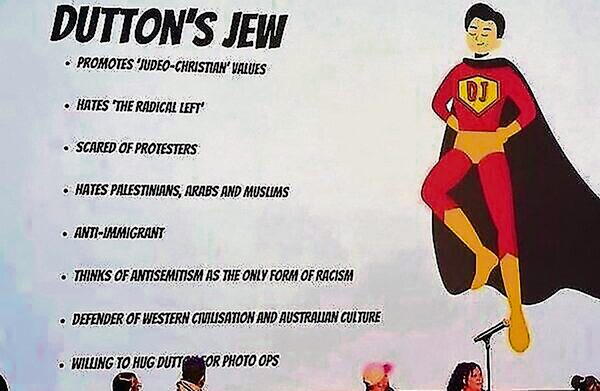
A recent example of how language can be weaponised occurred during an “anti-racism” symposium at Queensland University of Technology where the term “Dutton’s Jew” was coined by an “anti-Zionist” Jewish activist.
Andy: This reminds me of portrayals of Jews throughout history including propaganda and tropes. You can’t reduce Jews to bullet points on a slide.
Sarah: Recently I visited Yad Vashem, I haven’t been there since high school. I was struck by how much the propaganda focused on pouring all the ills of German society on the “Jew” using dehumanisation and division to justify persecution. This felt eerily familiar. Specifically, the tactics of vilification beyond discussion reducing complex issues to a simplistic “us” and “them”, “Good” and “Bad”.
On campus, it feels that there is no room for discussion, nuance or compromise. Academic freedom and free speech are dismissed as “racist” and dissent is not debated but sidelined. We support Josh Burns’ calls for a judicial enquiry into antisemitism on campus particularly given the recent escalation of Jew hatred in Australia making world headlines. Schools, universities, hospitals and other public services need to be safe places for all.
Beyond that, however, we need to recognise that the future leaders of Australia are current university students, and if we fail to make a safe university campus today, what hope to we have for a safe Australia tomorrow?
Andy Smidt is an academic at Southern Cross University (previously at the University of Sydney). Sarah Aamidor is an academic at the University of Sydney. Sharon Stoliar is a PhD student.
comments