



What should we be doing now?
'We honour those we lost not by disappearing, but by continuing to gather, to pray, to learn, and to live openly as Jews, even when it feels hard'
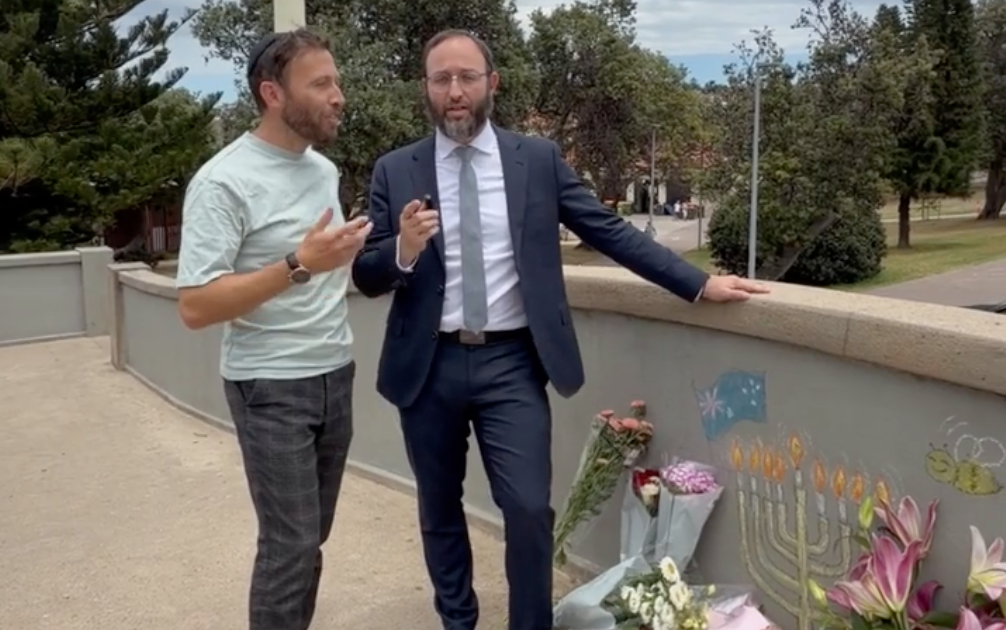
Over a week has passed.
Not enough time for wounds to heal, but enough time for the noise to return. Enough time for headlines to move on, for commentary to harden, for people to start telling us what this all “means”.
But for many Jews, the truth is simpler and heavier. We are still carrying it.
I’ve spent some time in Sydney, not as an observer but as a rabbi and a human being. Sitting in shiva houses. Visiting the injured. Standing with families whose lives have been split into before and after. Watching children with torn shirts trying to make sense of a world that no longer feels predictable or safe.
I stood on the Bondi bridge where people were still crying. Jews and non-Jews. No speeches. No slogans. Just grief sitting in the open. And then I stood on Bondi Beach with more than 20,000 people. Hearing the Shema Yisrael being said out loud was a moment I’ll never ever forget. And then it hits you again.
Fifteen people murdered. A child. Two rabbis.
Twelve other kedoshim. And heroes who ran toward danger and saved lives.
I certainly don’t have all the answers but these are some of my thoughts right now.
It is okay if you’re still shaken.
If you’re jumpy. If your chest tightens in crowds. If you keep checking exits. If you’re exhausted by the emotional whiplash of grief one moment and anger the next. Trauma doesn’t run on a news cycle, and neither does mourning.
There is no “right” way to feel Jewish right now. Some people feel fierce pride. Some feel fear. Some feel numb. Some feel all of it before breakfast. None of this is a failure of faith.
This didn’t come out of nowhere.
For months, many in our community sensed something building. Language becoming harsher. Jews spoken about as an idea rather than as people. The word “Zionist” increasingly used not to describe a belief, but to strip Jews of empathy and legitimacy.
Some spoke up. Others were told they were being dramatic. That it was just protest. Just politics. Just words.
But words create climate. Climate creates permission.
We now know, from the terrorists’ own recordings, that they wrapped their hatred in ideology. They spoke about “Zionists”. They justified their violence. And then they opened fire on a Chanukah celebration.
And who was killed? Jews and anyone else who happened to be in “the way”.
That fact alone should force us to stop pretending this is abstract.
Grief is also not polite.
At the vigil people let the Prime Minister know how they felt. It was heartbreak spilling out sideways. It was a community crying out, “Do you see us? Do you understand how unsafe this feels?”
When that pain is immediately reframed, judged, or weaponised, it deepens the wound. We are still burying people. Families are still sitting shiva. Children are still learning how to say Kaddish. There must be space for grief before debate.
So what should we be doing now?
First, staying connected. Trauma isolates. Judaism insists on presence. Show up again, not just in the first days. Check in next week. Next month. When the crowd thins and the meals stop.
Second, after events like this, something very human happens. People pull back. They avoid Jewish spaces. They stop wearing symbols. They keep their heads down and tell themselves it’s temporary.
But Jewish life has never survived by becoming invisible. We honour those we lost not by disappearing, but by continuing to gather, to pray, to learn, and to live openly as Jews, even when it feels hard.
Third, refusing to normalise what should never be normal. Jews gathering publicly in Australia should not require courage. A child attending a Jewish celebration should not be an act of risk.
And finally, we must be willing to ask hard questions without turning them into political weapons.
I am not a security analyst or a policymaker. I am just a rabbi who has listened to grief all week.
If a serious, independent inquiry can help Australia understand how this was allowed to happen, and how to prevent it from ever happening again, then it deserves to be pursued. Not for point-scoring. Not for headlines. But because responsibility demands learning, not forgetting.
The terror attack has changed us.
The question now is not how loudly we react, but how faithfully we respond. How we protect one another. How we speak. How we remember. And how we insist that Jewish life in Australia must be lived openly, safely, and without apology.
Rabbi Daniel Rabin is rabbi of Caulfield Hebrew Congregation.
comments