



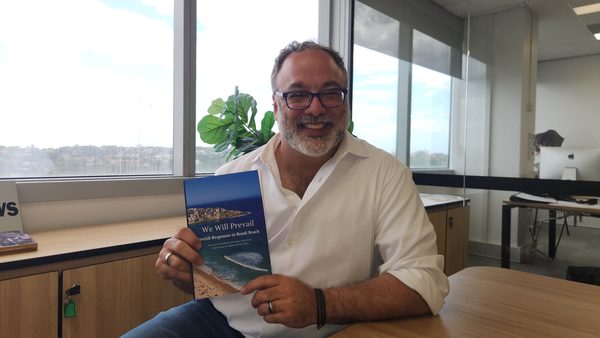
They say we Jews are the “people of the book”. It is then somewhat apt that in the aftermath of the Bondi Beach massacre, two new books have emerged – one from a non-Jewish Australian army veteran who has made combating antisemitism his life’s work, and another from a New York rabbi whose family survived the December 14 attack.
They offer starkly different but complementary responses to the question of how we move forward from tragedy.
We Will Prevail
When New York-based Rabbi Menachem Creditor heard his brother-in-law Arsen Ostrovsky had been shot at Bondi Beach on December 14, 2025, he sat in shock, able only to pray he would hear his family’s voices again.
Hours after the attack, Rabbi Creditor phoned Ostrovsky from New York. “I said, what language should I use in your name to the New York Jewish community? And his language was clear, and without even a blink, he said, ‘Evil will not triumph. We will prevail.'”
“That told me not only that my brother-in-law was going to be okay, but that testimony was going to be possible,” Rabbi Creditor said. 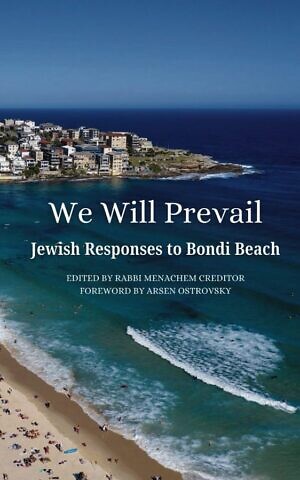
We Will Prevail: Jewish Responses to Bondi Beach, edited by Rabbi Creditor with a foreword by Ostrovsky, gathers essays, sermons, poems and prayers from Jewish voices across continents and denominations responding to the massacre.
Rabbi Creditor’s sister, Tzeira Ostrovsky, her husband Arsen and their children had recently moved to Australia from Israel when they attended the Chanukah by the Sea celebration at Bondi. The family survived the attack, though Arsen was shot.
“When I heard that Arsen had been shot, there was no processing,” Rabbi Creditor said. “I just sat in shock looking at the image that I think many people have come to recognise from that day.”
For him, a rabbi with UJA Federation of New York, compiling anthologies of response to tragedy has become a grim specialty. He has previously assembled collections responding to American gun violence, including attacks on synagogues.
“Unfortunately, there has been much need for that,” he said.
This time, the call for contributors spread through rabbinic networks. Rabbi Hillary Chorney in Los Angeles connected Rabbi Creditor with Tamar Paluch and Lee Kofman, who had compiled Ruptured, a collection of Australian women’s writing after October 7, 2023. Together, they cast a wide net for Australian voices.
“One of the beautiful things in the Jewish world is that someone always knows someone who knows someone,” Rabbi Creditor said.
The result combines raw testimony with thoughtful leadership analysis, examining where failures occurred in government, community and society, alongside expressions of global Jewish solidarity.
Rabbi Creditor placed an Elie Wiesel quote from 1973 at the book’s opening: “Now, as always, Jews are intimately linked one to the other. Shout here, and you’ll be heard in Kyiv … Thus, a Jew lives in more than one place, in more than one era, on more than one level. To be Jewish is to be possessed of a historical consciousness that transcends individual consciousness.”
“I just wanted to communicate that we’re one family, and when any of us is in pain, we all feel it,” Rabbi Creditor said.
Through self-publishing, he produced the book from his New York home. Within 24 hours of publication, it was available on Amazon in Australia and worldwide as print-on-demand.
“The process of producing it, for all of the technical ease, felt feverish. I don’t really know what a book changes, but I wanted to say ‘I love you’ to my family, and I wanted to do my work as a rabbi.”
Rabbi Creditor said he also wanted to reflect the beauty of Bondi Beach itself in the book’s design and colour choices.
“It’s storied and gorgeous and alive, and though it will be different now for a long time for us … it’s still a place of life and maybe even joy,” he said.
The book’s subtitle – Jewish Responses to Bondi Beach – deliberately centres Jewish voices. “It’s important that I first assert that this is a Jewish voice,” Rabbi Creditor said. “I want to make sure that we understand we have something to say. Our voices deserve amplification and the dignity of our own voice.”
While intended for everyone, especially those hurting, an unexpected audience emerged when Rabbi Creditor visited Australia in February. At a café in Bondi Beach, he convened survivors on a WhatsApp group organised by his sister.
When he explained the gathering to café staff, they immediately set up a table and lowered the music out of sensitivity for those who might be triggered by loud noises.
“I gave each of them a book. When the server came to clear, I said, I don’t know if you’d have any interest in this book, but I brought these to give out. She started crying, and she said, ‘My mother and I have been connected through friends to the Jewish holidays. I know the food very well, and I was here, and I feel very connected. So I’m going to give this to a friend of mine who’s Jewish, but I’m going to read it first.'”
“I’m so glad that I was able to connect with her through this,” he said.
During his visit, Rabbi Creditor’s sister and brother-in-law walked him through the park, showing where each family member had been during the attack. “The emotions – I’m not usually at a loss for words, especially when it comes to intuitive moments, but this surpasses my capacity to process,” he said.
“To stand on that bridge and to imagine the calloused heart, the cruelty of a human being who would target other human beings just for being who they are – it’s not unheard of in human history, but it is inhuman.”
He found meaning in learning that Aboriginal spiritual leaders had performed a cleansing of the land.
“I have to say that spoke to my Jewish heart, that this space, which is now sanctified, that Jews died there just because they were Jewish, is also recognised by the land itself and its historic custodians.”
All proceeds from the book will support survivors and families of those killed.
When Our Light is Tested
Retired army colonel Michael Scott fears Australia has not hit rock bottom in its response to antisemitism, despite the December 14, 2025 Bondi massacre that claimed 15 lives.
In his new book When Our Light is Tested: The Bondi Massacre and the Choices Ahead, Scott – who is not Jewish – argues the atrocity was a foreseeable consequence of Australia’s failure to address escalating antisemitism after October 7, 2023.
“Did I foresee the violence in Bondi? I think not the time, not the place, and not what the monsters actually did, but there’s no precedent in the history of our species where the challenges that we’ve been seeing since October 9, 2023 at our Opera House self-resolve,” Scott told The AJN.
“I don’t believe we’re at rock bottom yet. I do fear that it will get worse before it gets better. Because even now, I don’t sense a tipping point has been reached where enough people in Australia’s society are standing up and saying this stops now.”
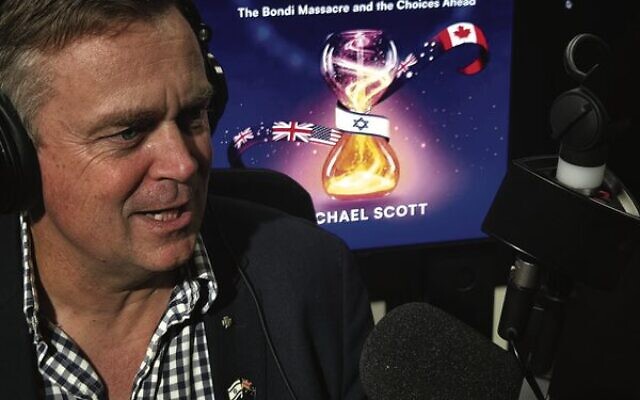
Scott, founder of the 2023 Foundation, a charity created to combat antisemitism, published his first book A Light Still Burns: Israel and the Values Worth Defending just two months before the Bondi attack. That book unpicked what he calls “libels” about Israel and examined how “so much mud has been flung over decades that a bit has stuck”.
His second book takes a different approach, examining what he describes as “foreseeable consequences to us in the comfortable, the complacent and the historically illiterate West”.
Scott structures his analysis around four key factors: civilisational self-harm, internal decay, worldview and moral indifference.
He identifies two groups working in “loose federation” to pose an existential threat: a percentage of Islamists who believe in a binary world of either war or Islamic rule, and what he calls “hard left zealots, intersectionalists, anti-Americanists and antisemites” who have captured key institutions.
“We’re seeing, or rather we’ve seen, in my view, a long march through our institutions, where institutions like the UN, Amnesty International, ICRC, the Australian Broadcasting Corporation, the New York Times, and let’s call it for what it is, the Australian Labor Party – a number of wonderful institutions have been taken over, and they’re rotting from within,” Scott said.
The non-Jewish author came to his support for Israel after living there for two years and witnessing what he describes as the gap between reality and media portrayal.
“I used to use the ABC as my source of truth. And in hindsight, I felt like a slow boiled frog,” he said. “When I went out of the pond that is Australia, and I lived in Israel for a couple of years, and then came back and listened to what was put forward as news, but through my learned eyes, I believe is very slanted political commentary dressed up as news.”
Scott believes Australia is “in a horrible mess” and argues the country needs more than just the Royal Commission on Antisemitism and Social Cohesion to resolve the crisis.
“I don’t think it’s prudent for us to deceive ourselves that the Royal Commission will be a panacea,” he said. “We need to support the Royal Commission,” he added, but for anyone who thinks “that that will just solve all of our problems – It won’t”.
Nonetheless, he called on Jewish Australians to submit to the Royal Commission, noting that of Australia’s 110,000 Jews, most have not yet made submissions.
“If we are too cowardly to do it now, or we are too lazy, or we prefer just to punch out some nonsense on a locked-down Facebook page to our friends that constitutes nothing more than traumatising people that already get trauma, then the only person to blame is the person that we see when we’re standing in front of a mirror.” 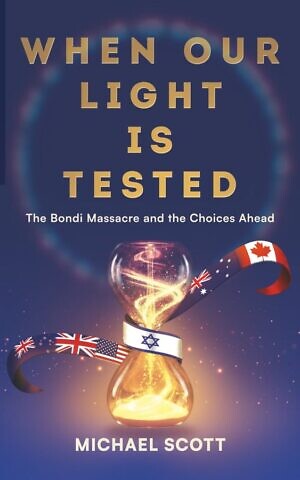
Scott’s approach centres on grassroots education through his 2023 Foundation, which organises short-duration visits to Israel, scholarship placements, and vocational opportunities. He targets people in their 20s to mid-30s, believing they will “inherit the earth” and need to understand the truth through lived experience rather than media narratives.
“The very best way I can overcome misinformation that sounds persuasive and convincing is lived experience,” he said. “I believe that good people in Australia have been hoodwinked.”
Despite the grim assessment, Scott maintains optimism about eventual success.
“Hope springs eternal with me. We will win in the end. If we’re not winning at a point in time, it’s not the end,” he said. “We have a compelling story to tell. We’ve got truth, we’ve got historical basis, but at the moment, we’ve got good music, but insufficient speakers to broadcast the tune.
“We’re competing today for our very tomorrow,” Scott said. “We need to compete today like our children’s tomorrow depends upon it, because in my judgement, it does.”
comments