



Who are the forgotten Jews?
A GRASSROOTS attempt to have a group of forgotten Jews recognised is gaining traction locally. Last Sunday, Rachel Merhav showed the documentary The Forgotten Refugees to WIZO Masada, her WIZO group.
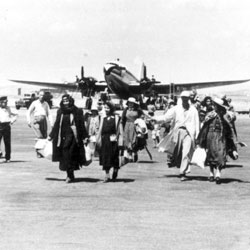
A GRASSROOTS attempt to have a group of forgotten Jews recognised is gaining traction locally.
Last Sunday, Rachel Merhav showed the documentary The Forgotten Refugees to WIZO Masada, her WIZO group.
She expected 60 people, but it was standing-room only as more than 100 people packed into a Brighton home to watch the film.
Afterwards, she gave a short presentation, imploring the community to recognise the hundreds of thousands of Jewish people who were displaced from their Arab homelands, mostly in the first half of last century. Many of these people, who had property and businesses confiscated, became refugees.
“It is not fair, their story also needs to be told,” Merhav said. “People did not know that it is not just the Palestinians who were refugees in
the area.”
While not a refugee or descendant herself, she said she was encouraged to act because of her own family’s circumstances. Her family has lived in Israel for eight generations — her father’s family from Tiberias and her mother’s from Hebron. “They were Sephardi and spoke Ladino,” she said.
Despite their long ties to the town, after the 1929 Hebron massacre, her mother’s family were “uprooted” by the local Arabs and forced out to Jerusalem, where her grandmother grew up.
More than one million Jewish people lived in North Africa, the Middle East and the Gulf region at the beginning of the 20th century. It is estimated by international activist group, Justice for Jews from Arab Countries, that today, less than 5000 Jews remain in Arab countries.
This group, which counts the Executive Council of Australian Jewry as an affiliate, seeks to promote the idea that the word refugees, in the context of the Middle East, does not only refer to Palestinians, but also Jews who were displaced from Arab countries.
Merhav knows personally of Jewish Australians whose families became refugees and, because of her own background, is painfully aware of the ma’abarot, or shanty towns, which were set up after the declaration of the Jewish State to house many of these families.
Together with other local Sephardis, she is seeking to raise awareness for the “other” refugees in the Middle East conflict and is encouraged by the level of public support. “So many people have asked me for a copy of the documentary, I just can’t believe it.”
NAOMI LEVIN
comments