



You don’t have to live like a refugee
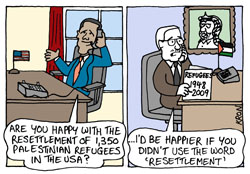
ANALYSIS/Ahron Shapiro THE Obama Administration deserves credit for following through with something that, since 1948, has been forbidden by Palestinian leadership and all Arab governments except perhaps Jordan: the assimilation of a significant number of Palestinian refugees into the population of a host country.
ANALYSIS/Ahron Shapiro
THE Obama Administration deserves credit for following through with something that, since 1948, has been forbidden by Palestinian leadership and all Arab governments except perhaps Jordan: the assimilation of a significant number of Palestinian refugees into the population of a host country.
An article on the subject first appeared in the Christian Science Monitor (CSM) under the headline “Risking Israel’s ire, US takes 1350 Palestinian refugees“. Then The Jerusalem Post reported on the CSM story, which led to an unlikely situation where an Israeli reader commented on The Post’s website. “[I’m] confused: Why would we [Israel] have a problem with this?”
It’s understandable this reader would find the CSM headline confusing, because Israel wouldn’t have a problem with it. Quite the opposite.
It has always been Israel’s position that the Palestinian refugee crisis could have been resolved — even as a temporary measure — decades ago, had neighbouring Arab countries and other concerned parties opened their doors for the resettlement of displaced Palestinians.
After all, weren’t 800,000 Jewish refugees from Arab countries given sanctuary in Israel during the late 1940s and early 1950s?
However, any effort to get the Palestinians out of refugee camps has been stubbornly resisted by the Palestinian leadership itself.
“Resettlement is a dirty word when it comes to the Palestinians,” Laurens Jolles, head of the UN refugee mission in Damascus, told The Times of London in an article about Iraqi-Palestinian refugees, published on February 6.
Jolles said the Palestinian Authority and the governments of Arab states opposed resettlement on grounds of political principle, an abrogation of the right to return to Palestine and an abandonment of hopes of a Palestinian state.
“We don’t agree with that,” Jolles lamented.
The contradiction — that Arab governments claim to care about the plight of the Palestinians, but actively work to make their lives more difficult — is not lost on many of the Palestinian people who have been used as pawns in this hurtful game.
One Iraqi-Palestinian refugee quoted in The Times story expressed it well, as he watched a television report about Syrians demonstrating in Damascus over the Gaza war.
“If they really cared anything for Palestinians, they would not leave us here in this terrible place,” Salim Ahmad said. “Don’t tell me about [Arab] solidarity when nobody cares that we are here at all.”
The facts being what they are, it is difficult to explain why the CSM spun the story in such a bizarre and illogical fashion. The only source they used to support their spurious contention that Israel was against the humanitarian resettlement of Palestinians was an anonymous diplomat from an unidentified country in the region — in all likelihood a country that rejects Palestinian resettlement. All they had to do to get the Israeli perspective would have been to approach the Israeli embassy. It reflects poorly on the CSM‘s journalistic integrity.
This resettlement sets an interesting precedent that demands further exploration, especially as it is being carried out without the blessing of the Palestinian leadership. Indeed, both the Palestinian Authority and Hamas are on record since 2006 as denouncing efforts to resettle the Iraqi-Palestinians outside of the region’s entrenched Palestinian refugee system.
The PA and Hamas tried everything, even hoping they could convince these refugees to resettle in Sudan, or, failing that, remote districts of Iraq. The refugees voted among themselves and turned them down.
So what is different about these Iraqi- Palestinians that has led them to defy the express wishes of the PA and Hamas and pursue resettlement in the West?
Most of them have lived and prospered in Iraq since 1948 until the fall of the Ba’athist regime and, to both the media and relief workers alike, express little ideological connection to the conflict in the distant land they fled.
Meanwhile, the PA and Hamas have publicly expressed displeasure at Jordan, in particular, for not opening its borders and making room for the refugees, which would have avoided this embarrassment.
It would certainly appear that Jordan’s King Abdullah, who comes from a new generation of Arab leadership, feels he owes no fealty to Ramallah and Gaza on the issue and would just as soon let the UN High Commissioner for Refugees handle the “new” Iraqi-Palestinian problem the way the office effectively handles refugee problems everywhere else in the world except for Israel and its environs, which are covered by the bureaucratic and heavily politicised UN Relief and Works Agency.
Much to the chagrin of President Mahmoud Abbas and Hamas leader Khaled Mashaal, that is exactly what happened.
Abbas and Mashaal must now fervently hope that the rest of the world does not catch on and wonder why is it that more Palestinian refugees are not permitted by Palestinian and “old guard” Arab leadership to take advantage of the same humanitarian resettlement frameworks that assisted these Iraqi-Palestinians.
comments