A comprehensive history lesson in Germany
SARAH and Tim Fife visit Germany as part of their world trip and find themselves immersed in a comprehensive history lesson.
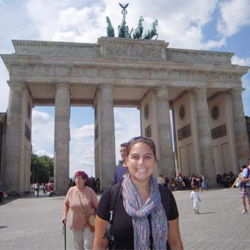
SARAH AND TIM FIFE
NEITHER of us had particular interest in coming to Germany, save for my request to visit Dachau. We knew that there were lots of places in Europe to see and we had been to Germany before.
As we were planning this trip, we knew we’d be coming from Copenhagen so we figured that we’d just make a stop in Munich and then continue on.
While traveling we talked to people and kept hearing about Berlin. And so, on a whim (backed by lots of recommendations), we decided to make a stop in Berlin.
I wasn’t sure what to expect but, as we committed to approaching this journey with eyes, minds and hearts wide open.
So, as it my natural inclination (and interest) to look at Germany through the eyes of a young Jewish American (and a social historian, no less!), I challenged myself to look at it as a place of incredible history outside of The Holocaust and World War II, to try and see Germany from another angle.
And so we started our pursuit of historical context at the Reichstag (German Parliament building), which was destroyed by fire in 1933 and, while the outside remains classical, the inside has been redesigned by Norman Foster and is completely modern.
We spent nearly an hour waiting in a line/queue for the lift up to the glass dome at the top of the building and, once upstairs, enjoyed listening to the audio tour as it guided our walk up, up, up to the top of the dome. There were beautiful views below, from the Brandenburg Gate, which was built in the late 1700s.
We spent a half-day in Potsdam which, while widely known as being the hosting town for the Potsdam Conference at the end of WWII, is also home to the Schloss Sanssouci, an enormous park through which we wandered between two massive palaces and all its expansive gardens.
And we spent a significant amount of time visiting Cold War era sites that are seemingly everywhere. Those who are older than us will surely remember the division and reunification of both Berlin and Germany from news stories from the late 1980s.
Our brief exploration into East/West German history was a serious eye-opener for us -— we were aware of the existence of the Berlin Wall, but I can honestly say that neither of us had any real understanding of the circumstances under which it was built let alone any insights into its actual implications for those living in Berlin.
Berlin is very committed to celebrating its unification and to commemorating the Wall (there is a cobblestone path that criss-crosses the street’s of the city marking where the wall once stood) as well as those who lived and suffered during its existence.
For anyone interested in the subject, Germany is the place to learn about it, not only because it actually happened there but, at the risk of stereotyping, because the exhibitions are created by Germans, who are, shall we say, forthcoming when it comes to the provision of information.
I swear, you could go to Germany and fill your days and nights by simply reading the endless streams of information in museums and exhibits.
Checkpoint Charlie proved to be a fantastic place for us to learn about The Wall since, in addition to a museum full of artifacts and information, there is also an outdoor display chronicling the history of Berlin from WWII until The Wall fell.
This display is nearly three blocks long, is free to the public, and has massive photos interspersed with stories, quotes, and even a list of all known people who died during escape attempts. After spending a couple of hours learning the background, we began to find evidence of the divided and reunified Berlin all over the place.
In Potsdamer Platz, a square which once was bisected by the Berlin Wall, you can now walk along the cobblestone path marking where the wall stood and even see a couple of sections of the Wall which have been left as a reminder.
The more we explored the city, the more things we found which seemed to be acceptable in Berlin but which wouldn’t necessarily have been OK at home (and, in retrospect, which probably wouldn’t even be OK in Munich).
People were drinking beers on the train (before noon!) and ladies were walking in and out of upscale stores with dogs. We saw that the grass in the lawn outside of the Reichstag had been subversively pulled out such that, when seen from above, you could read the demand “NO WAR” and we saw Smart cars parked head-in where other cars were parallel parked.
Funny little things which didn’t seem to be problematic as such but which were pushing the limits just a little bit. In a post-Berlin Wall world, we felt like the establishment was allowing its citizens just that little extra bit of freedom. And we liked it.
While we went to Germany looking for the “non-Holocaust” side of its history, we did not, by any means, wish to exclude the Jewish and Holocaust sites and, of course, we dedicated time to visiting both the old Jewish neighborhood, Scheunenviertel, and also various other sites.
From just walking around the old Jewish neighborhood in Berlin (and staring up at the massive Neue Syangogue) to visiting the Rosenstrasse Monument which commemorates non-Jewish wives and relatives who protested for days in a (successful) bid to gain 1800 Jewish mens’ freedom, places of Jewish interest remain all over Germany.
As we wandered the city, we came upon a number of “stumbling stones” which are small brass tiles that have been laid into sidewalks -— each one bearing the name, place of origin and date/place of death of someone who perished during the Holocaust.
The idea of the artist is that you are not supposed to step around these plaques, but rather tread directly over them — he hopes that, as you stumble upon them, you will stop for a moment to think about what happened to a person as their names and details catch your glance.
They are a beautiful reminder of each person named but also a daunting reminder of the sheer number of people who died. I began to wonder how much space it would take if there were a stumbling stone for each and every person lost.
While all of these sites and memorials interested me as a tourist, even more so, they interested me as a young Jew and as a social historian -— and I wanted to view the sites through various lenses so that I could come away with a picture of how Germany is presented, to those who live there, to those who visit, and to those who never set foot there.
One of the most amazing memorials we’ve seen throughout our trip would have to be the
Memorial to the Murdered Jews of Europe, which you can see from the Brandenburg Gate and the Reichstag — which is to say that it sits on prominent real estate within the city of Berlin.
On this 19,000 sqm (4.7 acre) space are 2,711 massive rectangular grey, concrete pillars of varying heights through which visitors can wind their way, walking up and down the aisles which undulate in varying degrees of incline along the way.
Directly beneath this imposing memorial is an Information Centre which does a concise and effective job of providing a timeline of German history as it pertains to the Murdered Jews of Europe.
It also includes an exhibition showing the paths of various European Jewish families — where they came from, when they were separated and where they went — accompanied by short stories and quotes further revealing their experiences.
Though it was a bit text-heavy (surprise!), we found the Information Centre to be very well-presented offering valuable context for first-time visitors but also providing other points of information and alternative angles for those who are familiar with the event but are nonetheless interested in visiting such a memorial.
Our visit to the Sachsenhausen Concentration Camp just outside of Berlin didn’t prove to be as fruitful -— after a train ride to Oranienburg and a walk through the small suburb, we found a museum/memorial which epitomizes the German obsession with providing information.
At the site of the camp, we were perplexed both by the unbelievable amount of text (we couldn’t have gotten through it all in a three-day visit), and the fact that the place itself is neither well-organized nor designed with any particular visitor or narrative in mind.
Rather than purposefully create a museum with a well thought out pathway or story to follow, it seems that Sachsenhausen, a concentration camp which was created as a model camp and after the war became a Russian camp for political prisoners, has been the home of a variety of exhibitions.
Rather than modify and edit the exhibits as new information is introduced, exhibits have simply been added, resulting in a wealth of information.
Sarah Fife and husband Tim, of Sydney, are living their dream by travelling around the world for a year. Their journey is taking them through Asia, Europe, Israel and the US.