A shlep beyond the shtetl
This year marks the 10th anniversary since Chabad RARA first started taking to the road to meet Jews living outside the capital cities and help them to reconnect with their heritage. According to its founder, Saul Spigler, the group is thriving.
CHANTAL ABITBOL
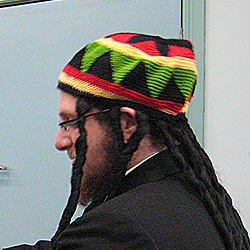
DOWN a winding, dusty country road in northwest NSW, three young rabbis drive their “Mitzvah Tank” van near the town of Lismore.
It is erev Shabbat, and they’re on a quest to find some Jews.
They pull up at the home of a 40-year-old Jewish woman named Clara, whom they had heard about through a friend. Their aim is to drop off a Shabbat candle-lighting kit and have a quick chat before continuing on their journey.
Once inside, however, they get a little more than they had bargained for.
“She just stared at it for a moment and started sobbing,” recalled one of the travelling rabbis, Shmuel Loebenstein. “She explained that her late mother was the last one to have lit Shabbat candles in her family.”
Now, 10 years later, with her own set of candles, the woman could finally do so again.
It was a small step towards rekindling her faith, but a significant one.
And it’s just the kind of action the rabbis of Chabad of Rural and Regional Australia (Chabad RARA) hope to inspire from their missions into some of the more remote parts of Australia, where Jews are few and far between.
This year marks the 10th anniversary since the group first started taking to the road to meet Jews living outside the capital cities and help them to reconnect with their heritage. According to its founder, Saul Spigler, the group is thriving.
From its Caufield-based headquarters in Melbourne, it routinely dispatches small groups of mostly young rabbis in their early 20s, to areas as far afield as Cairns and Darwin for periods of up to 10 weeks at a time.
Travelling in a painted canary-yellow van — with the words “Do A Mitzvah Today!” emblazoned on its side — the men organise everything from circumcisions and weddings to the provision of mezuzahs, teffillin and Jewish books.
They also host Jewish festivals and in the coming weeks for Pesach, the centre has lined up a number of sedars in cities scattered across Australia — including Nowra, Newcastle, on the Sunshine Coast and in Townsville.
“We’ve got people on the road for more than half the year,” said Spigler, who also works as a practicing lawyer.
“Some haven’t seen another Jewish person for 40 years, and we just turn up. Sometimes you just talk to people. We try to help as much as we can.”
The 55-year-old founder said he originally came up with the idea more than 30 years ago, when he took a road trip in his early 20s with a few of his mates around Australia.
At the time, he discovered a number of disenfranchised Jews living in rural towns.
“Everyone had a different reason for being somewhere, and these people had been isolated from their own. I saw a real need to care about these Jewish people.”
Years later in 2000, he officially opened the Chabad centre and since then, the group has steadily grown.
Apart from its missions, it has also set up programs such as JNET “Torah over the phone”, which pairs remote Jews with mentors, and runs summer and winter camps for youth. It also takes advantage of modern technology, offering video-conference shiurs via Skype, and is exploring the idea of setting up an online Jewish school for children.
“I didn’t believe it would go that far, that’s for sure,” said Spigler.
For Rabbi Moshe Loebenstein, Chabad RARA’s director of operations, however, it’s the face-to-face contact with remote Jews that is the most rewarding part of the job.
Recently, he traveled to Cairns to host a Shabbat dinner and met a young Jewish couple living in the northern town of Cooktown. The woman worked as a doctor in the local hospital.
“They drove three hours just to meet some other Jews. They had been isolated from any form of Judaism and just wanted to see another Jewish person and share a l’chaim,” he said. “It was so beautiful to see what we could do for them. They made some friends and contacts, and I can only hope they’ll keep in touch in between the times that I cannot be there.”
It’s these kinds of encounters that motivate Spigler and the rabbis to keep doing their work.
“Every time you scratch the surface, you find a new story and I guess that keeps me going,” said Spigler.