Holocaust academic: where to now?
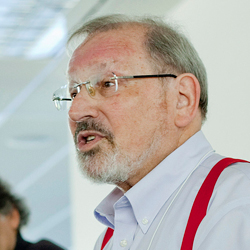
Chaired by author and son of survivors Arnold Zable, Monash University's Holocaust aftermath conference keynote address was delivered by Yad Vashem's Dr Zeev Mankowitz on the topic: 'Vohin - Whither Shall We Go?'.
DALIA SABLE
WHILE the act of survival is often examined in relation to the Holocaust, the question of life immediately after liberation is a less discussed topic.
But this was the subject of the first panel session at Monash University’s Holocaust aftermath conference this week.
Chaired by author and son of survivors Arnold Zable, the keynote address was delivered by Yad Vashem’s Dr Zeev Mankowitz on the topic: “Vohin – Whither Shall We Go?”.
Dr Mankowitz looked at patterns of survivor migration and the pull of Zionism, with Israel regarded as “the answer to this notion of homelessness”.
He also addressed the fact that many Western Europeans returned to their homes after the Holocaust, truly believing they had the “chance to reconstruct their lives and make a future in their former homes”. It was a very different feeling to that experienced by their Eastern European counterparts.
“How can I go back to the land where every stone tells me of the blood of my brother and sister. How can you erect a chuppah on our graves?”
The author and academic added that whatever justifications survivors used to settle in certain places, one thing was clear: “Survivors of the Holocaust, wherever they went in the world, were always a constructive presence and never a burden, despite what they carried with them.”
Three speakers covering different aspects of the Holocaust followed Dr Mankowitz. Author and child survivor Diane Armstrong spoke about immigration and her personal journey with her parents to Australia.
Armstrong said that a redeeming feature of many survivors was the fact that they embraced their new lives and countries, becoming a part of the community and were never “held back by the desire to return home”.
“Instead of yearning for a past that had vanished, they turned to the future and their future was here,” she explained.
Dr Paul Bartrop, an honorary fellow at Deakin University and head of history at Bialik College, spoke of Australia’s immigration policies, while survivor Tuvia Lipson concluded the session with a personal account of his journey from the Nazi camps to the Israeli army, fighting in the 1948 war, and eventually on to Australia.
Mr Lipson joked that his reason for not going back to Poland was simple.
“When I went back after the war, I came across some men who yelled at me in Polish, ‘You bloody Jew, you go to Palestine,’ so I listened to him and I went!”