Art exhibition of women’s roles in the bible
A MAJOR art exhibition depicting women's roles in the bible will open next week at the Jewish Museum of Australia.
DALIA SABLE
REBECCA Forgasz is not afraid to voice her opinion. During her masters degree in Jewish studies, she argued that “Rebekah, not Isaac, was the true successor to Abraham as bearer and transmitter of the covenantal relationship with God.”
After completing a degree at Oxford University following her masters degree at Monash University, Forgasz appeared the obvious choice as curator of a potential exhibition about the forefather of the Jewish people, Abraham.
Having previously curated an exhibition on Moses, when she was approached to research the proposed Abraham exhibition by Jewish Museum of Australia (JMA) director Dr Helen Light, Forgasz instead suggested an exhibition on women in the Bible -— something much closer to the self-confessed feminist’s heart.
And so began the three-year process to create Women in the Bible: Tricksters, Victors & (M)others, which opens on October 15 at JMA and runs until March 14.
“The scope of the topic was potentially vast,” Forgasz explains. Steering away from international artworks to minimise the expense of the exhibition, she began looking at Australia’s public galleries and collections, finding the best results at the National Gallery of Victoria (NGV), the National Gallery of Australia, and the print collection at The University of Melbourne’s Baillieu Library.
“I spent several hours in the NGV catalogue room, where I searched through files to find descriptions and images of works depicting biblical women. I found dozens of prints, numerous paintings and sculptures, and even items of furniture,” Forgasz says, adding that the exhibition would not have been possible without the support of these galleries.
While considered a patriarchal manuscript, the Bible has no one way of representing women, Forgasz says.
“[The Bible] is far from uniform in its portrayal of women. It contains surprisingly diverse depictions of women and femininity.
“There are paradigms of woman as wife and mother. There are tricksters, victims, prophets and heroes. There are stories that reinforce gender stereotypes, but also voices of protest and moments of subversion.”
So Forgasz made the deliberate decision to have characters in the exhibition representative of that diversity. She began selecting works reflecting different interpretations of women, including Eve, Sarah and Hagar, Rebekah, Miriam, Ruth, Yael, Esther and the Queen of Sheba. She also included works interpreting the book of proverbs’ Woman of Valour -— “an idealised depiction of the Israelite wife and mother”.
Forgasz sought modern interpretations of these women, inviting female artists from varying backgrounds to create pieces especially for the exhibition.
“Each artist, in her own way, has an interest in issues relating to religion and gender, and has developed a profound response to the biblical text, and in some cases, to the historical works appearing in the exhibition,” Forgasz says.
“As a result, the exhibition features a unique collection of original works by some of Australia’s leading artists.”
Among these artists are Anne Zahalka, who uses photography to represent the modern-day woman of valour; Fatima Killeen, who created a mixed-media piece depicting Hagar’s courage and faith and the experience of surrogacy; and Anne Ferran, who uses video to link the story of Ruth to the experience of other female outsiders, including convicts and mental asylum patients.
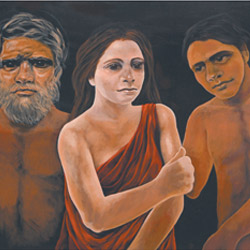
The exhibition also includes the work of Aboriginal artist Julie Dowling, who painted a portrait of Esther set against the history of colonial Australia.
International artists were also engaged, including American-Jewish artist Helene Aylon, who has previously exhibited at JMA. According to Forgasz, Aylon’s work “challenges us to confront some of the Bible’s most problematic and troubling laws and attitudes relating to women”. Her artwork has therefore been placed at the beginning of the exhibition.
“In one sense it provides the context for everything that follows. However, the rest of the exhibition may be seen as an attempt to move beyond Aylon’s critical stance, and find relevance, meaning and even inspiration in the stories of biblical women,” Forgasz says.
And just as the work of international artists opens the exhibition, the images and objects of an international group -— a women’s reconstructionist group from the US that has produced the first-ever Torah scroll written by women —- completes it.
But the similarities end there.
“These women negotiate their relationship with the Bible in a very different way to Aylon,” Forgasz says. “Rather than deconstruct the words of the Bible, these women lovingly reproduce them. This is their way of inserting themselves into the biblical tradition … as a community that welcomes the contributions, hears the voices, tells the stories and respects the humanity of all its members, men and women.”
And it seems that this is precisely what Forgasz has done herself through the exhibition.
The Jewish Museum of Australia’s Women in the Bible: Tricksters, Victors & (M)others will be showing in the Gross Gallery from October 15. Enquiries: www.jewishmuseum.com.au.