Celebrating 60 years of Club Med holidays
A FUN-loving holiday camp in Majorca was the start of the Club Med style of holiday, which this year is celebrating its 60th anniversary.
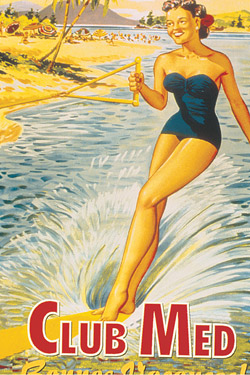
DANNY GOCS
CLUB Med had its beginnings 60 years ago when Gerard Blitz, a Belgian-Jewish water-polo player, came up with the idea of providing Europeans with inexpensive, bohemian vacations in the Mediterranean sunshine.
Blitz proposed that guests would eat meals at tables of eight to break down social barriers, and everyone would be addressed by their first names.
Holiday-makers were expected to help staff with the cooking and washing up. There was no need for money as everything was included in the holiday price. The only additional expense was alcohol, which was paid for with beads bought on arrival and kept on a necklace.
But first Blitz needed tents and beds for the holiday site he had located at Alcudia, situated on a deserted beach on the Spanish island of Majorca. So he turned to Gilbert Trigano, a Jewish friend from his years in the French Resistance during World War II.
Trigano’s father had a business renting out used US army tents and camping equipment, and agreed to supply all the requirements for the holiday camp.
The “village” at Alcudia opened in June 1950 and, over the summer, 2300 people attended the camps — they were so popular that almost 10,000 potential guests were turned away.
However, the sight of bikinis and skimpy bathers at Alcudia shocked the Spanish authorities, who refused to give permission for future camps.
The following year, 2400 holidaymakers returned to Majorca but stayed in hotels, while 1600 people enjoyed a camp site at Baratti in Tuscany, Italy.
Within four years Trigano had joined Blitz in running the camps. Blitz handed over the reins to Trigano who became managing director of Club Med in 1963 and presided over a period of rapid growth.
The tents soon gave way to straw huts and modern facilities as Club Med villages began to sprout up throughout Europe. In 1955 a village opened in Tahiti, in 1961 in Arziv in Israel and in 1965 the first village in Africa at Agadir.
The Club Med holiday was based on a formula of providing all-inclusive packages that included sumptuous buffets, sports, a non-stop party atmosphere, exotic locations and the freedom to join in all the activities or do nothing. People from all over the world flocked to Club Med. The fact that the doors on the huts were never locked helped to give the club a reputation as a happy hunting ground for singles.
But the rapid growth in the early years led to a heavy debt burden. In 1961, Club Med was rescued from financial troubles by Baron Edmond Adolphe de Rothschild, the French financier who visited Arziv and liked what he saw.
Baron de Rothschild paid the company’s debts and took a large stake in the capital.
By 1984, there were almost 100 Club Med villages in 24 countries, ranging from such exotic locations as Tahiti and the Caribbean to ski villages in Europe and Japan.
The spirit of Club Med was a holiday without TV, radio and newspapers. Instead of money, guests used beads at the bar. Club Med has changed with consumer demand, and today there are locks on the room doors, TV and internet access for guests, and mini-clubs for children who holiday with their parents.
Club Med has more than 80 villages around the world — a legacy to Blitz, who died in Paris in 1990 aged 78, and Trigano, who died in Paris in 2001 aged 80.