Changing Hollywood’s lens on Orthodox Judaism
YOU might not recognise Hollywood actor Yisrael 'Izzi' Lifschutz, but you've probably seen him in movies such as The Chosen, Stranger Among Us, A Price Above Rubies and Pi.
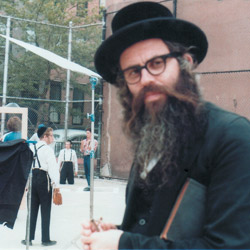
LEXI LANDSMAN
YOU might not recognise his name, but you’ve probably seen his movies. Among them The Chosen, Stranger Among Us, A Price Above Rubies, and Pi.
Meet Yisrael “Izzi” Lifschutz, an actor who has accrued an enviable list of Hollywood credits, appearing on the big screen with the likes of Melanie Griffith, Alec Baldwin, and Renee Zellweger, and in television shows such as NYPD Blue and Saturday Night Chai.
For all that though, with his long, now grey beard and his distinct New York drawl, Lifschutz is best known, not as a performer, but as the founder of the Hassidic Actors Guild (HAG).
Through HAG, the 67-year-old has trained actors to accurately portray Chassidism on film without resorting to demeaning stereotypes. And it’s that experience that has now been captured in its own cinematic re-imagining, precipitating his trip to Australia.
HAG: The Story of the Hassidic Actors Guild will be screened on December 2 at the Bondi Pavilion, the night after Lifschutz gives a keynote speech at the Jewish House gala dinner at the Sofitel Sydney Wentworth.
Living by the motto “you can be hip and still be Chassidic”, much about the actor is paradoxical, perhaps even unconventional.
He certainly seems to avoid being pigeonholed. Director Darren Aronofsky, who worked with Lifschutz on Pi among other films, claims the actor belongs “somewhere between Woody Allen and Bruce Willis” on the film spectrum, while Kenny Vance, producer of Titanic, says: “Izzi’s name pops up in every circle. It’s sort of like Izzi could be Forrest Gump.”
Given his enigmatic persona then, it’s hardly surprising that HAG —directed, produced and written by Lifschutz — is somewhat baffling. It’s seemingly his life story and yet he insists it’s a “hybrid of fact and fiction”.
“Some people believe it is the total truth,” he says from New York, “but my purpose was to tell the story of the man who ultimately does teshuvah —he returns to his roots; he kind of goes on the path of trying to shape Hollywood’s thinking about Jews and how to depict them.”
A storyteller first and foremost, Lifschutz says the movie is part-documentary and part-fiction.
“I wanted to make it plausible and realistic, and I did want to partly tell the truth.”
That truth is, in essence, his battle between Hollywood and Chassidism and the frequent confrontations when the two clashed.
On the Hollywood side, Lifschutz says he fought frequently with producers as he struggled to keep the depiction of Orthodoxy as authentic as possible. But he also faced a challenge from fellow Jews.
“The Jewish community called me on the carpet many times saying, ‘Why are you involved in this thing that is depicting our community in a very negative light?’.”
HAG shows Lifschutz eventually being excommunicated from the community for his Hollywood roles and affiliations, which is resolved (spoiler alert) when he burns the archives of HAG and resigns himself to being a wedding singer. Yet, ask him why he chose to fictionalise parts of the film and he evades the question.
“Hollywood is such an egocentric entity, so to come out almost theoretically unscathed and humbled is almost impossible but [I eventually] see the error of my ways and the correctness of the feelings of community,” he says, remaining elusive as to whether he’s referring to the real or “reel” Lifschutz.
Lifschutz grew up as an only child in pre-World War II Warsaw to parents who were both well-known Yiddish actors. His first film was The Dybbuk, where he appeared alongside his parents.
Startlingly, the next time he appeared on camera was in a Nazi propaganda film, which showed him waving “happily” through a concentration camp wire fence. Both his parents perished and he miraculously escaped, and joined partisan fighters.
After the war, he fled to pre-Israel Palestine, later moving to New York City. To make ends meet, he worked as an artist’s model in Brooklyn but soon fell into “the drugs and rock ‘n’ roll of the sixties”.
“Certainly it was not a way to live and it’s not a lifestyle,” he admits. “It caused me a great deal of pain until I worked my way out of it.”
In the 1970s, he was still finding his feet when he met a rabbi, who asked him to edit a manuscript on Kabbalah for a fee of $US1 per page.
Struggling to decipher the document, he was about to quit when the rabbi suggested he wear a yarmulke while editing. “I thought it was a very funny line,” he recalls, “but I tried it, and I had a breakthrough.”
The rabbi subsequently bought him his first set of tefillin and, soon enough, he says, he “succumbed” to spending Shabbat at the rabbi’s house. It was there that he had an epiphany.
“Having been in that [1960s] drug world, that first Shabbat was the equivalent of taking LSD. It was like dropping acid; it was unbelievable. I got so high that in order to come down after Shabbat, I had to take a tranquilliser,” he says, his voice buzzing.
“So I thought if I can achieve this naturally, I want a part of it. It gave me a new chartered course of returning to the faith of my forefathers and foremothers.”
It was soon afterwards that he founded HAG. “Judaism became my life, my blueprint for living and, invariably, you want to share that experience.”
Suddenly, his lifelong aspiration to be in the entertainment industry began to materialise. “When I tried to crack it in Hollywood when I wasn’t religious all the doors were shut; nothing opened up for me.
“It didn’t happen until I became religious; it’s almost like a divine joke,” he laughs.
And yet, it remains unclear how much of the film is fact and how much is fiction. Despite this uncertainty, it is the realisation of a 16-year filmmmaking process for Lifschutz, who pushed through financial difficulties to make the movie.
“Since I’m an independent filmmaker, you kind of savour every aspect of the film. You want to diaper it, clean it, dress it up -— it’s your baby.”
A baby that, he hopes, will give viewers the same pleasure and insight it’s given him. “It’s a wonderful experience when you bring people together and they can share an experience,” he muses, “where they are happy together, where they are laughing and, at the same time, hearing relevant and meaningful messages”.
HAG: The Story of the Hassidic Actors Guild will be screened at Bondi Pavilion Theatre, on December 2, at 7.30pm, with a Q and A with Lifschutz. Bookings: (02) 9386 0770.