Daylight saving dilemma for observant Jews
SHUL service start times in many parts of Australia will be disrupted with the start of daylight saving this weekend.
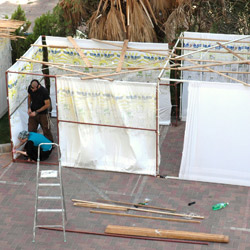
DALIA SABLE
SHUL service start times will be disrupted this weekend with daylight saving beginning at 2am on Sunday morning.
While daylight saving is not usually an issue, this year Succot falls on the changeover evening.
Because of the festival, observant Jews cannot change the time on their clocks, meaning they will effectively ignore daylight saving for 18 hours until the yom tov ends. But what does this mean for shuls?
Daylight saving time is observed in NSW, Victoria, South Australia, Tasmania and the ACT.
While some congregations in Victoria are keeping the prayer times to Australian Eastern Standard Time, others are scheduling services one hour later due to daylight saving.
In many instances, daylight saving times will apply for services, even though congregants’ clocks will remain an hour behind.
While there was initial talk of implementing a uniformed approach to the time dilemma across Victorian synagogues, Rabbinical Council of Victoria president Rabbi Meir Shlomo Kluwgant said the decision was left up to each shul.
“Each shul can implement as they see fit,” he said. “We advise people to stay in touch with their shul to ensure they are up-to-date with the times and the shul’s decision.”
Service times in NSW will also vary, with many leaving prayer times the same as standard time, despite yom tov ending an hour later due to daylight saving.
“For all intents and purposes, the times will be kept the same except for yom tov, which finishes one hour later,” Rabbi Eli Feldman of Young Adult Chabad in Bondi said.
This means that where Yom Kippur ended at 6.30pm or 7pm this week, depending on the state, Succot will end around 8pm.
Commencing on Friday October 2, Succot runs for a week and concludes with Shemini Atzeret and Simchat Torah next weekend.
It is customary to build a succah, or tabernacle, and to eat, sleep and live in it, as if it were a home.
By law, a succah must have at least two-and-a-half walls and must be roofed with schach -— a covering traditionally made from palm branches or bamboo, through which one can see the stars.
Daylight saving commences on Sunday, October 4, at 2am and ends on the first Sunday in April.