



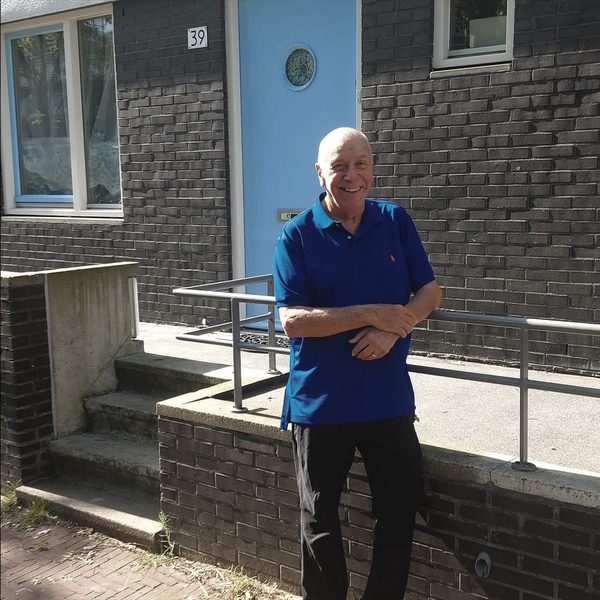
For Eddy Boas, the email that arrived out of the blue earlier this year was almost impossible to reconcile with his family’s history. The City of The Hague was inviting him back to the place of his birth as guest of honour for its 2026 Holland Liberation Day commemorations – three days of official events marking the country’s liberation from Nazi occupation.
It was an all-expenses-paid trip for Boas and his wife, Donna, from a municipal body that had once shut its doors on his family when they had nowhere else to turn.
“I was surprised, because I haven’t been kind to either the Dutch or the City Council of The Hague in my book, or even in my documentary,” Boas said.
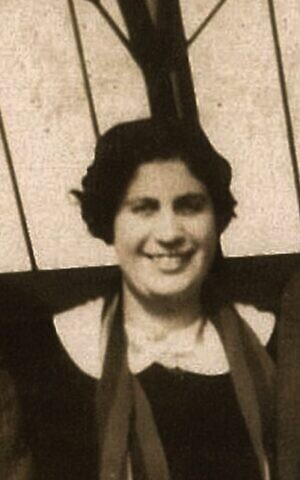
The reason for his wariness ran deep. When his family returned to The Hague in June 1945 after being evicted and sent to the Westerbork transit camp, followed by 14 months in Bergen-Belsen concentration camp – suffering unimaginable hardship but surviving against all the odds – they walked to the flat his parents had lived in since 1937.
There, they were turned away by the people who had moved in and taken ownership of it, including all the furniture and belongings.
Police would not get involved at the time and when Boas’s father Philip appealed directly to the City Council, before he died in 1948, he was told they could not reclaim what had been forcibly taken from them in 1943.
Years later, when Boas had tried to raise the matter, he recalled how “the councillors just weren’t interested in even saying who became owners of the flat when we were deported, so I’ve never been able to find out – even to this day.”
It is against that backdrop that this year’s invitation felt so extraordinary. When asked if he was happy to accept it straightaway, Boas replied, “Yes, I was,” but added that behind the scenes was a dear Dutch friend whose involvement he learned of later.
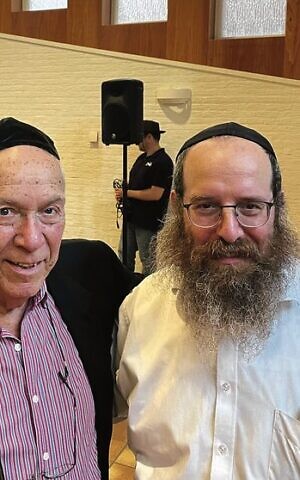
He said that The Hague’s chief rabbi, Shmuel Katzman – an American who sits on the council’s advisory committee to combat antisemitism – had said in a meeting late last year “why not bring Eddy up here … so it was his actual doing.”
Boas had first met Rabbi Katzman in 2017 at the Dutch launch of his book and later spoke to his congregation in 2023.
That autobiography, I’m Not a Victim, I’m a Survivor, took Boas 17 years to write, beginning after his mother’s death in 2001 and was published in 2017.
He and his family – parents Philip and Sara and older brother Samuel – survived the Holocaust intact, a rarity among survivor families.
Of the 107,000 Dutch Jews sent to the camps, only around 5000 survived. Boas, his mother, older brother and his younger sister who was born after the war in 1947, then emigrated to Australia in 1954, when he was 14.
Now, Boas is a father, a grandfather and a great-grandfather.
In 2025, his family’s story of survival and post-war life in Australia reached the screen in the documentary Reflections of Courage, made by Iranian-Australian filmmaker Janet Shay, who has described the opportunity to tell Eddy’s story “as not just a project, but a mission”.
It has since aired on Sky Documentaries and won Best Australian Documentary at the 2025 Melbourne Documentary Film Festival – where it was shown – plus best feature documentary honours at Cannes, the New York Film and Cinematography Awards and the Los Angeles Short Film Awards.
From a ‘flat feeling’ to meeting all the children
Among the most affecting moments of the trip was Boas’s return to the apartment building that was stolen from his family. He had visited it on previous trips, but this time it felt a bit different.
“I’m 86, so who knows if I will visit it, or Holland again?” he said.
“The front door hasn’t changed at all, but the area it is in has, a lot.”
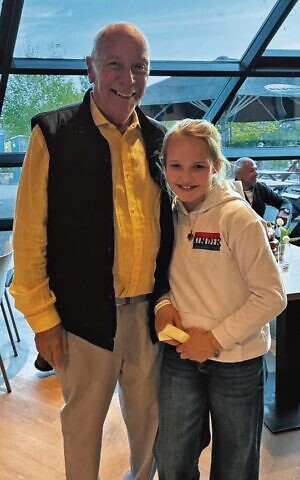
A Dutch friend who is a policewoman accompanied him there, as a camera crew filmed the moment – including an interview conducted by a 10-year-old girl named Elise, later shown to almost 6000 people on a big screen at the city’s Children’s Remembrance Day event on May 4.
It is an annual special event held at the Madurodam theme park, which Boas said was a highlight of his trip.
“It was totally packed,” Boas recalled, describing a long queue of people filing past a memorial grave to lay stones.
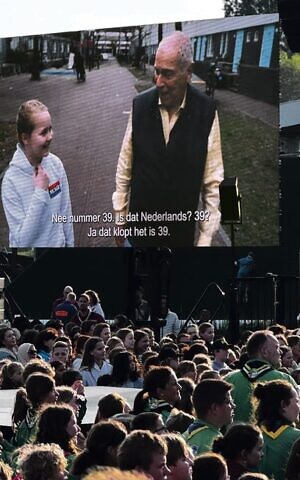
Afterwards, in the main reception area, he was “inundated with young people wanting to talk to me” and he didn’t return to his hotel until 11pm.
“And I’m 86,” he added, with characteristic wry delivery.
The children he met there and at talks he delivered at Jewish and non-Jewish schools during the trip ranged in age from 10 to 18.
Boas approaches conversations with young people about the Holocaust with deliberate care, to make sure it is age appropriate.
For the heavier stuff, he said he generally prefers to talk about it to students from year 10 up, roughly aged 15 or more, given the confronting nature of some of the content in his documentary.
Boas met the four young organisers of The Hague’s Children’s Memorial Day committee, who asked him for advice on speaking about the Holocaust and fielding difficult questions.
“My answer to them was that when I speak to children I say to them two things especially: don’t be afraid to ask questions and make sure that you live for today – not for yesterday or tomorrow.
“Don’t go back in life, as you can’t do anything about what happened 80 years ago, or even yesterday. Just live for today.”
Days later, he met those four young people again at a smaller event and they keenly approached him.
“They said, we are now following what you said completely – we are living for today. And I thought that was fantastic.”
Humour is never far from Boas’s storytelling either – even amid and perhaps especially because of, the difficult subject matter involved.
“It all helps – it’s needed,” Boas said.
He cited an example during the trip when he was asked by one schoolboy what his teeth were like, given he has avoided having milk and many vegetables in adulthood, as he was deprived of them until he was six and never got used to their taste. In his reply, Boas pointed to his teeth and said with a smile, “See, they are still mine.”
As he puts it: “When I talk to people who don’t know me, I make them laugh and I make them cry. And I do both because that’s my story.”
A packed screening and praise from an ambassador
On May 3, the documentary Reflections of Courage, subtitled in Dutch, was screened at a newly opened entertainment centre in The Hague, to an audience of more than 300. Among those present was Australia’s ambassador to the Netherlands, Dr Greg French, along with numerous Dutch dignitaries, including representatives and senior staff from the Council of The Hague.
“It all went fantastically well,” Boas said, adding, “It was powerful to be there in person and as always, I let the audience ask questions after the screening and they were very good ones.”
French himself asked a question from the crowd and the two men later spoke at length in private.
The reaction from City Council figures was equally warm. Lars Smit, its Policy Advisor on Anti-discrimination, provided a glowing testimonial about the film and the Q&A session following its screening.
Boas said the positive and honest feedback he received following that event and Smit’s comments in particular, “certainly does leave me with hope for the future”.
“Nobody has praised me as much as Lars – it meant a lot.”
The documentary’s screening in The Hague also generated interest from Dutch education leaders, keen to use it for teaching purposes and Boas said that he held a brief meeting that was requested by a top official from Holland’s Department of Education on the last day before he flew back to Sydney.
Fighting antisemitism through education and refusing to look away
The trip has only sharpened Boas’s focus on Holocaust education and combating antisemitism, both in Holland and particularly in Australia.
He said getting to speak to non-Jewish audiences, from Christian groups to school assemblies, is where he finds the most meaning and impact, “and that’s because the questions I get asked are very different.”
And when in The Hague, he found audiences asked yet even more personal questions, given that city’s own history and his own, as well as his openness in speaking to Dutch teenagers about surviving in the camps when he was a young child.
Boas’s approach to rising antisemitism today is unambiguous. He believes protest marches against Israel “attract more antisemites” and believes they should be stopped and that both the Australian and Dutch governments have shown insufficient resolve in that regard, with dangerous consequences for society.
And in a detailed submission to Australia’s Royal Commission on Antisemitism and Social Cohesion, Boas argued that there is a need for the Jewish community and for education initiatives to shift toward a more assertive, positive message that highlights the achievements and contributions of Jewish Australians.
Content, for example, could include references to members of the Jewish community having served twice as governors-general, three times as state governors, that the nation’s most decorated soldier was a Jew and promote Jewish contributions to modern technology, the economy, sport, life-saving healthcare and more.
“And I’ll be very honest – and I wrote this in my submission – that the Jewish community was too weak initially; they weren’t forceful enough with the government. Since the Bondi terror attack, that has changed quite a bit”, but, he added, still not enough.
Upon returning home at the end of May, Boas has kept up the momentum.
On June 19 he had a meeting over coffee with Jillian Segal, Australia’s Special Envoy to Combat Antisemitism, to discuss ways to offer and include Reflections of Courage as a teaching resource within the school curriculum.
It is an objective he is also pursuing in Holland through key contacts gained in The Hague and one he hopes to raise in Sydney directly with NSW Premier Chris Minns, having built a rapport with him after leading last year’s Holocaust survivors’ reunion event at NSW Parliament House.
And on July 22, he led the first screening of the documentary at an Australian public high school – Ku-ring-gai High School in northern Sydney, followed by a Q&A.
It next screens publicly in Melbourne on Sunday, August 30, hosted by the Australian Jewish Association at Classic Cinema in Elsternwick.
Looking at both Australia and Holland, Boas sees shared challenges and risks for society.
“We and they and all of Europe are allowing the wrong people to immigrate,” he said, contrasting the postwar migration of Dutch, Italian, Greek and English families who “came here to Australia to become Australians” with what he observes today.
But whatever the difficulties ahead, Boas shows no sign of slowing down his advocacy at 86, although he acknowledges that long haul trips may no longer be possible.
“I will be remaining very active in making sure that the Holocaust is not forgotten,” he said.
Tickets for the documentary screening can be purchased at events.humanitix.com/reflections-of-courage
comments