Extending a Jewish helping hand
MANY of us are familiar with the OU sign that appears on several food products as a sign of kashrut. But there is much more to the American Orthodox Union than just the provision of hechsherim.
As the roof body of American Orthodoxy, its interests and activities extend to outreach, education and political advocacy, as well as a host of other commitments. Further information can be found at www.ou.org.
And in the context of its communal responsibilities, last week saw the OU issue the following statement as an introduction to its Jewish communal appeal for victims of the Haiti earthquake:
“It is difficult to comprehend the enormity of the devastation in Haiti. Jews are described by the Talmud as ‘rachmanim b’nei rachmanim’, a particularly compassionate people who are sensitive to the suffering of all, and we cannot sit by and ignore this terrible drama of human suffering and misery.
“We echo the words of the psalmist who said ‘imo anochi b’tzarah’ (Psalm 91), when we call upon members of our community to open their hearts and join us in extending a helping hand.”
That the Australian Jewish community should emulate this approach — and is so doing — goes without saying. For those who have not yet done so and wish to participate in the appeal, the necessary information as to how to go about this can found on page 3 of this edition of The AJN.
But perhaps a little more could be said on our responsibilities as Jews in the face of this tragedy, whose toll may approach that of the Boxing Day tsunami of 2004.
When seeking to determine our responsibilities in regard to any matter, a religious Jew turns to our traditional texts. However, there is nothing in the traditional halachic writings about a tragedy of this scale with worldwide implications.
That is hardly surprising, as there were no such concentrations of population as we have today, while the scope of communications prior to the modern era limited the extent of one’s immediate concerns. Jewish communities worldwide, however, found the ways and means of communication that kept Jewry as a united whole, despite geographic distance. But perhaps, in a case like this, we can apply principles to the global village that applied in the geographically and demographically defined village with which Jewry was so familiar not so long ago.
And in that regard, many halachic principles apply. The quotation referred to above simply sets the scene in regard to our moral obligations. Then there is a principle of “mefarnsim aniyei acum im aniyei Yisrael” — “we assist the needy of the nations together with the needy of Israel”.
In that context, the activities of ZAKA — the Orthodox emergency responder group that has unfortunately gained so much experience through assisting terrorist victims in however, Israel — are also striking. There is the concept of “darchei shalom” — “the ways of peace” — that define and prescribe the way that we as Jews live as part of a world community — helping each other in the interests of broader humanity. And there is the overall principle of tikkun olam — the requirement, where necessary, to repair the world (the literal meaning of tikkun) and ensure its progress and that of civilisation as a whole.
The pending festival of Tu b’Shevat has in recent times become a date on which our attention is increasingly focused on nature and the environment. Just when much of that attention has turned to comparatively subtle and longer term dangers inherent in climate change, events such as this earthquake and the tsunami of 2004 remind us that the powers of nature can also be more immediate and devastatingly dangerous.
While one cannot (at least as yet) forecast when such events may happen, we need to do all in our power to be prepared. As I indicated recently while recalling the 19th century earthquake in Tzfat (AJN 08/01), and as has also been the subject of much writing in the Israeli media since the Haitian calamity, Israel, located in an area of geologic instability, needs to be prepared for the possibility that it too could suffer just such an event.
In line with its policy of helping other countries in need, based on Jewish morality, the Israeli government has dispatched relief teams to Haiti to assist in relief and rescue work. Hopefully, at the same time, Israel will learn some useful lessons that will assist in reducing dangers to those in its own land, reducing potential casualty numbers in the event of a possible future earthquake.
The direct benefits of Israeli assistance to Haitian victims aside, such self-help gained through assisting others would indeed be an additional element of tikkun olam salvaged from the ruins of this catastrophe.
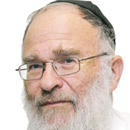
Yossi Aron is The AJN’s religious affairs editor.