Feelings of guilt leads to documentary film
FILMMAKER Rod Freedman explores the wounds of Apartheid-era South Africa in a new documentary film.
LEXI LANDSMAN
IN apartheid-era South Africa, legal racial segregation stipulated where white and black people could sit on a bus, before they were separated entirely.
It was just one of the regulations of the government-imposed system, another grey line, caught in the periphery between white and black, right and wrong.
Those racial laws, enforced from 1948 until 1994, came to permanently scar the face of South Africa, a wound that still suppurates after so many years.
While some took their place on the bus, sitting as the signs instructed, others disregarded the regulations and suffered the consequences. And then there were those who have since suffered, not because they acted, because they failed to.
Sidney Bloch is one of them.
At the age of 15, on the day they enforced bus segregation, Bloch made a brave attempt to act against the system by sitting on the side reserved for blacks.
His act of defiance was quickly scolded by the bus conductor and, fearing police action, he took his “rightful” place on the whites-only side of the bus.
“I moved. I regret it to this day,” Bloch, now 68 and a well-known professor of psychiatry based in Melbourne, recalls.
And it is that bystander guilt -— of looking on while the oppressive regime forever changed the fabric of his birthplace -— that has continually haunted him.
“I fell into the racist system without any great degree of trouble,” he laments. “[I feel] anger, guilt, shame.”
Bloch’s journey from Melbourne back to his country of birth was captured in Jewish filmmaker Rod Freedman’s documentary, Wrong Side of the Bus, which premieres at the Festival of Jewish Cinema later this month.
The film centres on Bloch’s return to South Africa for a 40-year medical school reunion, one marred by his guilt that several of his classmates were classified “non-whites” and he did little to help their plight.
He returns with his 18-year-old son Aaron, hoping to reconcile his feelings of guilt for not taking a more active role in opposing the system.
“I left 24 hours after I graduated as a doctor. I waited for that day most of my life. Certainly, as long as I could sense, apartheid was a dreadful thing and something I couldn’t do anything about,” he says in the film.
As a Jewish person who had lost many family members during the Holocaust, Bloch admits harbouring guilt for having succumbed so easily to a racist system.
“I never voted for the government or supported their actions, but standing by fairly idly must amount to collusion, and collusion to me, I guess, is complicity.”
In conflict, there are those classed as perpetrators, victims and bystanders. As a Jewish documentary-maker, Freedman is all too familiar with the issues the three categories pose. But it is through the lens of the bystander that Wrong Side of the Bus explores the wounds of apartheid.
A South African expat himself, making the film was Freedman’s first trip back to Johannesburg since he left at the age of 14 in 1965.
During the course of the research for the documentary, Freedman found himself reviewing his own family history in South Africa.
“[My family’s Lithuanian] forebears had migrated from the oppression and poverty of Eastern Europe to a land of opportunity in South Africa. Paradoxically, we became oppressors, simply because we were white,” he says.
His mother worked for well-known Jewish human rights activist Helen Suzman in her electoral office and his father was a doctor, who worked for 25 years with the black community in Botswana and later in public health in Johannesburg.
“I regarded my family as being morally very strong; they had well-thought-out ethics and morals within a Jewish context. We left because we opposed and abhorred the system. Yet, having said that, what did we actually do?”
But Freedman acknowledges the reasons many didn’t act, namely a sense of helplessness to change the system and fear of speaking out. Adding to the debate, the documentary raises confronting questions about the role Jewish people had in standing up to racism after the Holocaust.
“There is an argument that having suffered racism over the centuries, we should be more acutely aware of it and perhaps, more ready to oppose it.”
Explaining that Jews have generally been thought of as victims, being seen instead as bystanders, he says, poses a challenge.
“My concern is [feelings of] helplessness made us take action, but it wasn’t action in opposing the government, it was action in fleeing the country — the only moral stand we thought we could take.”
By the time Bloch returns to South Africa, it is four decades since he has graduated and it is no longer the same country he left.
Together with his son, Bloch visits his former synagogue to find it has become a commercial gallery. He tours old haunts and takes part in a moving reconciliation session at the Cape Town Holocaust Centre.
They meet Albie Sachs, a Jewish anti-apartheid activist and justice of the South Africa Constitutional Court, who was jailed during apartheid without trial and lost an arm and sight in one eye when his car was blown up.
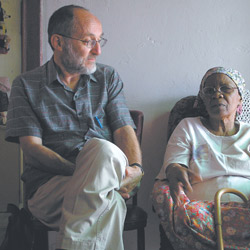
Bloch visits his mother’s former caretaker in the Langa township near Cape Town, Beauty Ngoza, and her nephew. In a soft-spoken voice, she tells him: “I always cry for the apartheid business that fell on us in South Africa. It was like a rain the way it was pouring on us. I do forgive but I never forget what happened to us.”
This notion of forgiveness becomes the focus of the latter part of the documentary. Bloch is overwhelmed by the ability of the country’s citizens to forgive their perpetrators for past wrongdoings.
And yet, he cannot forgive himself. His medical school reconciliation ceremony after their reunion does little to absolve his guilt.
Instead, it is only on the very last day of his journey back to his birthplace that his feelings of resolution (spoiler alert) emerge from the wise words of a guide at the Robben Island Museum.
“[You] neglected your responsibility; you walked away. But now you have come back and you realise things have changed,” Modise Phekonyane, who was a political prisoner for five years during apartheid, tells Bloch.
“And you were not part of that change, but you want to be part of the future and that’s the bottom line.”
It’s a poignant message and one Freedman hopes will hit home with audiences. “The themes of being a bystander -— facing the past and forgiveness -— are relevant to Australian and international audiences.
To a greater or lesser extent, we are all bystanders. We may oppose the government’s treatment of refugees, but when it comes down to it, what do we do?
“So this film is not just about guilt, it’s about the lessons we can take from victims and their capacity for forgiveness in order to move on. All of us are affected by racism, whether we were the perpetrator, victim, or bystander.”
Wrong Side of the Bus premieres in Melbourne on Sunday, November 22, at 3.30pm, at ACMI Cinemas, Federation Square. Bookings: (03) 8663 2222. Enquiries: www.jewishfilmfestival.com.au.